理财代销

Search documents
基金大事件|节前“红包雨”来了!春节前近50只产品“同台竞技”
Zhong Guo Ji Jin Bao· 2026-02-14 12:58
Group 1: Banking Wealth Management - The wealth management industry is experiencing a shift as companies like Su Yin Wealth Management, Ning Yin Wealth Management, and Minsheng Wealth Management are expanding their distribution channels to include local small and medium-sized banks [1] - Regulatory requirements mandate that non-licensed institutions clear their existing products by the end of 2026, prompting small banks to transition to distribution models and providing growth opportunities for wealth management companies [1] - The competition in third and fourth-tier cities, as well as county markets, is intensifying, with wealth management companies focusing on product differentiation and service enhancements [1] Group 2: Fund Issuance and Performance - In the last trading week before the Spring Festival, nearly 50 new fund products are competing for attention, with over 20 products ready for issuance [2] - The current issuance includes 47 funds, with 23 awaiting issuance, indicating strong market activity [2] - The Shanghai Stock Exchange Fund Index decreased by 0.16%, while the Shenzhen ETF and LeFu Index fell by 0.96% and 0.93%, respectively, reflecting market volatility [2] Group 3: Fund Distributions - A record high in fund distributions has been noted, with companies distributing nearly 350 billion yuan in cash dividends before the Spring Festival, surpassing the previous year's figures [3] - Investors are receiving tangible returns, enhancing their confidence in holding stocks [3] Group 4: Fund Management Changes - Li Yunliang has been appointed as the new general manager of Quan Guo Fund, marking a leadership change as the company celebrates its fourth anniversary [5] - A rare occurrence in the public fund industry is noted, where former general manager Li Ji continues as a fund manager instead of taking on a managerial role [6] - DeBang Fund announced the resignation of its chairman, Zuo Chang, with Wu Xiaochun stepping in as acting chairman [7][8] - Zhong Guangzheng has been promoted to general manager of Zhongke Wotu Fund following the departure of Yu Jianwei [9] Group 5: Fund Company Developments - HSBC Jin Xin Fund Management is undergoing a potential change in shareholding, with relevant materials submitted to the regulatory authority [10] - Ruiyuan Fund has increased its registered capital from 100 million yuan to 104.95 million yuan, with existing shareholders contributing additional funds [11]
有农商行年内产品数量暴增两倍
Di Yi Cai Jing Zi Xun· 2025-12-29 02:55
Core Insights - The bank wealth management distribution market has significantly heated up since 2025, with banks rapidly expanding the number and scale of wealth management products, making it a crucial focus amid narrowing interest margins [2] - As the business accelerates, management loopholes in wealth management and distribution are becoming apparent, leading to increased regulatory scrutiny and penalties for several banks [2] - The industry is transitioning from "scale competition" to "capability competition," posing a challenge for banks to capture market opportunities while managing risks effectively [2] Group 1: Market Growth and Trends - As of September 2025, the total outstanding wealth management product scale reached 32.13 trillion yuan, marking a historical high, with the number of investors growing by 12.7% year-on-year to 139 million [3] - The number of outstanding wealth management products increased by 10.01% year-on-year to 43,900, with a year-on-year growth in scale of 9.42% [3] - Regional rural commercial banks have emerged as the main force in the expansion of wealth management distribution, while joint-stock banks maintain scale advantages [4] Group 2: Regulatory Environment and Penalties - Multiple banks have faced significant penalties this year due to imprudent management in wealth management and distribution, with the Shanghai Pudong Development Bank fined 15.6 million yuan for management issues [5] - Other banks, such as Hengfeng Bank and Ping An Bank, have also received hefty fines for various compliance failures, indicating a widespread issue across the sector [5] - The regulatory framework is tightening, with the introduction of new guidelines that require banks to enhance due diligence and risk management in their distribution activities [6] Group 3: Strategic Shifts in Wealth Management Distribution - Analysts suggest that the expansion of wealth management distribution is driven by the need for banks to find new revenue sources amid slowing growth in traditional channels [7] - The focus is shifting from merely increasing the number of partnerships to enhancing the depth of cooperation, emphasizing sales capabilities and customer quality [7] - The sustainability of growth in wealth management distribution will depend on banks' long-term investments in compliance management, customer service, and risk control capabilities [8]



有农商行年内产品数量暴增两倍
第一财经· 2025-12-29 02:45
Core Viewpoint - The bank wealth management distribution market has significantly heated up since 2025, with rapid expansion in the number and scale of wealth management products sold by banks, becoming a crucial focus for banks amid narrowing interest margins. However, management loopholes have emerged, leading to increased regulatory scrutiny and penalties for several banks [3][4]. Group 1: Market Expansion - As of September 2025, the total scale of existing wealth management products in the market reached 32.13 trillion yuan, marking a historical high, with the number of investors increasing to 139 million, a year-on-year growth of 12.7% [4][5]. - The number of existing wealth management products reached 43,900, an increase of 10.01% year-on-year, with a year-on-year growth in scale of 9.42%. Wealth management is increasingly seen as an important tool for replacing deposits in a low-interest environment [5]. - Regional banks have emerged as the main force in the current expansion, with Changshu Rural Commercial Bank's wealth management distribution products increasing by 211% in 2025, from 685 to 2,130 products, the highest growth rate in the industry [5][6]. Group 2: Regulatory Challenges - Despite rapid expansion, management shortcomings in wealth management and distribution have become apparent, leading to significant penalties for several banks due to imprudent management practices [8][9]. - Notable penalties include Shanghai Pudong Development Bank fined 15.6 million yuan for management issues, and Hengfeng Bank fined 61.5 million yuan for various compliance failures [8][9]. - The regulatory environment is tightening, with the issuance of the "New Regulations on Agency Sales Business Management" by the financial regulatory authority, which imposes stricter requirements on cooperation institution selection, product admission, and sales behavior [9][10]. Group 3: Shift in Competitive Focus - The wealth management distribution market is transitioning from a focus on quantity to a focus on capability, with banks needing to balance market share acquisition with risk management [10][11]. - Analysts suggest that the core motivation for banks to increase wealth management distribution is the need to find new growth points amid slowing channel growth and intensified competition [11]. - Future success in the wealth management distribution market will depend on banks' long-term investments in compliance management, customer service, and risk control capabilities [11].


理财公司与中小银行共拓代销新蓝海
Zhong Guo Zheng Quan Bao· 2025-10-20 20:18
Core Insights - Multiple wealth management companies have recently signed distribution agreements with small and medium-sized banks, indicating a growing trend in the number of banks participating in wealth management distribution [1][2] - Small and medium-sized banks are increasingly looking to enhance their intermediary income through distribution partnerships due to pressure on net interest margins and limited space for self-conducted wealth management [1][2] - The collaboration between wealth management companies and small banks is expected to deepen in the future, driven by mutual benefits [2][3] Group 1: Distribution Partnerships - Several wealth management companies, including Su Yin Wealth Management and Ning Yin Wealth Management, have announced new distribution agreements with small banks such as Weihai Bank and Jiangnan Rural Commercial Bank [1] - Since the beginning of October, nearly ten wealth management companies have added new distribution partners, including Wenzhou Bank and High Postal Rural Commercial Bank [1][2] - A wealth management company under a joint-stock bank has expanded its distribution channels to include nearly 30 new small banks this year, focusing on rural commercial banks [2] Group 2: Strategic Shift of Small Banks - Regional small banks are facing pressure from narrowing net interest margins and limited self-investment income, prompting them to explore wealth management distribution as a strategic pivot [2][3] - Regulatory constraints on self-conducted wealth management have further limited small banks' ability to grow their own wealth management businesses [2] - The shift towards distribution partnerships allows small banks to adopt a "light capital, light asset" operational model, which is seen as a necessary strategic path [2][3] Group 3: Performance Metrics - In the first half of 2025, several small banks reported significant growth in intermediary income, with Changshu Bank's net income from fees and commissions reaching 142 million, a year-on-year increase of over 600% [3] - Changshu Bank's wealth management distribution scale reached 7.277 billion by mid-2025, up from 4.954 billion at the end of 2024 [3] Group 4: Market Expansion Strategies - Wealth management companies are actively expanding their distribution networks beyond their parent banks to include small and medium-sized banks, aiming to tap into broader market opportunities [5] - The strategy includes covering state-owned and joint-stock banks, as well as deepening partnerships with city and rural commercial banks to reach lower-tier markets [5] - The diversification of distribution channels is expected to enhance the long-term development of wealth management companies, reducing the impact of market fluctuations on their investment behavior [5][6]
互联网型银行2024年业绩分化明显,头部谋转型,腰部助贷业务“上压力”
Bei Jing Shang Bao· 2025-05-06 14:30
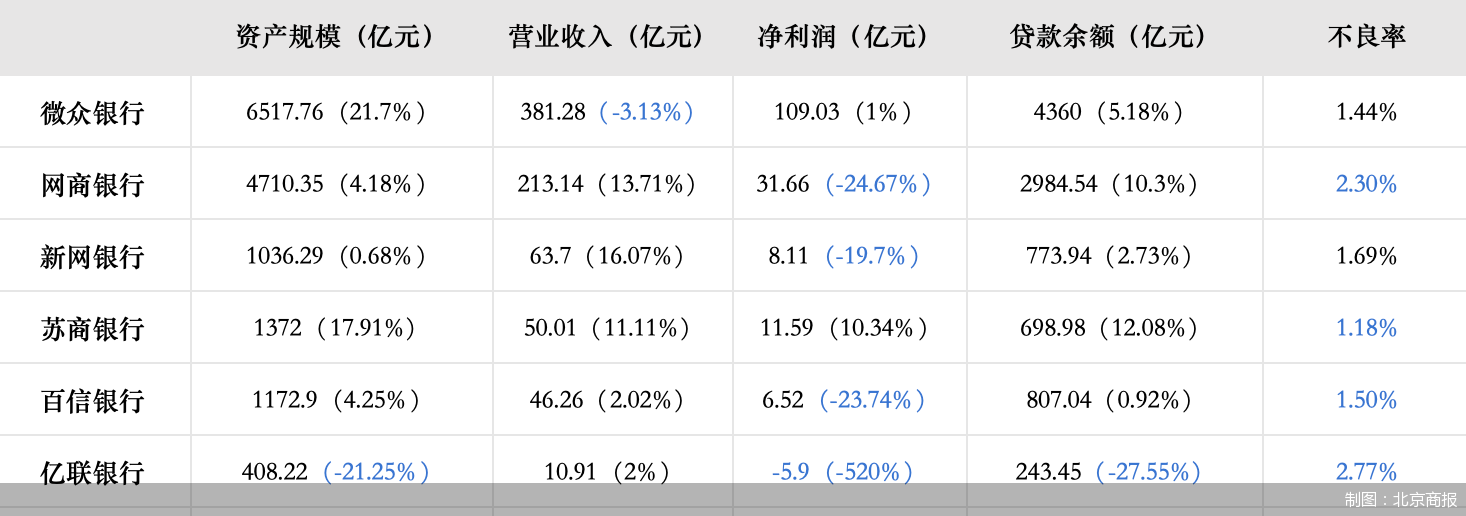
Core Insights - The annual reports of major internet banks, including WeBank and Ant Bank, reveal a mixed performance in profitability and revenue growth for 2024, with some banks facing increased credit risks and regulatory pressures [1][3]. Financial Performance - WeBank reported an asset scale of 651.77 billion yuan, with a revenue of 38.13 billion yuan, and a net profit of 10.90 billion yuan, showing a slight decrease in revenue by 3.13% but a 1% increase in net profit [2][3]. - Ant Bank's asset scale reached 471.04 billion yuan, with a revenue of 21.31 billion yuan, but its net profit fell by 24.67% to 3.17 billion yuan [2][3]. - NewNet Bank, Baixin Bank, and Yilian Bank also reported revenue growth but faced declines in net profit, indicating a trend of increasing revenue without corresponding profit growth [5][6]. Market Trends - The internet banking sector is experiencing intensified competition and tightening regulations, leading to a focus on risk management and business structure optimization rather than mere scale expansion [6][12]. - WeBank is shifting its lending focus from consumer loans to small and micro-enterprise loans, reflecting a strategic pivot in response to rising credit risks [4][12]. Credit Quality and Risk Management - Ant Bank's credit impairment losses increased to 12.06 billion yuan, contributing to a rise in its non-performing loan ratio to 2.30% [5][6]. - Several banks, including Baixin Bank and Yilian Bank, reported increased credit risks and higher impairment losses, impacting their profitability [5][6]. Business Strategy and Growth Areas - Internet banks are increasingly exploring wealth management and financial advisory services as a new growth avenue, with WeBank managing assets worth 3.24 trillion yuan through partnerships with various financial institutions [11][12]. - The introduction of new regulations on internet lending is prompting banks to refine their operational practices and enhance compliance measures [9][10]. Customer Acquisition and Technology Utilization - Banks are leveraging digital tools and platforms to enhance customer acquisition and service delivery, with Ant Bank reporting over 12 million followers across various social media channels [9][12]. - The focus on digital transformation is evident as banks aim to improve efficiency in customer service and product design through advanced data analytics [12].