理财子公司

Search documents
银行系基金二十年进化论:解码资管机构规模崛起与内在蝶变
Jing Ji Guan Cha Wang· 2025-12-22 02:40
Core Insights - The establishment of bank-affiliated fund companies in China in 2005 marked a significant transformation in the asset management industry, leading to a reshaping of the market landscape and influencing the evolution of the industry over the past two decades [1][2]. Group 1: Initial Developments - In 2005, the Chinese fund industry was at a critical turning point, recovering from a bear market that had led to difficulties in fund issuance, with many funds failing to raise over 1 billion yuan [2]. - The release of the "Pilot Management Measures for Commercial Banks to Establish Fund Management Companies" opened the door for banks to enter the fund management sector [2]. Group 2: Market Reactions - There were two contrasting viewpoints regarding the entry of bank-affiliated funds: the "threat theory," which expressed concerns over the monopolistic sales channel advantages of banks, and the "development theory," which viewed their entry as a means to expand the overall market and diversify the industry [3]. Group 3: Early Success - The first bank-affiliated fund companies, including ICBC Credit Suisse, Bank of Communications Schroder, and CCB Fund, were established in mid-2005 [4]. - ICBC Credit Suisse's first fund, the ICBC Core Value Mixed Fund, launched with a scale of 4.345 billion yuan and 144,700 subscribers, showcasing the advantages of bank channels [5]. Group 4: Growth Phase - From 2006 to 2007, the A-share market experienced a bull market, leading to rapid growth in the fund industry, with bank-affiliated funds achieving significant scale increases [6]. - In 2006, ICBC Credit Suisse ranked 10th among 53 companies with a management scale of 29.6 billion yuan, while Bank of Communications Schroder reached 23.1 billion yuan, ranking 14th [7]. Group 5: Differentiated Strategies - The first bank-affiliated fund companies began to adopt different development paths, with ICBC Credit Suisse focusing on comprehensive development, including launching its first QDII fund and index fund [8][9]. - Bank of Communications Schroder emphasized building active equity capabilities, while CCB Fund took a more conservative approach in its research and investment framework [9][10]. Group 6: Challenges and Adaptation - The introduction of third-party fund sales licenses in 2012 and the rise of internet channels posed challenges to the traditional sales advantages of banks [9]. - ICBC Credit Suisse demonstrated adaptability by engaging in new industry models and enhancing its product offerings and digital capabilities [10]. Group 7: Recent Developments - By 2020, bank-affiliated fund companies faced unprecedented competition, prompting a second entrepreneurial phase, with ICBC Credit Suisse focusing on a multi-strategy research and investment system [11]. - CCB Fund and other bank-affiliated funds have also made significant strides in their investment strategies, particularly in emerging industries and pension fund management [12][13]. Group 8: Future Outlook - As the industry enters a new competitive environment, bank-affiliated funds are expected to enhance their core competencies in research, risk control, customer service, and technological innovation [14]. - The success of bank-affiliated funds will depend on their ability to build independent capabilities beyond shareholder resources while supporting national strategies and meeting wealth management needs [15][16].
26万亿理财子大洗牌!农银理财产品规模超越工银、中银理财,上银理财净利大跌61%
Xin Lang Cai Jing· 2025-05-14 00:55
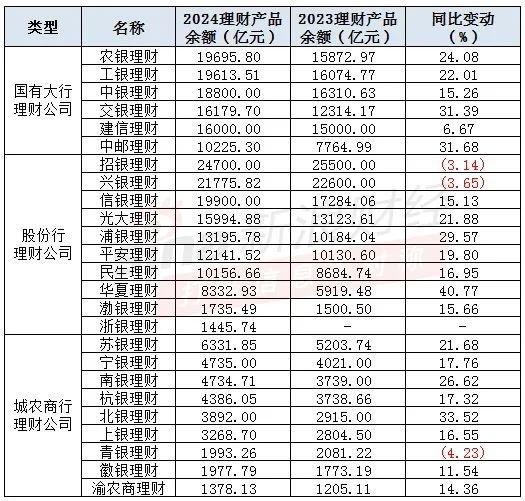
Core Insights - The 2024 annual reports of 25 bank wealth management subsidiaries reveal a total managed product scale of 26.3 trillion yuan, accounting for 88% of the wealth management market [1][5] - State-owned banks' wealth management subsidiaries showed positive growth in product scale and net profit, while some joint-stock banks experienced declines [1][4] Product Scale Summary - The total managed product scale of the 25 bank wealth management subsidiaries reached 26.3 trillion yuan, with state-owned banks showing stable growth [1][5] - Agricultural Bank of China Wealth Management surpassed Industrial and Commercial Bank of China Wealth Management, reaching 1.96958 trillion yuan, a year-on-year increase of over 24% [6] - Joint-stock banks like China Merchants Bank Wealth Management and Industrial Bank Wealth Management saw declines of 3.14% and 3.65% respectively, despite maintaining high rankings [6][4] Net Profit Summary - State-owned banks' wealth management subsidiaries achieved positive net profit growth in 2024, with notable increases for Bank of China Wealth Management and Agricultural Bank of China Wealth Management, both exceeding 20% [10] - Joint-stock banks like China Merchants Bank Wealth Management and Minsheng Bank Wealth Management reported net profit declines of over 10% [10][11] - Notably, Agricultural Bank of China Wealth Management and China Construction Bank Wealth Management had previously suffered significant profit drops in 2023, but rebounded in 2024 [10] Product Innovation and Distribution Channels - Several banks are innovating by launching unique products, such as Agricultural Bank of China Wealth Management's rural revitalization bond index-linked product [13] - Wealth management subsidiaries are actively expanding external distribution channels, with China Merchants Bank Wealth Management reporting a 137.02% increase in external distribution scale [14][15] - The focus on enhancing collaboration with parent banks has led to increased participation in bond tenders and non-standard asset investments [15]