生物制药行业发展

Search documents
江西90后姐妹花再闯港股
3 6 Ke· 2025-10-28 00:35
Core Viewpoint - Jiangxi Biological has submitted its application for listing on the Hong Kong Stock Exchange, marking its third attempt to go public and its second attempt after transitioning from the A-share market. The company is the largest supplier of Tetanus Antitoxin (TAT) in China and globally, with significant revenue growth driven by increased sales, particularly in overseas markets [1][2]. Group 1: Company Performance - In the first half of 2025, Jiangxi Biological achieved revenue of 99.704 million yuan, a year-on-year increase of 12.96%, and a net profit of 36.838 million yuan, up 118.02% year-on-year. The growth in revenue is attributed to increased sales of core products, especially exports to the Philippines and Ethiopia [1]. - From 2022 to 2024, Jiangxi Biological's annual revenue was 142 million yuan, 198 million yuan, and 221 million yuan, with a compound annual growth rate (CAGR) of 24.7%. During the same period, profits were 26.468 million yuan, 55.481 million yuan, and 75.14 million yuan, with a CAGR of 68.5% [2]. Group 2: Market Position - Jiangxi Biological holds a market share of 65.8% in China and 36.6% globally for TAT by 2024. The company has maintained over 50% market share in the Chinese TAT market for 18 consecutive years [2]. - The global demand for human antiserum is expected to grow at a CAGR of 4.9% from 2019 to 2024, reaching 821 million USD by 2028, while the Chinese market is projected to grow at a CAGR of 5.9%, reaching 132 million USD by 2028 [2]. Group 3: International Expansion - In 2024, Jiangxi Biological's total sales of human TAT reached 25.4 million doses, with 13.2 million doses sold in China and 12.2 million doses exported. In the first half of 2025, total sales were 12.2 million doses, with 5.8 million sold in China and 6.4 million exported [3]. - The company has exported human TAT to over 30 countries and regions in Asia and Africa, nearly monopolizing the export market in this field [3]. Group 4: Future Plans - The funds raised from the IPO will be used to further develop antivenom products, expand production facilities, and optimize production technology. The company plans to establish new production bases in Jiangxi and Inner Mongolia and will also invest in hiring new sales and marketing personnel [3]. Group 5: Company History and Management - Jiangxi Biological has a history dating back to 1969 and has undergone several transformations, becoming a modern biopharmaceutical company with over 50 years of research history. The company is currently led by a young management team, including the 29-year-old chairwoman, Jing Yue [4][5][6].
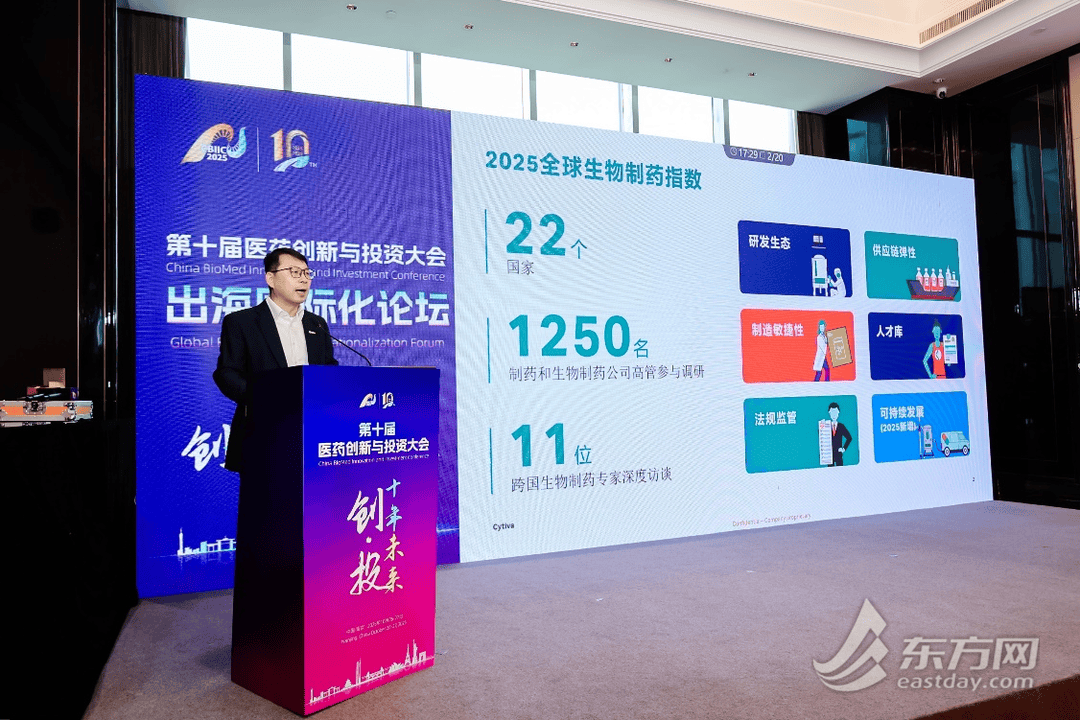
《2025全球生物制药指数》发布 揭示行业四大挑战与机遇
Sou Hu Cai Jing· 2025-10-27 12:30
Core Insights - Cytiva released the "2025 Global Biopharmaceutical Index" at the 10th Pharmaceutical Innovation and Investment Conference, aimed at helping decision-makers understand industry trends and develop resilient strategies to drive innovation [1][3] Industry Overview - This is the third release of the index since its inception in 2021, based on in-depth surveys of 1,250 biopharmaceutical executives across 22 countries, evaluating performance across six dimensions: supply chain resilience, manufacturing agility, R&D ecosystem, talent pool, policy and regulation, and newly added sustainability [3][4] - The global biopharmaceutical industry score for 2025 has slightly decreased compared to 2023, highlighting the need for the industry to address the gap between innovation and market access to benefit patients more quickly [3][4] Challenges Faced by the Industry - The report identifies four major challenges: 1. Bottlenecks in academia-industry collaboration, with nearly half of respondents struggling to find high-quality partners, particularly in CROs, CDMOs, academic institutions, and government labs [4] 2. Talent shortages in new therapy areas, with 38% of respondents indicating a lack of specialized talent in cell and gene therapy, mRNA, ADCs, and bispecific antibodies, as well as significant gaps in sustainability, digitalization, and AI talent [4] 3. Inconsistencies and lack of innovation in regulatory frameworks, with about half of respondents noting a lack of coherence in policies, and a quarter stating that traditional approval processes do not match the complexity of new therapies [4] 4. Supply chains being more susceptible to geopolitical influences, with over 70% of respondents believing that fluctuations in tariffs and trade policies will significantly impact procurement strategies in the coming year, leading over 60% to expand regional or local sourcing and promote domestic production to enhance supply chain security [4] Strategic Initiatives - Cytiva's president in China emphasized that the index serves as both a health check for the industry and a guide for action, with plans to leverage global industry experience and local capabilities through end-to-end solutions, a comprehensive talent development system, and the "Sail Plan" to support the global reach of Chinese innovations [7] - The "Sail Plan," initiated this year, focuses on addressing core challenges for Chinese innovative drugs going abroad, providing professional support across key areas from source innovation, international regulatory compliance, outbound strategies, to global business expansion, aiming to transition the Chinese biopharmaceutical industry from following to leading [7]