田野考古

Search documents
“田野首秀”
Ren Min Ri Bao· 2025-10-28 22:56
Core Insights - The article reflects on a personal journey through the Qinba Mountains, highlighting the experiences and challenges faced during a field archaeological project that began 13 years ago [1][2][3][4] Group 1: Fieldwork Experience - The archaeological work involved intense physical labor under challenging conditions, including heat and rain, which created a unique camaraderie among the team members [2][3] - The team consisted of both students and local laborers, with meals being a significant aspect of daily life, often involving simple dishes shared among the group [2][3] - The author was assigned a large excavation area, which required guidance from more experienced peers, showcasing the learning process in a field setting [3][4] Group 2: Learning and Development - The author experienced a steep learning curve, transitioning from a novice to managing multiple excavation areas, indicating personal growth and skill acquisition in archaeology [4] - Mentorship played a crucial role, with experienced students providing guidance on technical skills such as soil identification and excavation techniques [4] - The culmination of the fieldwork involved significant achievements, including uncovering artifacts from various historical periods, marking a successful first field experience [4]
五名洋学生琉璃河遗址学考古
Bei Jing Qing Nian Bao· 2025-07-17 03:51
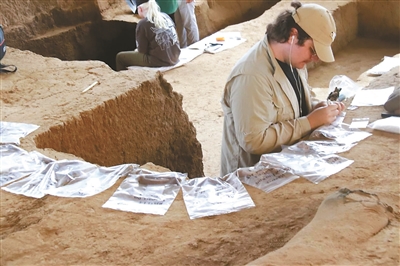
Core Insights - The article discusses the ongoing excavation activities at the Liulihe site in Beijing, where international students are participating in an archaeological training program under the guidance of Chinese experts [9][10]. Group 1: Program Overview - The 2025 Liulihe International Field Archaeology School is designed to provide international students with immersive archaeological training, combining theoretical knowledge with practical excavation experience [9][10]. - This year marks the second year of the program, which previously included four students from American universities [9]. Group 2: Student Activities and Learning - Students are required to complete various tasks such as excavation, recording, and analyzing findings, with a focus on mastering techniques like "scraping" and "finding edges" [5][6]. - The program includes intensive theoretical courses covering topics such as Chinese settlement archaeology and fieldwork principles before students engage in actual excavation [9][10]. Group 3: Discoveries and Findings - Students have made significant discoveries, including remains of ritual dog burials, which are characteristic of Shang Dynasty burial customs [7][8]. - The findings suggest that the burial site belonged to a male individual of considerable height, indicating a relatively affluent lifestyle based on the number of shells found [8]. Group 4: Cultural Experience - In addition to fieldwork, students participate in various cultural activities, visiting historical sites and museums to deepen their understanding of Chinese civilization [11][12]. - The program fosters camaraderie among students, enhancing their overall experience while learning about archaeology and Chinese culture [11][12].

田野考古的足迹
Ren Min Ri Bao· 2025-06-20 21:41
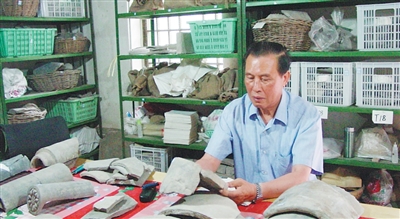
Core Insights - Xu Guangji has dedicated 70 years to archaeology and cultural heritage protection in China, witnessing significant developments in these fields [1][2] Group 1: Career and Contributions - Xu Guangji was born in 1935 and began his archaeology studies at Peking University in 1954, later working at the Chinese Academy of Sciences Archaeology Institute [2] - He was a key figure in the excavation of important archaeological sites, including the Fuhugou site, where he identified the Fuhugou culture, contributing to the understanding of various cultures in the Liao River basin [2] - Xu led the archaeological excavation of the Ye City site, which was significant for its historical and archaeological value, and developed effective methods for urban archaeology [3] Group 2: Academic Rigor and Legacy - Xu Guangji emphasized the importance of scientific rigor in archaeology, often expressing that research is an ongoing process with no definitive end [4] - After stepping down from leadership roles, he continued to guide national archaeological work and remained actively involved in the Ye City site, which celebrated its 40th anniversary of archaeological work in 2023 [4] - At 88 years old, Xu still works six hours a day and is involved in compiling archaeological reports, demonstrating his commitment to the field [4]