
真净值化

Search documents
业绩基准全线跌破3%,华夏理财发产品最多
2 1 Shi Ji Jing Ji Bao Dao· 2026-02-10 08:36
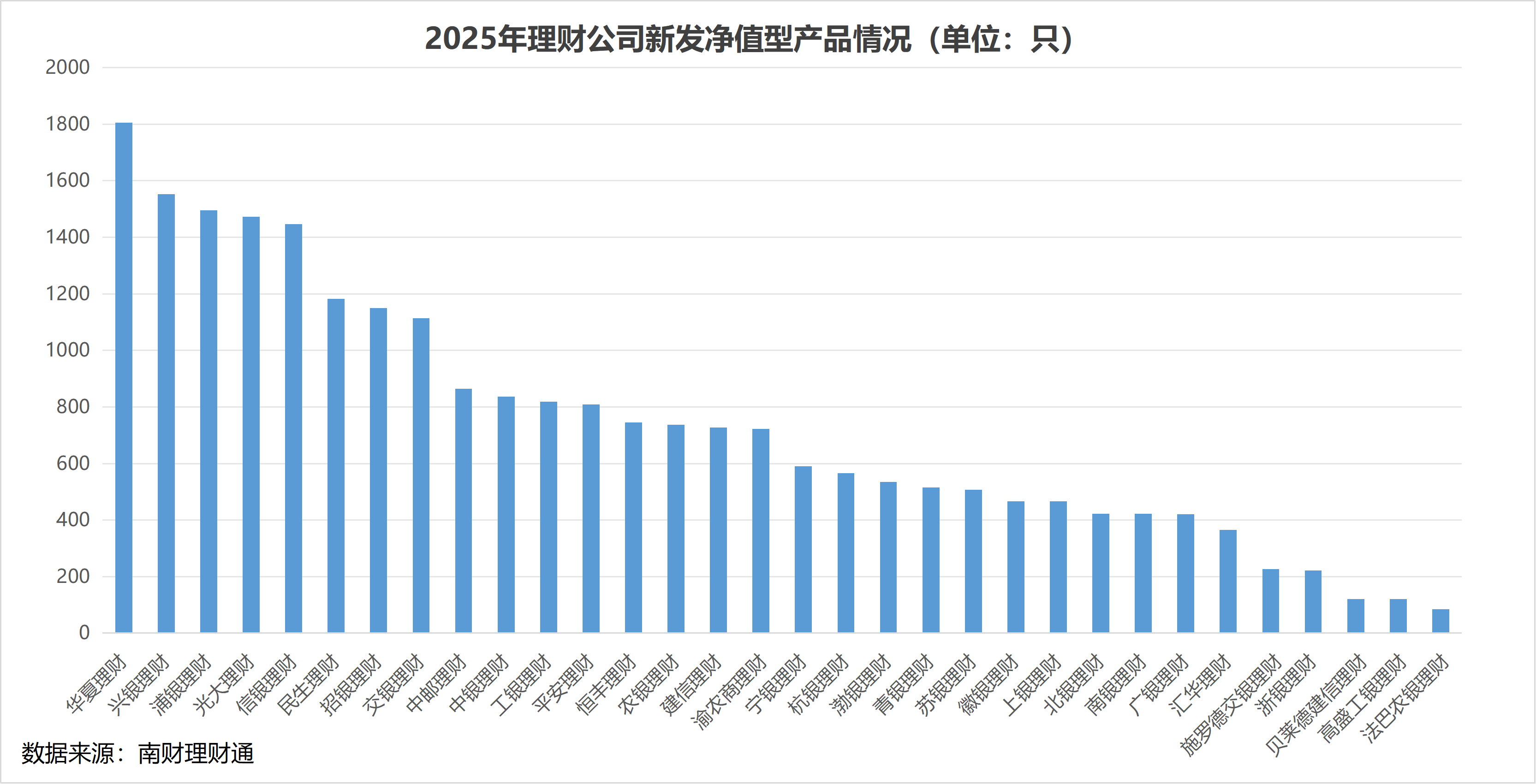
Core Viewpoint - In 2025, the issuance of net value-based wealth management products significantly increased, with 32 companies issuing 23,525 products, marking a nearly 70% rise compared to 14,099 products in 2024, while the focus remains on fixed-income products despite some expansion into mixed and equity products [1][2][6] Product Issuance - The number of wealth management products issued rose dramatically, with a total of 23,525 products in 2025, a 66.86% increase from 2024 [2] - The top seven issuers are primarily backed by joint-stock banks, with Huaxia Wealth Management leading at 1,805 products, followed by Xingyin Wealth Management with over 1,500 products [2] - Among state-owned banks, Jiaoyun Wealth Management issued the most products at 1,113, while Yunan Agricultural Commercial Bank led among rural commercial banks with 722 products [2] Product Structure - Fixed-income products dominate the market, accounting for 97.5%, while mixed products represent 2.0%, and equity and commodity products account for 0.2% and 0.3%, respectively, showing little change from 2024 [5] - Publicly offered products make up over 93.2% of the total, reflecting a 3.8 percentage point increase from 2024, indicating a more inclusive nature of wealth management products [5] - The proportion of closed-end net value products decreased from 73.80% in 2024 to 59.18% in 2025, while open-end products increased to 40.82%, highlighting a trend towards higher liquidity [5] Investment Duration - The trend towards shorter investment durations is evident, with products of 6-12 months being the most common but decreasing from 28.22% in 2024 to 23.82% in 2025 [5] - The share of products with a duration of 3-6 months also declined, while products with a duration of less than one month increased from 15.57% in 2024 to 22.50% in 2025, becoming the second-largest category [5] Pricing Trends - The performance benchmark for wealth management products has declined, with pricing ranges dropping from 2.30%-3.00% to 1.90%-2.70%, and all products now average below 3% [10] - The downward pressure on performance benchmarks is expected to continue, although the rate of decline may slow [10][12] - Several wealth management companies have announced adjustments to existing product benchmarks, affecting hundreds of products [12] Fundraising Scale - The total fundraising scale for new products in 2025 reached approximately 34,878.66 billion yuan, with an average fundraising scale of 256 million yuan per product [15] - Three products exceeded 10 billion yuan in fundraising, with the top product from Boyin Wealth Management raising 18.745 billion yuan [15][16]

多只理财产品业绩比较基准上限下调至不足3%
Zheng Quan Ri Bao· 2026-01-25 16:52
Core Viewpoint - Multiple financial institutions, including Agricultural Bank of China Wealth Management, China Post Wealth Management, and others, have lowered the performance benchmark for their wealth management products, with some products seeing a maximum reduction of 100 basis points, indicating a new normal of low returns in the wealth management market [1][4]. Group 1: Performance Benchmark Adjustments - China Post Wealth Management announced a reduction in the performance benchmark for its wealth management product from an annualized range of 3% to 4% to 2.5% to 3.5% [3]. - Agricultural Bank of China Wealth Management made more significant adjustments, with one product's benchmark dropping from 2.4% to 3% to a new range of 1.90% to 2.3% [3]. - Other institutions, such as Shanghai Bank Wealth Management, have also adjusted their benchmarks, with some products now having upper limits below 3% [4]. Group 2: Market and Regulatory Influences - The adjustments are driven by changes in the market interest rate environment and regulatory guidance, with expectations of continued downward pressure on performance benchmarks, although the rate of decline may slow [2][5]. - The ongoing low interest rate environment and the shift towards net asset value-based management of wealth products are influencing these changes, as companies adapt to the new regulatory landscape [4][5]. Group 3: Future Trends and Recommendations - Industry experts predict that the downward trend in performance benchmarks will continue, but the extent of the decline will moderate [5]. - Financial institutions are expected to enhance their investment research capabilities and explore the inclusion of equity assets in their product offerings to improve yield performance [5]. - Investors are advised to recognize the inevitability of low yields and adjust their return expectations accordingly, considering diversified asset allocation strategies [6].