矢量量化

Search documents
TurboQuant之于存储详解(GenAI系列之74):有理论启发的常规学术进展
Shenwan Hongyuan Securities· 2026-03-30 13:08
Investment Rating - The report maintains a "Positive" investment rating for the storage industry, particularly in relation to the implications of the TurboQuant algorithm on storage demand [2]. Core Insights - The report discusses the recent Google paper on TurboQuant, which has sparked debates regarding storage demand, suggesting that the excitement may be overstated and that TurboQuant may represent a conventional academic advancement rather than a groundbreaking change in storage technology [4][12]. - It emphasizes the need for investors to understand the nuances of TurboQuant, including its operational mechanics and potential limitations, particularly in terms of its application in various scenarios [4][24]. - The report highlights that while TurboQuant claims significant performance improvements, the actual benefits may not be as pronounced as suggested, particularly when compared to existing methods [25][26]. Summary by Sections 1. Background and Context - The report outlines the context of the TurboQuant paper, noting that media coverage has often been more aggressive than the original research, which presents a more tempered view of its innovations [4][9]. - It identifies that previous algorithms like PolarQuant and RaBitQ have laid the groundwork for TurboQuant, suggesting that the latter may not be as revolutionary as portrayed [12][13]. 2. TurboQuant Overview - The report provides a detailed summary of the TurboQuant algorithm, explaining its methodology and the theoretical underpinnings that guide its design [16]. - It describes the algorithm's focus on minimizing mean squared error (MSE) and optimizing inner product calculations, which are critical for its performance [16][18]. 3. Advantages and Disadvantages - The report discusses the advantages of TurboQuant, such as its potential for significant memory compression, but also highlights critical drawbacks, including its limited applicability to certain types of processing and potential accuracy trade-offs [24][25]. - It notes that TurboQuant primarily compresses KV-Cache without addressing other components like model weights, which remain a significant factor in overall memory usage [24]. 4. Broader Implications - The report suggests that while TurboQuant may not drastically alter storage demand, it raises important questions about the alignment of interests across different segments of the storage industry [28]. - It emphasizes the importance of understanding the diverse technological approaches within the AI-native storage landscape, which may lead to varying preferences among manufacturers [29][30]. 5. Academic Contributions and Insights - The report concludes by recognizing the academic contributions of the TurboQuant paper, particularly its innovative approach to applying digital communication theory to optimize storage solutions [31][32]. - It encourages further exploration of these theoretical frameworks as they may yield significant advancements in the field [31].

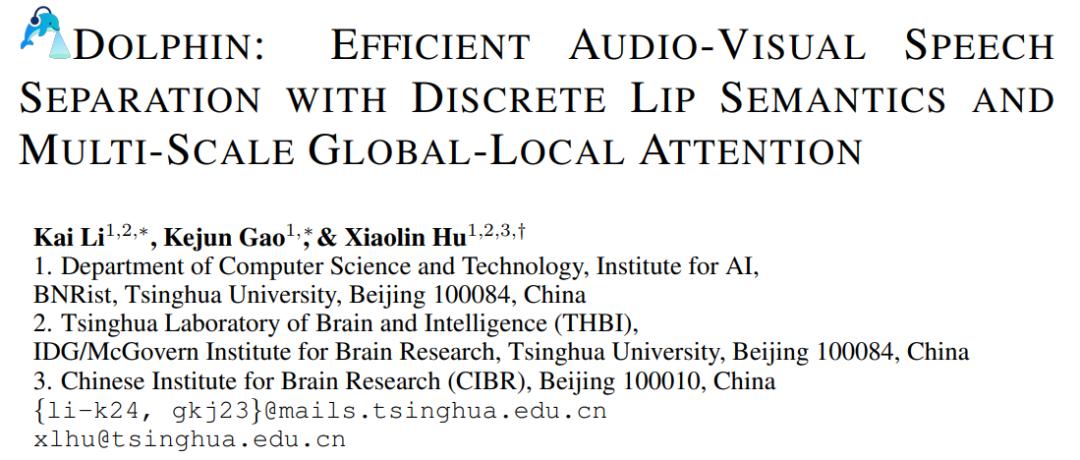
视听分离SOTA提速6倍,清华发布首个6M高性能模型
3 6 Ke· 2026-02-13 07:58
Core Insights - Tsinghua University's Dolphin model breaks the "high performance must mean high energy consumption" bottleneck by using only 6 million parameters, achieving a speed increase of over 6 times while maintaining high-quality audio-visual speech separation [1][2][14] Group 1: Model Innovations - Dolphin introduces a novel dual-path discrete visual encoder called DP-LipCoder, which utilizes vector quantization to achieve high-quality visual semantics while being lightweight [4][7] - The model employs a Global-Local Attention (GLA) module that allows for efficient global and local feature modeling in a single forward pass, eliminating the need for time-consuming iterative processes [8][10] - Dolphin uses a direct feature regression mechanism instead of traditional masking strategies, enhancing signal fidelity and achieving a significant improvement in the SI-SNRi metric [10] Group 2: Performance Metrics - Dolphin outperforms existing state-of-the-art (SOTA) models in multiple benchmark datasets, achieving a SI-SNRi of 16.8 dB on the LRS2 dataset, surpassing IIANet and AV-Mossformer2 [11][14] - The model's total parameter count is only 6.22 million, which is over 50% less than IIANet's 15.01 million, while also demonstrating a GPU inference latency of just 33.24 milliseconds for 1 second of audio, making it significantly faster than competitors [14] - In subjective listening tests, Dolphin received a mean opinion score (MOS) of 3.86, indicating superior audio clarity and naturalness compared to other models [14] Group 3: Application Potential - The advancements in Dolphin's technology provide a new pathway for deploying high-precision speech separation in resource-constrained environments such as smart glasses and mobile devices [13]