碳基文明

Search documents
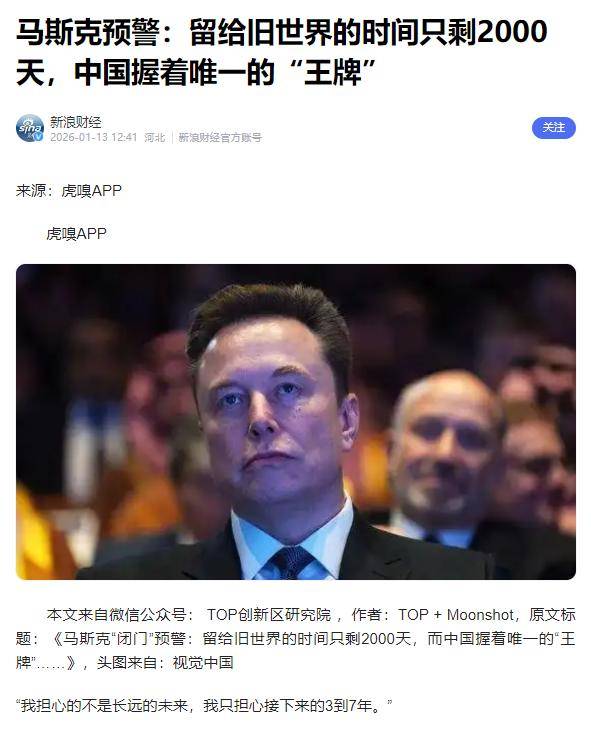
马斯克预警:留给旧世界的时间只剩2000天,中国握着唯一“王牌”
Sou Hu Cai Jing· 2026-01-25 01:51
Group 1 - The core message emphasizes that a significant transformation driven by technology is imminent, with predictions of a major reshuffling of jobs and wealth distribution within the next seven years, leading to increased disparities between individuals [1][4][19] - The white-collar workforce is identified as particularly vulnerable, with projections that many may exit the mainstream job market within three years due to advancements in AI [4][7] - The article discusses the rapid evolution of AI capabilities, suggesting that by 2026, general artificial intelligence will achieve breakthroughs that allow it to think and solve complex problems like humans, fundamentally altering the job landscape by 2030 [4][6] Group 2 - AI's impact on employment is immediate, with young students and white-collar workers facing the highest risks as traditional job security diminishes [7][9] - The article highlights that even high-paying professions such as law and accounting are not immune to AI replacement, as AI can process vast amounts of information more efficiently than humans [9][11] - The healthcare sector is also at risk, with AI potentially surpassing human doctors in knowledge and skill, leading to a future where AI plays a significant role in medical practices [13] Group 3 - Despite the challenges posed by AI, there is a belief that it could lead to a new era of prosperity, where robots become the primary labor force, significantly reducing costs and improving living standards [15][19] - The article notes that China is positioned to lead in AI capabilities, particularly in energy and computational power, which could give it a competitive edge over other nations [17][19] - The AI industry is characterized by a "winner-takes-all" dynamic, where a few major players dominate the market, exacerbating wealth inequality and limiting opportunities for smaller companies [19][21] Group 4 - The article suggests that while AI will eliminate repetitive jobs, it will also create opportunities for individuals to leverage uniquely human skills such as creativity and emotional intelligence [23] - It encourages a mindset shift towards collaboration with AI, advocating for individuals to use AI as a tool to enhance their productivity and focus on areas where they can add unique value [23]