硅基文明

Search documents
马斯克放狠话!旧世界只剩5年,中国王牌不是芯片!
Sou Hu Cai Jing· 2026-02-03 10:00
Group 1 - Elon Musk highlighted the limited timeframe of 2000 days for humanity's transition from a "carbon-based civilization" to a "silicon-based civilization" [1] - Musk emphasized that China's ultimate advantage lies not in widely discussed "core competencies" like chips, but in its long-ignored "foundational capabilities" [1] - The energy infrastructure in China, characterized by stable, cheap, and clean electricity supply, is becoming a significant advantage over the West [5][7] Group 2 - Predictions based on Musk's timeline suggest that by 2026, AI intelligence will surpass the smartest human individuals, and by 2029, it will exceed the total intelligence of humanity [3] - The energy demands of silicon-based civilization are immense, with Musk expressing concern that energy support may not keep pace with technological advancements [3] - China's total electricity consumption is projected to exceed 10.4 trillion kilowatt-hours by 2025, three times that of the United States [5] Group 3 - The construction of China's ultra-high voltage transmission lines, totaling 46 with a capacity of 370 million kilowatts, supports the country's energy needs [5][7] - By 2025, China is expected to add 370 GW of wind and solar capacity, accounting for nearly half of the global total, establishing a solid energy foundation for silicon-based civilization [7] - The density of industrial robots in China reached 392 units per 10,000 people by 2025, significantly higher than that of the United States, indicating deep integration of AI in manufacturing [12] Group 4 - China's approach to circumventing technological barriers, such as using "self-etching technology" to achieve 1-nanometer circuits, demonstrates its innovative capabilities despite external pressures [10] - The integration of AI and robotics in manufacturing is expected to drastically reduce labor costs, with Tesla's factories potentially operating continuously at high efficiency [12] - The ongoing evolution of China's internet industry amidst technological restrictions showcases its ability to grow through exploration and innovation [14]

马斯克预警:留给旧世界的时间只剩2000天,中国握着唯一“王牌”
Sou Hu Cai Jing· 2026-01-25 01:51
Group 1 - The core message emphasizes that a significant transformation driven by technology is imminent, with predictions of a major reshuffling of jobs and wealth distribution within the next seven years, leading to increased disparities between individuals [1][4][19] - The white-collar workforce is identified as particularly vulnerable, with projections that many may exit the mainstream job market within three years due to advancements in AI [4][7] - The article discusses the rapid evolution of AI capabilities, suggesting that by 2026, general artificial intelligence will achieve breakthroughs that allow it to think and solve complex problems like humans, fundamentally altering the job landscape by 2030 [4][6] Group 2 - AI's impact on employment is immediate, with young students and white-collar workers facing the highest risks as traditional job security diminishes [7][9] - The article highlights that even high-paying professions such as law and accounting are not immune to AI replacement, as AI can process vast amounts of information more efficiently than humans [9][11] - The healthcare sector is also at risk, with AI potentially surpassing human doctors in knowledge and skill, leading to a future where AI plays a significant role in medical practices [13] Group 3 - Despite the challenges posed by AI, there is a belief that it could lead to a new era of prosperity, where robots become the primary labor force, significantly reducing costs and improving living standards [15][19] - The article notes that China is positioned to lead in AI capabilities, particularly in energy and computational power, which could give it a competitive edge over other nations [17][19] - The AI industry is characterized by a "winner-takes-all" dynamic, where a few major players dominate the market, exacerbating wealth inequality and limiting opportunities for smaller companies [19][21] Group 4 - The article suggests that while AI will eliminate repetitive jobs, it will also create opportunities for individuals to leverage uniquely human skills such as creativity and emotional intelligence [23] - It encourages a mindset shift towards collaboration with AI, advocating for individuals to use AI as a tool to enhance their productivity and focus on areas where they can add unique value [23]
百融云-w(06608):硅基员工的推出有望重塑toB端AI应用商业模式
Haitong Securities International· 2025-12-21 15:38
Investment Rating - The report assigns an "Outperform" rating to BaiRong Cloud, indicating an expected relative return exceeding 10% over the next 12-18 months [14]. Core Insights - BaiRong Cloud launched its ResultsCloud platform, which aims to transform the business model from "selling tools" to "selling outcomes" through three major technological innovations and a RaaS (Results-as-a-Service) model [1][6]. - The introduction of silicon-based employees (AI Agent-like applications) represents a fundamental shift in production factors, moving from human reliance to human-machine collaboration [1][6]. - The company plans a three-phase strategy: consolidating fintech advantages and improving silicon-based employee standards from 2025-2026, expanding into vertical sectors like healthcare and education from 2027-2028, and becoming a global leader in silicon-based productivity by 2029-2030 [2][6]. Summary by Sections Technological Innovations - The ResultsCloud platform features a three-layer architecture: AI Infra reasoning engine, AgentOS lifecycle management, and AgentStore commercialization applications [2]. - The AI Infra reasoning engine enhances inference performance by 300% compared to general frameworks, while AgentOS allows for rapid deployment of silicon-based employees within two weeks [2]. Product Offerings - The AgentStore has launched four key products: 1. BaiYing for customer service and marketing, improving customer satisfaction by 40% 2. BaiCai for recruitment, reducing hiring cycles to 28 days and increasing productivity by 5 times 3. BaiJian for cross-border legal and tax services, enhancing efficiency by 90% and reducing costs by 70% 4. BaiZhi for knowledge production, compressing cycles to 4 days and boosting efficiency by 400% [2]. Strategic Importance - The large-scale application of silicon-based employees is expected to redefine core competitiveness in enterprises, with early adopters of human-machine collaboration gaining a competitive edge in the digital economy [3][6]. - BaiRong Cloud's transition from a model service provider to a rental provider of AI employees could lead to a disruptive transformation in the B-end AI and software industries, expanding its business scope beyond finance [3][6].
八年磨一剑,硅基智能冲击 “数字人第一股”:B 端红利难掩盈利薄弱与竞争压力
3 6 Ke· 2025-11-20 01:58
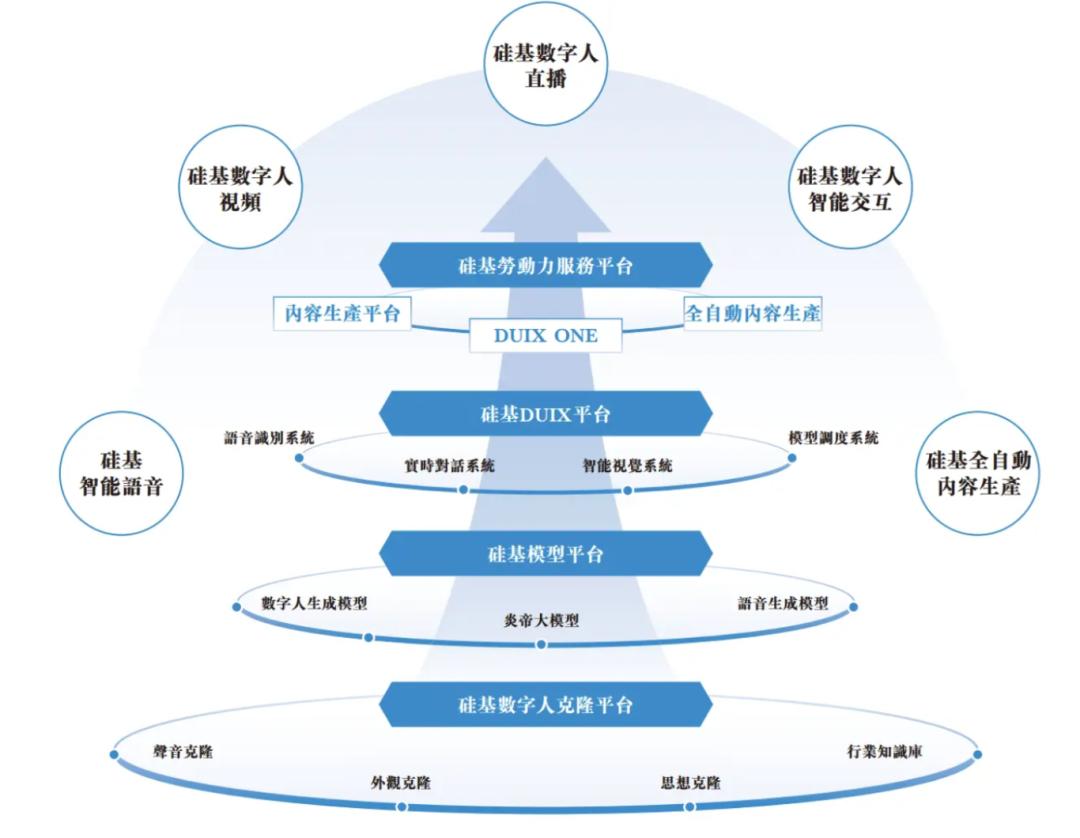
Core Viewpoint - The company, Silicon-based Intelligence, is set to become the first digital human operator to go public in Hong Kong by submitting its prospectus to the Hong Kong Stock Exchange, aiming for profitability through AI-driven digital human solutions [1]. Group 1: Company Overview - Silicon-based Intelligence was founded in August 2017 by entrepreneur Si Ma Huapeng, capitalizing on the AI boom initiated by AlphaGo, with a focus on voice technology for customer service in finance and telecommunications [2]. - The company has evolved through three technological leaps, introducing its first AIGC digital human in 2019, which integrated voice and image technologies [3]. - By 2024, the company launched a multimodal large model, DUIXONE, transitioning its business model from selling tools to providing comprehensive API platforms for various applications [3]. Group 2: Financial Performance - The company reported revenues of RMB 2.23 billion, RMB 5.31 billion, RMB 6.55 billion, and RMB 3.26 billion for the years 2022, 2023, 2024, and the first half of 2025, respectively, with growth rates of 138.12%, 23.40%, and 11.26% [6]. - In 2025, Silicon-based Intelligence achieved an adjusted net profit of approximately RMB 529 million, marking a turnaround from previous losses [1][11]. - The average customer value increased significantly from RMB 380,000 in 2022 to RMB 1,130,000 in the first half of 2025, reflecting a strategic focus on large clients [11]. Group 3: Market Position and Competition - Silicon-based Intelligence holds a leading position in China's digital human market with a 32.2% market share as of 2024, amidst increasing competition from major players like Baidu, Tencent, and Huawei [5][15]. - The company has completed eight rounds of financing since its inception, raising over RMB 1 billion, with significant investments from Tencent and other notable funds [5]. - The digital human market is projected to grow to RMB 155 billion by 2030, but current demand remains below the "100 billion level," posing challenges for the company [11][17]. Group 4: Strategic Focus and Challenges - The company employs a "small but beautiful" strategy, focusing on B-end markets and offering standardized products to meet the needs of small and medium-sized enterprises [8]. - Despite achieving profitability, the company faces challenges such as reliance on a few large clients, with the top five clients contributing over 64.4% of revenue in 2023 [10]. - The competitive landscape is intensifying, leading to price reductions that have pressured profit margins, with gross margins declining from 45.8% in 2023 to 31.6% in the first half of 2025 [14][15].