碳酸锂再定价

Search documents
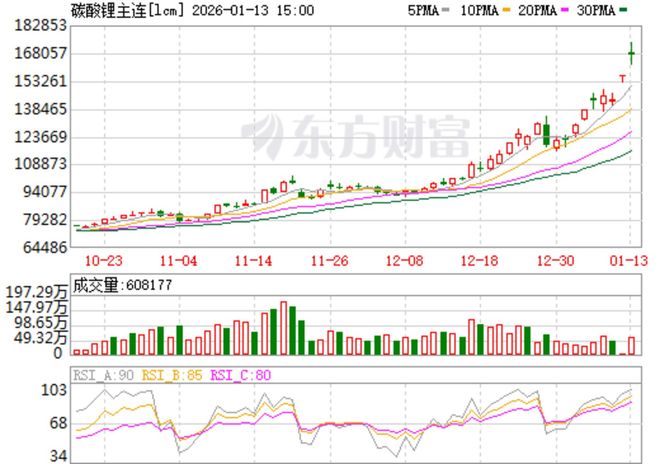
碳酸锂冲破17万:这不是行情,是一次再定价
Tai Mei Ti A P P· 2026-01-13 09:55
Core Viewpoint - The lithium carbonate futures price has surpassed 170,000 yuan/ton, indicating a shift in market dynamics and the formation of a new price anchor, as the market tests a new price range after a significant increase [1][3]. Group 1: Price Dynamics - The recent price surge reflects a transition from cash cost and current supply-demand dynamics to a focus on supply realization probability, inventory positioning, and demand concentration [3]. - The price increase from 130,000 to 170,000 yuan/ton represents a second phase of tight balance, where the key variables influencing price are no longer just quantity differences but also the certainty of supply and timing of demand [4]. - The upward movement in price is supported by a shift in inventory from high levels to sensitive ranges, where any uncertainty in supply triggers restocking, leading to a preemptive tightening of the market [4][6]. Group 2: Supply Chain Changes - The supply side's credibility has diminished due to multiple upstream production cuts and maintenance events, making the market more sensitive to supply stability [8]. - Regulatory pressures regarding resource development and environmental compliance have increased, altering market expectations for supply elasticity [8]. - In a tight balance, changes in quantity dictate direction, while changes in certainty dictate slope, emphasizing the importance of reliable supply in price determination [8]. Group 3: Demand Dynamics - The demand structure is evolving, with significant contributions from energy storage, which introduces more concentrated and project-based purchasing patterns, leading to sharp demand spikes [9]. - Anticipated adjustments to tax policies related to battery exports may shift order placements and production schedules, increasing short-term demand concentration [9][10]. Group 4: Pricing Mechanisms - The combination of declining supply certainty and demand pulses amplifies effects in the futures market, leading to increased volatility and rapid price fluctuations [11]. - The market is not merely reacting to current supply changes but is also pricing in future expectations, indicating a potential formation of a new consensus price range [11]. Group 5: Profit Distribution and Market Anxiety - The re-pricing process favors companies with stable, low-cost production capabilities, as they benefit more directly from price increases [12]. - Midstream lithium salt companies face greater differentiation based on their raw material stability and cash flow management, with high-cost firms potentially experiencing cash flow issues despite improved profit margins [12]. - Downstream sectors, including materials and battery integration, are under pressure due to mismatches between rapidly changing input costs and slower revenue recognition [12]. Group 6: Future Outlook - The next 3 to 6 months are likely to see high-level fluctuations, contingent on intermittent supply disruptions and sustained energy storage demand [13]. - If supply exceeds expectations or downstream pricing resistance becomes evident, prices may experience a quicker retraction [13][15]. - The upward price movement is not limitless, as increased production incentives may lead to a return of supply elasticity, potentially compressing price ceilings [13][16]. Group 7: Pathways and Triggers - Monitoring inventory depletion is crucial; if prices rise alongside inventory reduction, it indicates solid fundamental support [15]. - Observing the rebound in lithium salt production and its impact on inventory replenishment will be key to understanding price pressures [15]. - The relationship between concentrate and lithium salt pricing will help determine whether the current price increase is driven by demand or cost pressures [15].