
价格弹性

Search documents
需求预期强化-供给扰动频发-重视锂电Q2超额收益窗口
2026-03-30 05:15
Summary of Conference Call Records Industry Overview: Lithium Battery Sector Key Points - **Demand Growth Expectations**: Lithium battery demand growth for 2026 has been revised upward from 20% to 35%, with a compound annual growth rate (CAGR) forecasted at 23%-25% over the next three years. This adjustment is expected to enhance the sector's price-to-earnings (PE) valuation from 20x to 23-25x [1][3] - **Supply Disruptions**: Lithium hexafluorophosphate (LiPF6) inventory is projected to drop to less than one week’s supply by the end of March 2026, with potential shortages in May-June, leading to price recovery from 110,000 CNY/ton to over 150,000 CNY/ton [1] - **Lithium Carbonate Price Surge**: A second wave of price increases for lithium carbonate is anticipated, driven by supply disruptions from Zimbabwe's export ban and delays in production resumption in Jiangxi, with prices likely to exceed 200,000 CNY/ton in Q2 [1] - **Midstream Material Price Recovery**: Midstream materials such as separators and copper foils are entering a price recovery phase, with new rounds of price negotiations underway. The cost of electrolytes has increased due to geopolitical conflicts, expanding profit margins by 1,500-2,000 CNY per ton [1][4] Company-Specific Insights Key Companies - **Contemporary Amperex Technology Co., Ltd. (CATL)**: April production plans exceeded expectations, enhancing the credibility of annual guidance. The sodium battery industry is accelerating, with a projected scale of 10 GWh by 2026, and multiple models to be unveiled at the Beijing Auto Show [1][4] - **Investment Focus**: The investment logic emphasizes valuation recovery and price elasticity, favoring leading battery manufacturers and lithium hexafluorophosphate producers such as Tianqi Lithium and DLG [1][5] Market Dynamics and Future Outlook Demand and Supply Analysis - **April Production Growth**: The lithium battery industry is expected to see a 20% month-over-month increase in production for April, building on March's growth. This demand is supported by the domestic market's marginal improvements and robust data on electric vehicle (EV) battery capacity [2] - **Long-term Demand Projections**: The demand growth forecast for 2026 has been adjusted to approximately 35%, reflecting improved expectations in the European and Southeast Asian markets for energy storage and EVs [2][3] Price Trends and Profitability - **LiPF6 Market Dynamics**: The price of LiPF6 has fluctuated significantly, with a peak of 180,000 CNY/ton in 2025, followed by a decline to 100,000-110,000 CNY/ton in March 2026. A balanced supply-demand scenario is expected in April, but potential shortages could lead to price increases [3][4] - **Midstream Material Pricing**: April marks a critical period for price recovery in midstream materials, with separators and copper foils experiencing upward price adjustments. The cost pressures from rising raw material prices are expected to drive up processing fees in the phosphoric acid lithium supply chain [4][5] Investment Strategies Recommended Investment Targets - **Core Investment Logic**: The lithium battery supply chain is viewed positively, with specific focus on valuation recovery in the battery segment. Companies like CATL and Penghui Energy are highlighted for their stable earnings and growth potential [5] - **Emerging Technologies**: Sodium-ion battery technology is progressing steadily, with CATL's plans to launch multiple sodium battery models at the Beijing Auto Show. The expected scale for sodium batteries is around 10 GWh in 2026, with significant growth anticipated in subsequent years [5][6] Geopolitical Considerations - **Investment Strategy Amid Geopolitical Risks**: The investment strategy should focus on domestic resource certainty and companies with strong Q1 performance. The lithium carbonate sector is expected to see continued growth, with a focus on companies that can navigate geopolitical uncertainties effectively [7][8]

能源危机的超级赢家-天然气
2026-03-16 02:20
Summary of Conference Call on Natural Gas Industry Industry Overview - The conference call focuses on the natural gas industry, particularly the impact of geopolitical events on supply and pricing dynamics, specifically referencing the blockade of the Strait of Hormuz and its implications for global natural gas supply and pricing [1][2][3]. Key Points and Arguments Impact of the Strait of Hormuz Blockade - The blockade is expected to affect natural gas supply by approximately 110 billion cubic meters per day, which is double the supply gap experienced during the Russia-Ukraine conflict [1]. - The current price of natural gas has doubled to $16 per million British thermal units (MMBtu), with potential for further increases if the blockade continues [1][2]. Price Elasticity of Natural Gas - Natural gas exhibits significantly higher price elasticity compared to oil, with historical price increases during crises showing potential for much larger fluctuations [2]. - In 2022, natural gas prices surged nearly 8 times, while current expectations for oil prices are limited to a rise of about 1-2 times [2]. Beneficiaries of Price Increases - Companies with overseas low-cost long-term contracts, such as Shenzhen Gas (800,000 tons for resale + 57,000 tons of DES contracts), New Hope Group, and Fuan Energy, are positioned to benefit from rising prices [1][5]. - Upstream unconventional gas producers like Shouhua Gas and New Natural Gas are also expected to see direct positive correlations with domestic gas price increases [1][5]. Market Dynamics and Investment Strategies - The gas sector is viewed as aggressive with stock prices not fully reflecting expected gains, while the electricity sector, particularly hydropower, is seen as defensive [1][6]. - The market logic differentiates between electricity stocks as defensive assets during crises and grid stocks as part of recovery trading linked to AI infrastructure [1][6][8]. Structural Challenges in the Gas Sector - The gas sector's performance has been muted due to several factors, including the relatively small size of listed gas companies in the A-share market and the mixed benefits across different companies [3][4]. - Not all gas companies will benefit from price increases; midstream traders may suffer as they purchase gas at higher prices to sell downstream [3]. Comparison with Previous Crises - The current supply disruption from the Strait of Hormuz is more significant than that during the Russia-Ukraine conflict, with a daily supply disruption of 110 billion cubic meters compared to 50 billion cubic meters previously [4]. - The market's perception of the blockade's duration may lead to quicker price increases if sustained [4]. Price Transmission to Domestic Companies - The impact of international gas price increases on domestic A-share companies varies; unconventional gas producers have a higher correlation with domestic prices, while international resale companies depend on global price dynamics [5]. - Historical data indicates that domestic price increases tend to be more moderate compared to international spikes [5]. Investment Opportunities - Companies with significant long-term contracts for overseas resale, such as Shenzhen Gas, New Hope Group, and Fuan Energy, are highlighted as having the greatest earnings elasticity [5][6]. - The green fuel sector is identified as a growth area that benefits from rising traditional fuel prices while aligning with carbon reduction goals [7]. Differentiation of Utility Stocks - A simplistic classification of A-share electricity and grid stocks as defensive "High-Low" assets is deemed inaccurate; their investment logic differs significantly [8]. - Electricity stocks are defensive in crisis scenarios, while grid stocks are linked to recovery and technological investment trends [8]. Additional Important Insights - The conference emphasized the need for investors to have a deeper understanding of the gas sector to identify true beneficiaries of price increases [3][5]. - The discussion highlighted the importance of monitoring geopolitical developments and their potential impact on supply and pricing in the natural gas market [2][4].
航空行业2026年1月数据点评:1月6家上市航司机队净退出5架;春运火热开启,继续看好航空板块机会
Huachuang Securities· 2026-02-14 13:56
Investment Rating - The report maintains a "Recommend" rating for the aviation sector, expecting the industry index to outperform the benchmark index by over 5% in the next 3-6 months [56]. Core Insights - The report highlights a strong demand for air travel during the Spring Festival, with a projected growth in passenger numbers of around 5% due to the recovery of international routes and increased domestic travel demand driven by service consumption [8]. - The report notes that the supply of aircraft is expected to grow at a compound rate of approximately 3% over the next three years, indicating a "hardcore" constraint on supply [8]. - High load factors are anticipated to lead to significant price elasticity, particularly for major airlines such as China National Aviation, Southern Airlines, and Eastern Airlines, which are expected to see a release of elasticity [8]. Monthly Data Analysis Overall Performance - In January, the overall ASK (Available Seat Kilometers) growth rates varied among airlines, with Spring Airlines leading at 4.5% growth, while Hainan Airlines saw a decline of 6.6% [1]. - RPK (Revenue Passenger Kilometers) growth also showed a similar trend, with Spring Airlines at 6.0% and Hainan Airlines at -4.4% [1]. Domestic Routes - For domestic routes in January, Spring Airlines had the highest ASK growth at 13.3%, while Hainan Airlines had the lowest at -8.5% [2]. - RPK growth for domestic routes was led by Spring Airlines at 14.4%, with Hainan Airlines again at the bottom with -6.3% [2]. International Routes - On international routes, Southern Airlines showed the highest ASK growth at 10.5%, while Spring Airlines experienced a decline of 20.8% [2]. - RPK growth on international routes was also led by Southern Airlines at 8.0%, with Spring Airlines again showing a significant decline of 19.5% [2]. Regional Routes - Spring Airlines led regional routes with an ASK growth of 41.6%, while the lowest was seen in 吉祥 Airlines at -39.4% [2]. - RPK growth for regional routes was similarly led by Spring Airlines at 40.7% [2]. Load Factor - In January, Spring Airlines achieved the highest load factor at 92.0%, with a year-on-year increase of 1.3 percentage points [3]. - The load factors for other airlines were as follows: Eastern Airlines at 85.0%, 吉祥 Airlines at 84.0%, and Southern Airlines at 83.3% [3]. Fleet Size - In January 2026, the six listed airlines collectively saw a net exit of 5 aircraft from their fleets [3].






浮法玻璃-再平衡-看弹性
2026-02-13 02:17
Summary of the Glass Industry Conference Call Industry Overview - The glass industry is experiencing a significant downturn, with profitability hitting historical lows in 2025, leading to cash flow losses for some companies and a noticeable supply contraction in November and December [2][4]. - Current supply and demand in the float glass industry are slightly imbalanced, but effective capacity reduction can be achieved through cold repairs [2][4]. Key Insights - Approximately 10% of production lines are over 10 years old, and if these lines undergo cold repairs, capacity could decrease to around 136,000 tons, potentially achieving supply-demand balance [2][4]. - There are marginal improvements expected from policy changes, such as the coal-to-gas transition in the Shahe region and fuel system replacements under carbon neutrality policies, which may accelerate cold repairs or shutdowns [2][4]. - Historical data indicates that the typical restart time for cold-repaired lines is between 4 to 10 months, but the current average is nearly one year, reflecting a pessimistic outlook for the industry [5][6]. Price Elasticity and Future Projections - If a short-term demand improvement similar to that of May to June 2023 occurs, glass prices could rise by 200 to 300 yuan per ton, indicating significant price elasticity [2][6]. - The industry has seen a supply reduction from 159,000 tons to approximately 150,000 tons, a decrease of about 6%, primarily due to prolonged low profitability [4][6]. Company-Specific Insights - For example, if the excess profit per heavy box of float glass for Qibin Group returns to 15 yuan, and the excess profit for photovoltaic glass is 2 yuan per square meter, the company's market value could reach 35 billion yuan, indicating substantial valuation potential [2][7]. - Qibin Group produces 100 million heavy boxes annually, which could translate to a profit increase of 1.5 billion yuan, while Xinyi Glass, producing 120-130 million heavy boxes, could see a profit increase of around 1.8 billion yuan [6][7]. Recommendations - It is advisable to focus on leading companies such as Qibin Group and Xinyi Glass, as changes in policy expectations and improved market sentiment may present investment opportunities [3][7].
浮法玻璃深度:再平衡,看弹性
Changjiang Securities· 2026-02-11 06:06
Investment Rating - The report maintains a "Positive" investment rating for the industry [14] Core Insights - The glass industry has been experiencing continuous losses since 2025, leading to accelerated cold repairs. By the end of 2025, the production capacity decreased from approximately 160,000 tons/day to 151,000 tons/day, a decline of about 6%. The report anticipates that supply cold repairs will continue, gradually achieving a supply-demand rebalancing. If demand shows marginal improvement, glass prices are expected to exhibit elasticity and sustainability. The report is optimistic about leading companies such as Qibin Group and Xinyi Glass, which have significant cost advantages and sustained growth [3][8][12]. Current Situation: Profit Bottom, Accelerated Cold Repairs - The glass industry has faced significant pressure, with some companies experiencing cash flow losses. The average profitability level has been in continuous loss since 2025, with some companies expected to reach cash flow losses. The report highlights that the cold repair process has accelerated due to these pressures [23][26]. Supply Reduction Potential - The report identifies two main factors affecting glass cold repairs: profitability and furnace age. Currently, production lines over 10 years old account for a total of 18,800 tons/day. Excluding profitable lines from Xinyi and Qibin, as well as automotive and electronic glass lines, the potential cold repair capacity is around 15,000 tons/day. If all these lines are cold repaired, supply could drop to approximately 136,000 tons/day, representing a further 10% reduction from the end of 2025 capacity [9][35]. Supply Recovery Outlook - The report discusses the cautious approach companies may take regarding cold repairs due to high investment costs. For instance, the cold repair cost for an 800 tons/day glass production line typically exceeds 50 million, and upgrades could reach 100 million. The recovery period for investments is estimated to be 1.77 years under optimistic profit scenarios [10][43]. Price Elasticity Post Supply-Demand Rebalancing - The report suggests that under a scenario where real estate demand declines by 10% in 2026, the annual supply needs to decrease to about 145,000 tons/day, a reduction of 0.6 million tons/day from the end of 2025. The ongoing losses in the industry indicate that supply cold repairs will continue, potentially leading to a seasonal price recovery in 2026 [11][57]. Leading Companies: Cost Advantages and Growth - Qibin Group and Xinyi Glass are highlighted as industry leaders with significant profitability advantages. For instance, Qibin's gross profit per unit has been consistently higher than the industry average by 5 yuan/unit since 2020. The report also notes that Qibin has diversified into photovoltaic glass, enhancing its profitability [12][68].


Hershey(HSY) - 2025 Q4 - Earnings Call Transcript
2026-02-05 14:32
Financial Data and Key Metrics Changes - The company anticipates 4%-5% net sales growth and meaningful earnings recovery for 2026, indicating a positive outlook following a challenging 2025 [4] - The gross margin is expected to recover to 41% in 2026, which is an improvement from 2025 but still below historical levels [24][26] Business Line Data and Key Metrics Changes - The snacks business experienced an 18% growth in Q4, driven by double-digit volume growth, showcasing strong performance in this segment [12][47] - Organic sales growth for the confection segment is around 3%, while salty snacks are expected to grow in the mid-single digits [99] Market Data and Key Metrics Changes - The company is gaining market share in key international markets such as Canada, Mexico, Brazil, and the UK, indicating a strong international growth potential [102] - The company has factored in the impact of SNAP waivers into its outlook, with only 2 states currently implementing these waivers for candy [88] Company Strategy and Development Direction - The company is focused on investing in innovation, brand building, and execution to drive growth, with a significant increase in advertising planned for 2026 [29][30] - The strategy includes a balanced approach to growth and margin recovery, with multi-year investments aimed at sustaining long-term top-line growth [30][63] Management's Comments on Operating Environment and Future Outlook - Management expressed confidence in the resilience of their portfolio despite headwinds like cocoa inflation and macro volatility [4] - The company is optimistic about the cocoa market, anticipating a larger supply surplus in 2025 and 2026, which could lead to further deflation in cocoa prices [26][60] Other Important Information - The company plans to connect its brands to cultural moments throughout the year, enhancing consumer engagement and driving sales [90] - The management highlighted the importance of maintaining a rational pricing strategy in the category, with expectations for continued promotional activities [95] Q&A Session Summary Question: Concerns about potential price deflation due to cocoa price decline - Management acknowledged the sophisticated nature of competitors and emphasized their patient approach to pricing, ensuring affordability while navigating cocoa cost inflation [9][10] Question: Elasticity and its impact on pricing strategy - Management noted that current elasticities are favorable, and they are planning for around 0.8 to account for fluctuations, with a goal to exceed this [19] Question: Insights on cocoa's impact on margins - Management indicated that while cocoa prices have declined, they expect to see a recovery in gross margins, but volatility remains a concern [24][26] Question: Plans for brand investment and its durability - Management stated that investments in 2026 are designed to lay a foundation for future growth, with a focus on demand creation and innovation [30] Question: Performance in international markets - Management expressed optimism about international growth, highlighting market share gains and a focused strategy for key markets [102] Question: Impact of SNAP changes on business - Management described SNAP changes as a manageable headwind, with ongoing monitoring and strategies in place to adapt [88] Question: Expectations for earnings growth and flexibility in guidance - Management emphasized the momentum in the business and the flexibility built into their guidance to respond to changing conditions [46][49]

Hershey(HSY) - 2025 Q4 - Earnings Call Transcript
2026-02-05 14:32
Financial Data and Key Metrics Changes - The company anticipates 4%-5% net sales growth and meaningful earnings recovery for 2026, indicating a positive outlook after navigating challenges in 2025 [7] - The pricing taken in 2025 does not fully cover cocoa cost inflation for 2026, suggesting a recovery path while investing in marketing and innovation [12][13] - Gross margins are expected to recover to 41% in 2026, which is an improvement from 2025 but still below historical levels [28] Business Line Data and Key Metrics Changes - The snacks business experienced an 18% growth in Q4, driven by double-digit volume growth, indicating strong performance in this segment [15] - The confection segment is projected to have organic sales growth around 3%, while salty snacks are expected to grow in the mid-single digits [102] Market Data and Key Metrics Changes - The company is gaining market share in key international markets such as Canada, Mexico, Brazil, and the U.K., reflecting a positive trend in its international business [105] - The salty category was relatively flat last year, but the company achieved double-digit growth, indicating strong performance against market trends [55] Company Strategy and Development Direction - The company is focused on brand building and innovation, with significant investments planned for 2026, including a double-digit increase in advertising [31][34] - The strategy includes leveraging cultural moments and seasonal events to enhance brand engagement and drive sales [94] Management's Comments on Operating Environment and Future Outlook - Management expressed confidence in the resilience of the portfolio and the ability to navigate macroeconomic challenges, including cocoa inflation [7] - The company is monitoring changes in SNAP regulations but views them as a manageable headwind [92] Other Important Information - The company plans to provide more detailed insights into its long-term strategy and investments during the upcoming investor day [66] - The management emphasized the importance of balancing growth and margin recovery in their investment strategy [63] Q&A Session Summary Question: Concerns about potential price deflation due to cocoa price changes - Management acknowledged the risk but emphasized their strategic pricing approach and consumer insights [12][19] Question: Elasticity and its impact on pricing strategy - Management noted that current elasticities are favorable and are planning for flexibility in their pricing strategy [21][22] Question: Cocoa's impact on margin framework - Management indicated optimism about cocoa prices stabilizing and potential for margin recovery in 2027 [30] Question: Brand investment durability and future reinvestment - Management stated that investments in 2026 are designed to support long-term growth and will continue into 2027 [32] Question: Gross margin performance in Q4 - Management highlighted strong volume growth and lower-than-expected tariffs as key contributors to improved gross margins [40][41] Question: International segment performance and pricing actions - Management discussed the challenges and strategies in the international market, focusing on premium pricing and market share gains [104][105] Question: SNAP program changes and their impact - Management provided insights on the early assessment of SNAP changes and their manageable impact on the business [91][92] Question: Cultural and seasonal events to boost engagement - Management emphasized the importance of connecting brands to cultural moments to enhance consumer engagement [94][95] Question: Balancing promotions and marketing investments - Management indicated a rational approach to pricing and promotions while maintaining strong brand investments [98][100]
供需共振叠加资金涌入 公募发力有色金属赛道
Shang Hai Zheng Quan Bao· 2026-01-25 14:24
Group 1: Institutional Movements - The non-ferrous metal sector is becoming a focal point for both fund companies and investors, with public funds significantly increasing their positions in this industry by Q4 2025 [1][2] - The allocation ratio of non-ferrous metals in actively managed equity funds has notably increased, rising by 2.3 percentage points compared to the end of Q3 2025, driven by strong demand and favorable liquidity conditions [2] - Major funds are concentrating their holdings in strategic metals such as gold, copper, aluminum, tin, and antimony, with specific funds optimizing their stock selections [2] Group 2: ETF Inflows - A substantial amount of capital is flowing into non-ferrous metal ETFs, with a net subscription of nearly 20 billion yuan in Q4 2025 alone [3] - The total scale of non-ferrous metal theme ETFs has surpassed 100 billion yuan, indicating strong investor interest and confidence in this sector [4] Group 3: New Product Launches - There has been a surge in the issuance of new non-ferrous metal-themed ETFs, with four new products currently in the pipeline as of January 23 [4] - The mining companies within the non-ferrous metal sector are expected to benefit significantly from rising metal prices, as their revenues are closely linked to the spot prices of metals like copper, lithium, and zinc [4] Group 4: Long-term Investment Outlook - The long-term investment logic for the non-ferrous metal mining sector is being reinforced due to tightening supply and demand dynamics, alongside a favorable macroeconomic environment [4] - Despite recent price corrections, the overall bullish outlook on resource commodities remains intact, with expectations for long-term investment returns in the non-ferrous sector [5]
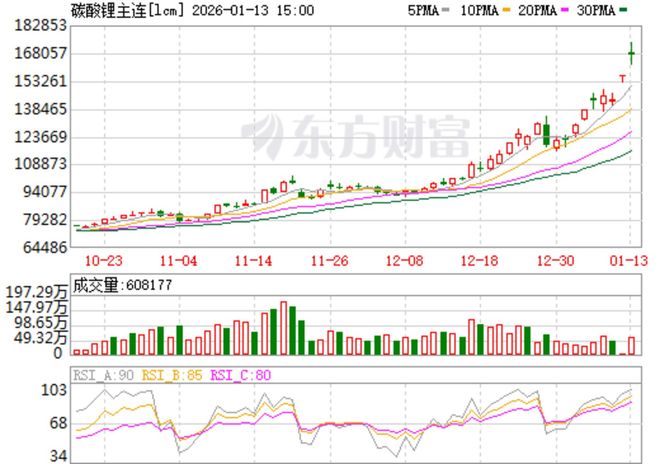
碳酸锂冲破17万:这不是行情,是一次再定价
Tai Mei Ti A P P· 2026-01-13 09:55
Core Viewpoint - The lithium carbonate futures price has surpassed 170,000 yuan/ton, indicating a shift in market dynamics and the formation of a new price anchor, as the market tests a new price range after a significant increase [1][3]. Group 1: Price Dynamics - The recent price surge reflects a transition from cash cost and current supply-demand dynamics to a focus on supply realization probability, inventory positioning, and demand concentration [3]. - The price increase from 130,000 to 170,000 yuan/ton represents a second phase of tight balance, where the key variables influencing price are no longer just quantity differences but also the certainty of supply and timing of demand [4]. - The upward movement in price is supported by a shift in inventory from high levels to sensitive ranges, where any uncertainty in supply triggers restocking, leading to a preemptive tightening of the market [4][6]. Group 2: Supply Chain Changes - The supply side's credibility has diminished due to multiple upstream production cuts and maintenance events, making the market more sensitive to supply stability [8]. - Regulatory pressures regarding resource development and environmental compliance have increased, altering market expectations for supply elasticity [8]. - In a tight balance, changes in quantity dictate direction, while changes in certainty dictate slope, emphasizing the importance of reliable supply in price determination [8]. Group 3: Demand Dynamics - The demand structure is evolving, with significant contributions from energy storage, which introduces more concentrated and project-based purchasing patterns, leading to sharp demand spikes [9]. - Anticipated adjustments to tax policies related to battery exports may shift order placements and production schedules, increasing short-term demand concentration [9][10]. Group 4: Pricing Mechanisms - The combination of declining supply certainty and demand pulses amplifies effects in the futures market, leading to increased volatility and rapid price fluctuations [11]. - The market is not merely reacting to current supply changes but is also pricing in future expectations, indicating a potential formation of a new consensus price range [11]. Group 5: Profit Distribution and Market Anxiety - The re-pricing process favors companies with stable, low-cost production capabilities, as they benefit more directly from price increases [12]. - Midstream lithium salt companies face greater differentiation based on their raw material stability and cash flow management, with high-cost firms potentially experiencing cash flow issues despite improved profit margins [12]. - Downstream sectors, including materials and battery integration, are under pressure due to mismatches between rapidly changing input costs and slower revenue recognition [12]. Group 6: Future Outlook - The next 3 to 6 months are likely to see high-level fluctuations, contingent on intermittent supply disruptions and sustained energy storage demand [13]. - If supply exceeds expectations or downstream pricing resistance becomes evident, prices may experience a quicker retraction [13][15]. - The upward price movement is not limitless, as increased production incentives may lead to a return of supply elasticity, potentially compressing price ceilings [13][16]. Group 7: Pathways and Triggers - Monitoring inventory depletion is crucial; if prices rise alongside inventory reduction, it indicates solid fundamental support [15]. - Observing the rebound in lithium salt production and its impact on inventory replenishment will be key to understanding price pressures [15]. - The relationship between concentrate and lithium salt pricing will help determine whether the current price increase is driven by demand or cost pressures [15].

【广发宏观郭磊】继续改善的价格弹性
郭磊宏观茶座· 2026-01-09 13:45
Core Viewpoint - The article discusses the trends in CPI and PPI for December 2025, highlighting a month-on-month increase of 0.2% for both indices, with PPI marking its fifth consecutive month of positive growth. Year-on-year, CPI and PPI are reported at 0.8% and -1.9%, respectively, exceeding previous model predictions [1][4]. CPI Analysis - The month-on-month CPI increase of 0.2% is attributed to various sectors, with negative growth observed in pork, alcoholic beverages, rent, fuel, and traditional Chinese medicine. Positive growth is noted in fresh vegetables, fruits, medical services, gold jewelry, and durable goods [6][7]. - Durable goods prices showed significant improvement, particularly in household appliances, which saw a historical high month-on-month increase of 1.4% in December, likely influenced by seasonal factors and PPI transmission [6][8]. - Transportation tools experienced a month-on-month increase of 0.1%, above the ten-year average of -0.15%, possibly due to stabilization in car prices amid a "de-involution" context [6][8]. PPI Analysis - The month-on-month PPI increase of 0.2% is driven by a 0.8% rise in the mining industry, marking its fifth consecutive month of positive growth. Raw materials and processing industries also saw increases of 0.6% and 0.2%, respectively, the fastest rates of the year [2][9]. - In the living goods category, while food and durable goods continued to show negative growth, clothing and general daily necessities recorded increases of 0.2% and 0.5%, respectively, marking the second-highest points of the year [2][9]. - Specific industries showed price differentiation, with rising prices in coal mining and processing, contributing significantly to PPI growth. Additionally, prices in lithium-ion battery manufacturing and cement production increased by 1.0% and 0.5%, respectively [10][9]. Future Outlook - The article suggests that the simulated deflation index is expected to rise gradually after hitting a low in July 2025, correlating with the timing of increased "de-involution" efforts. The central economic work conference indicates that addressing "involution" will be a key focus for 2026 [3][11]. - Historical economic cycles indicate that periods of nominal growth elasticity, such as 2006-2007 and 2010-2011, are characterized by strong internal demand stimulation. The outlook for 2026 suggests potential benefits from external demand due to fiscal expansions in developed economies and industrialization in developing countries [3][11].
