社会学中国化

Search documents
京报读书|本周书单来了!留言送苏童新作《好天气》
Xin Lang Cai Jing· 2026-01-10 05:02
Group 1 - The core viewpoint of the article is the release of Su Tong's new novel "Good Weather," which took 11 years to complete and reflects the social transformation during the early reform and opening-up period in China [7] - The novel focuses on the fate of two families across three generations in the southern urban-rural junction of "Xianshui Pond," showcasing the intertwining of personal and societal narratives [7] - Su Tong employs a magical realism style, using vivid imagery and absurd elements to explore themes of resilience and the human experience, encapsulated in the phrase "no matter how much rain and wind life brings, one can always wait for good weather" [7] Group 2 - "Good Weather" is included in the "14th Five-Year Plan" for key publications and the China Writers Association's New Era Literary Climbing Plan, indicating its cultural significance [7] - The novel has received high praise from notable literary figures such as Yu Hua and Mo Yan, who commend Su Tong's delicate writing and ability to capture emotional depth [7] - The book has resonated with readers, being described as a summary of the author's perspective on the world, transforming individual family struggles into a romantic narrative [7]


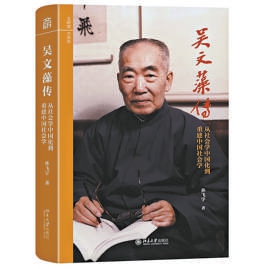
吴文藻:社会学中国化的践行者
Xin Lang Cai Jing· 2025-12-25 23:32
Core Viewpoint - The biography "Wu Wenzao: From the Sinicization of Sociology to the Reconstruction of Chinese Sociology" by Sun Feiyu fills a gap in the understanding of Wu Wenzao's contributions to Chinese sociology and highlights the early development of the discipline in China [3][4]. Group 1: Early Academic Journey - Wu Wenzao began his academic journey at Tsinghua University at the age of 15 and later pursued further studies in sociology and anthropology at Dartmouth College and Columbia University, where he was influenced by Franz Boas' cultural relativism and fieldwork methods [3][4]. - He earned his Ph.D. in 1928 and became prominent in the international academic community, driven by a belief in adapting sociology to fit Chinese contexts [3][4]. Group 2: Advocacy for Sinicization of Sociology - Upon returning to China, Wu Wenzao advocated for the "Sinicization of Sociology," emphasizing the need for sociology to address local issues rather than relying solely on Western theories [4]. - He initiated teaching reforms at Yenching University, opting to teach in Chinese instead of English, which was a significant shift in the academic landscape at the time [4]. Group 3: Contributions During Turbulent Times - The outbreak of the Second Sino-Japanese War disrupted Wu Wenzao's academic plans, but he continued to contribute by establishing a sociology department at Yunnan University and promoting research that addressed local societal needs [5]. - He faced challenges in Yunnan due to ideological differences but remained committed to education and research, even while transitioning into political roles in Chongqing [5]. Group 4: Post-War Contributions and Challenges - After World War II, Wu Wenzao served as a political advisor in Japan and later returned to China to focus on ethnic studies, contributing significantly to the training of professionals in this field [6]. - The suppression of sociology in China for over two decades did not deter him; he continued to engage with international theories and contributed to academic publications [6]. Group 5: Revival of Sociology in China - With the onset of the reform and opening-up period, Wu Wenzao played a crucial role in revitalizing sociology, integrating contemporary issues such as environmental protection and post-industrial society into the discipline [6][7]. - His efforts in promoting international academic exchanges helped bridge Chinese sociology with global perspectives, enhancing its relevance and impact [7].
湃书单|澎湃新闻编辑们在读的13本书:工资的真相
Xin Lang Cai Jing· 2025-11-15 09:08
Group 1 - The core argument of the article revolves around the systemic unfairness in the modern American labor market, particularly focusing on low wages and the factors influencing wage determination [5][6][9] - The author critiques traditional economic theories that link wages directly to risk or productivity, arguing that this assumption does not hold true in practice [6][9] - The book discusses how employers maintain low wages through policies like salary secrecy and non-compete agreements, which limit employees' bargaining power [6][9] Group 2 - The author identifies key factors in wage determination, including power dynamics, inertia, imitation, and fairness, which challenge mainstream human capital and job theories [6][9] - The analysis highlights the role of weakened unions and the shareholder primacy ideology in contributing to wage stagnation and widening income inequality in the U.S. [6][9] - The book suggests that the current plight of American workers is not coincidental but rather a result of carefully designed systemic forces [8][9] Group 3 - The author proposes comprehensive reform ideas aimed at raising minimum wages, expanding the middle class, and limiting elite incomes, which face significant political resistance in a weakened union environment [9] - The discussion includes the importance of understanding organizational performance metrics and the underlying power intentions rather than blindly accepting them [7][9] - The book emphasizes the need for workers to critically assess the performance indicators set by organizations to recognize the power dynamics at play [9]