私募信息泄露

Search documents
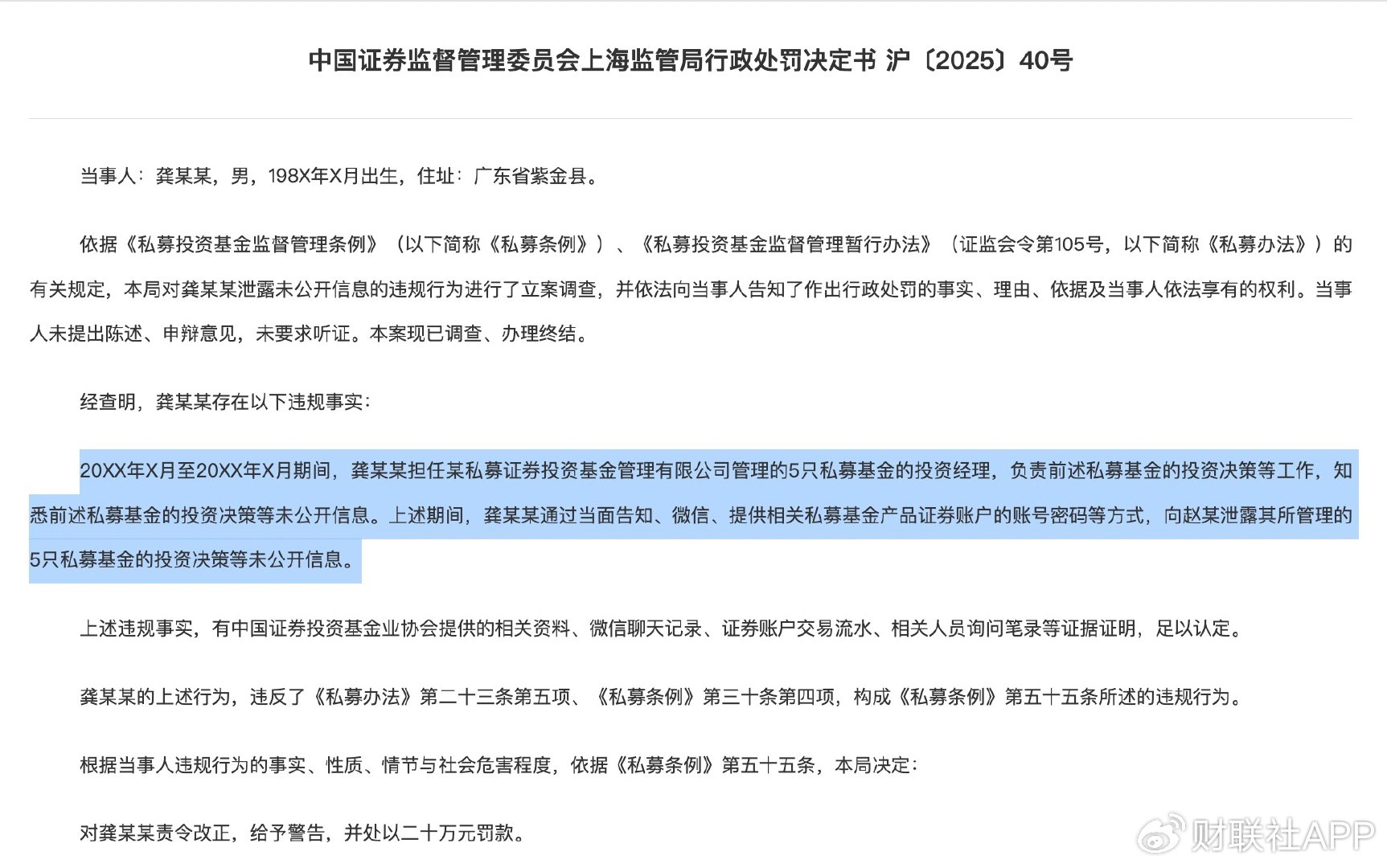
私募基金经理外泄账户密码,买啥卖啥告诉朋友,被证监局罚20万
Mei Ri Jing Ji Xin Wen· 2025-12-14 23:00
Core Viewpoint - Recent incidents of information leakage in the private equity sector have raised concerns about compliance and regulatory oversight in the industry [1] Group 1: Regulatory Actions - The Shanghai Securities Regulatory Bureau has recently penalized an individual, Gong, for leaking undisclosed information, imposing a fine of 200,000 yuan [2] - In July, the bureau issued fines totaling 500,000 yuan to three private equity managers for similar information leakage violations, highlighting a trend of regulatory scrutiny in the sector [4] - The penalties were issued without disclosing the identities of the private equity firms involved, making it difficult to ascertain if the individuals were from the same firm [4] Group 2: Patterns of Information Leakage - Private equity managers have emerged as a high-risk group for information leakage, with multiple cases reported in recent years [4] - Specific individuals, such as Zhang, Chen, and Xu, were found to have disclosed investment decisions and other undisclosed information during their tenure as investment managers [4][5] - Xu was noted for having worked at two different private equity firms, where he was responsible for investment decisions and also leaked sensitive information [5]

私募基金经理外泄账户密码,买啥卖啥告诉朋友
财联社· 2025-12-14 14:30
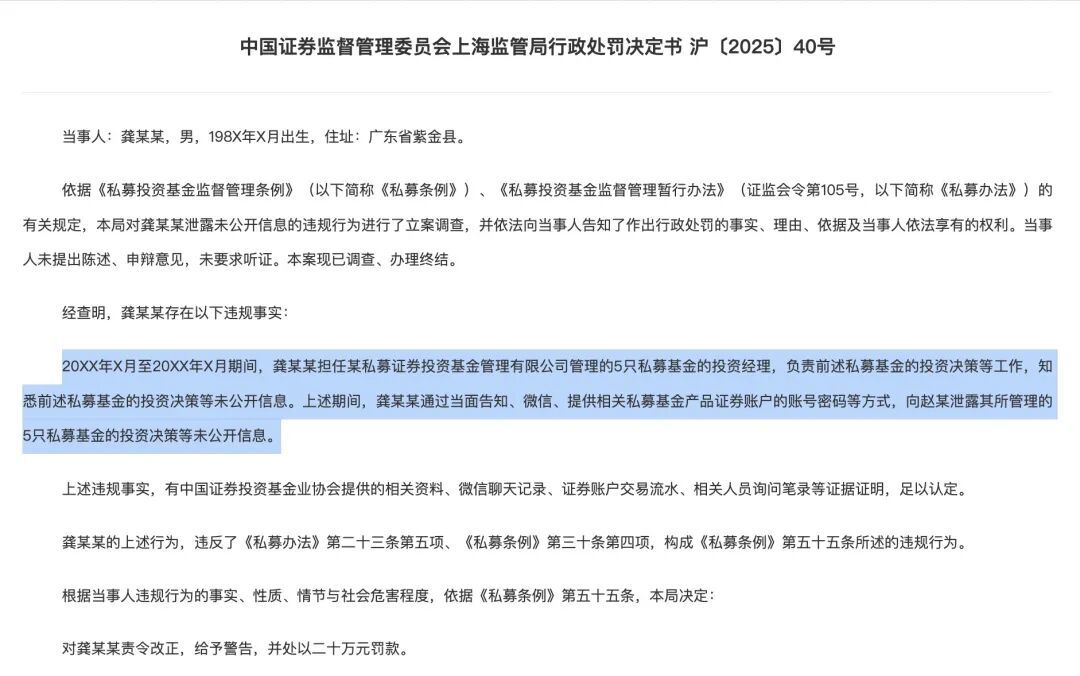
Core Viewpoint - The article highlights the increasing challenges in risk control within the private equity industry, exacerbated by frequent information leakage incidents and the digital transformation of the sector [1]. Group 1: Information Leakage Incidents - The Shanghai Securities Regulatory Bureau has issued penalties for information leakage, including a fine of 200,000 yuan against an individual for disclosing non-public investment decisions of five private equity funds [2]. - Multiple private equity managers have been penalized for similar violations, with three managers fined 500,000 yuan each in July for leaking non-public information [4][7]. - The trend of information leakage is shifting from traditional investment roles to IT and operational positions, which have access to core data, making it harder to control risks [5][11]. Group 2: Regulatory Actions and Penalties - The regulatory authorities have intensified penalties for private equity professionals involved in information leakage and illegal trading, with significant fines imposed on individuals for utilizing non-public information for trading [9][12]. - A notable case involved an IT personnel who was fined 17.7 million yuan for trading based on non-public information, highlighting the severity of penalties for such violations [12]. - The regulatory environment is becoming stricter, with increased scrutiny on non-traditional roles that have access to sensitive information, indicating a shift in focus for compliance efforts [11][13]. Group 3: Risk Control Measures - Industry experts emphasize the need for private equity firms to establish strict information barriers and control measures to prevent unauthorized access to sensitive information [6]. - The article suggests implementing physical isolation, network access controls, and monitoring systems to ensure compliance with the principle of "least privilege" [6]. - The risk of information leakage is compounded by the presence of intermediaries in non-investment roles, which complicates the tracking and prevention of such incidents [5][11].

奇葩操作!私募基金经理外泄账户密码,买啥卖啥告诉朋友
Xin Lang Cai Jing· 2025-12-14 14:07
Core Viewpoint - The increasing frequency of information leakage incidents in the private equity sector, coupled with new risk control challenges brought about by digital transformation, highlights significant shortcomings in industry risk management [1][3][11]. Group 1: Regulatory Actions - The Shanghai Securities Regulatory Bureau has issued fines for information leakage, including a recent case where an individual was fined 200,000 yuan for leaking non-public information related to five private equity products [1][14]. - In July, three private equity investment managers were fined 500,000 yuan each for similar violations, indicating a trend of heightened regulatory scrutiny in the sector [3][18]. - The regulatory body has noted that private equity investment managers have become a high-risk group for information leakage, with multiple cases of non-compliance being reported [3][22]. Group 2: Digital Transformation and Risk Management - The digital transformation of the asset management industry has led to a shift in the sources of information leakage, moving from traditional investment roles to IT, risk control, and operational positions that have access to core data [3][11]. - Non-investment staff in private equity and related institutions may act as "intermediary hubs" for leaking non-public information, complicating risk management efforts [3][11][12]. - The complexity of information transmission chains and the difficulty in tracing leaks have been identified as significant challenges for regulatory and institutional risk management [3][11]. Group 3: Recommendations for Improvement - Industry experts emphasize the need for private equity firms to establish strict information barriers, clearly defining access to core information and implementing advanced monitoring and approval processes for access requests [4][17]. - The adoption of technical measures such as physical isolation, network permission control, and system log monitoring is recommended to ensure compliance with the "least privilege" principle [4][17]. Group 4: Case Studies of Violations - Numerous cases have emerged where private equity insiders have used their positions to engage in insider trading, resulting in significant fines and penalties [6][21]. - For instance, an investment manager was fined a total of 601,400 yuan for utilizing non-public information for trading, showcasing the serious consequences of such violations [6][20]. - The trend of increasing penalties for violations indicates a growing commitment from regulatory bodies to enforce compliance and protect market integrity [8][22].