种质创新

Search documents
(乡村行·看振兴)浙江湖州:沼虾出苗迎高峰 科技助力渔业丰收
Xin Lang Cai Jing· 2026-01-01 09:28
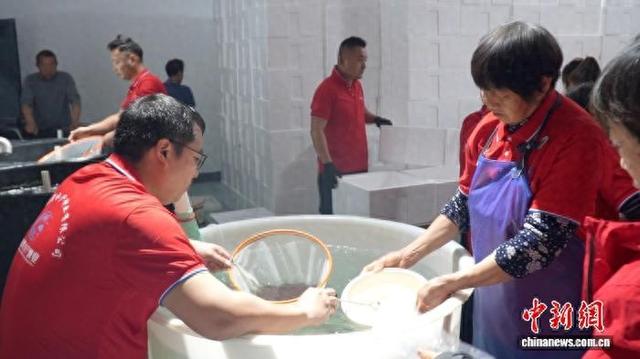
Core Viewpoint - The article highlights the booming production of high-quality shrimp seedlings in Huzhou, Zhejiang Province, driven by technological advancements and increased market demand for the shrimp industry. Group 1: Production and Technology - The shrimp seedling base in Huzhou can produce up to 7 million seedlings daily, primarily supplying regions like Xiamen and Guangdong [3] - The annual seedling supply from Huzhou accounts for nearly half of the national total, with an annual production exceeding 20 billion seedlings and a market value of 700 million RMB [3] - Technological innovations have significantly reduced the time required for counting seedlings from over 20 minutes to about 10 seconds [3] Group 2: Industry Development - Huzhou is recognized as a key distribution center for Chinese shrimp seedlings, with the local industry benefiting from the introduction of new shrimp varieties that are larger, more disease-resistant, and more profitable [3] - The "Nantaihu No. 3" shrimp seedlings developed by the Zhejiang Freshwater Aquatic Research Institute are being widely cultivated in various regions, addressing issues of slow growth and low survival rates [3] - The demand for shrimp is increasing, leading to an extension of the seedling supply period, which is now expected to last until June 2026 [5] Group 3: Infrastructure and Quality Control - The production facilities utilize artificially adjusted seawater and maintain a stable water temperature of around 31°C, enhancing overall production quality [5] - The establishment of nearly 100 seedling enterprises in Huzhou has effectively empowered the industry, contributing to the local economy and agricultural development [5]

农业新质生产力 绘就粮仓新图景|黑土珍味多佳品 寒地浆果产业兴
Xin Lang Cai Jing· 2025-12-24 22:54
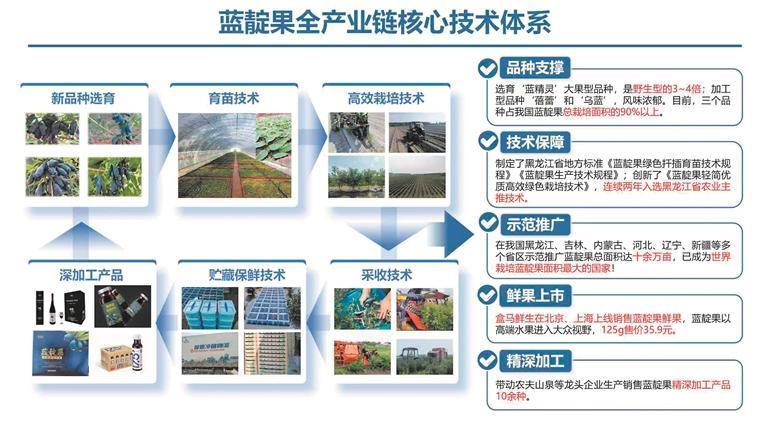
Core Viewpoint - The article highlights the development and commercialization of cold-climate berry agriculture in Heilongjiang Province, emphasizing the successful cultivation, innovation, and market entry of various berry species, particularly the blue honeysuckle and its new varieties. Group 1: Berry Cultivation and Resources - Heilongjiang Province is positioned in the world's northern latitude "golden berry belt," making it the largest area for cold-climate berry cultivation in China, with significant advantages in land, climate, and ecology [20] - The province has established a modern agricultural technology innovation system for cold-climate berries, achieving breakthroughs in germplasm innovation, cultivation techniques, and rural revitalization [20][21] - The province maintains the largest germplasm resource banks for blue honeysuckle and currants in China, with over 300 and 200 germplasm resources respectively, and has developed numerous new varieties with strong cold resistance and high yield [21][23] Group 2: Technological Innovations - The province's cold-climate berry system has formed cross-disciplinary research teams to address cultivation, seedling, harvesting, preservation, and processing challenges, leading to a series of innovative results with independent intellectual property rights [24] - Efficient cultivation techniques have been developed, increasing the marketable fruit rate by 23% and improving overall economic benefits by 24% [24] - New preservation technologies have extended the shelf life of berries from 10 days to 90 days, addressing the short shelf life issue that has hindered market access [25] Group 3: Market Entry and Product Development - Blue honeysuckle has recently entered high-end markets, with fresh fruit being sold at 35.9 yuan for 125 grams in Beijing's Hema Fresh, marking a significant step for the industry [28] - The new varieties "Blue Elf" and "Black Blue" have gained recognition, with "Blue Elf" topping the berry price list in Shanghai and achieving a 165% increase in sales [28] - The province has attracted major companies like Nongfu Spring to participate in the blue honeysuckle processing sector, enhancing product offerings and market presence [28] Group 4: Rural Revitalization and Economic Impact - The cold-climate berry system supports rural revitalization by establishing a model that integrates government guidance, system support, cooperative promotion, and farmer participation, leading to increased income for local farmers [29] - In Qiqihar City, raspberry cultivation has generated significant income for local residents, with projected earnings of nearly 639 million yuan from raspberry harvesting [30] - The province's focus on high-quality sea buckthorn production has resulted in over 80,000 acres of cultivation, contributing to local economic development and recognition as a geographical indication product [31]
河南葡萄的甜蜜叙事
He Nan Ri Bao· 2025-08-13 23:34
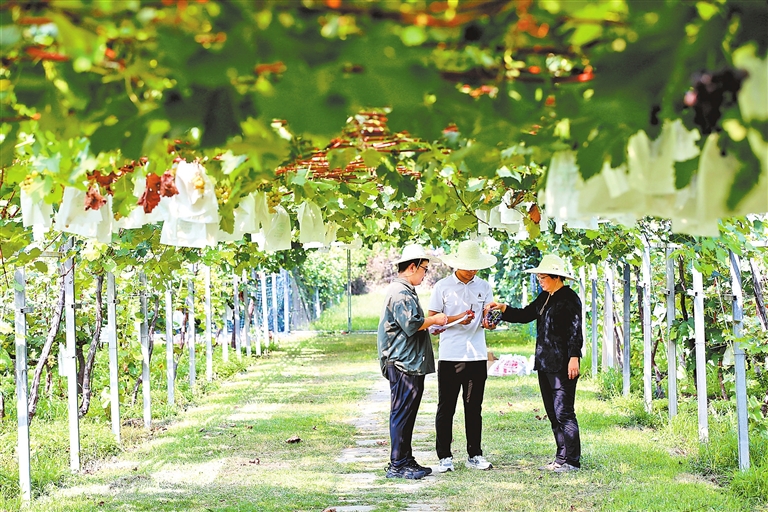
Core Viewpoint - The decline in the price and quality of "Sunshine Rose" grapes in Henan is attributed to uncontrolled expansion and increased production leading to a drop in quality, with consumers reporting poor taste and lack of aroma [1][4][7]. Industry Overview - Henan has rapidly developed its grape industry, with production increasing from approximately 150,000 tons in 2000 to an estimated 905,000 tons by 2024, over half of which is "Sunshine Rose" [1]. - The planting area for "Sunshine Rose" exceeded 600,000 acres nationwide by 2020 and is projected to reach over 1.5 million acres by the end of 2024, with Henan alone accounting for 150,000 acres [7]. Market Dynamics - The price of "Sunshine Rose" grapes has significantly decreased, with local prices dropping to as low as 3.98 yuan per pound, compared to 40 yuan per pound three years ago [2][3]. - The market is experiencing a stratification phenomenon, where high-quality grapes can still command prices of 22.9 yuan per pound, while lower quality grapes struggle to sell [2][6]. Quality Issues - The decline in quality is linked to excessive production, with many farmers pushing yields to 7,000-10,000 pounds per acre, which negatively impacts the taste and aroma of the grapes [7]. - Consumers have reported that the grapes have lost their characteristic "rose fragrance," indicating a direct correlation between production practices and quality [4][7]. Innovation and Future Prospects - The introduction of new grape varieties, such as "Zhongpu Meiying," which boasts high quality and early maturity, is seen as a potential solution to the current market challenges [12][15]. - The "Zhongpu Meiying" variety, developed from a combination of "Sunshine Rose" and "Early Agate," has shown promising characteristics, including a sugar content of 21% and strong market interest [12][15]. Research and Development - The National Grape Germplasm Resource Nursery in Zhengzhou houses over 2,100 grape varieties, serving as a critical resource for breeding and innovation in the grape industry [10][11]. - The research team has developed a "South-South Grape Breeding Model," allowing for rapid breeding cycles and the introduction of new varieties to the market [11].