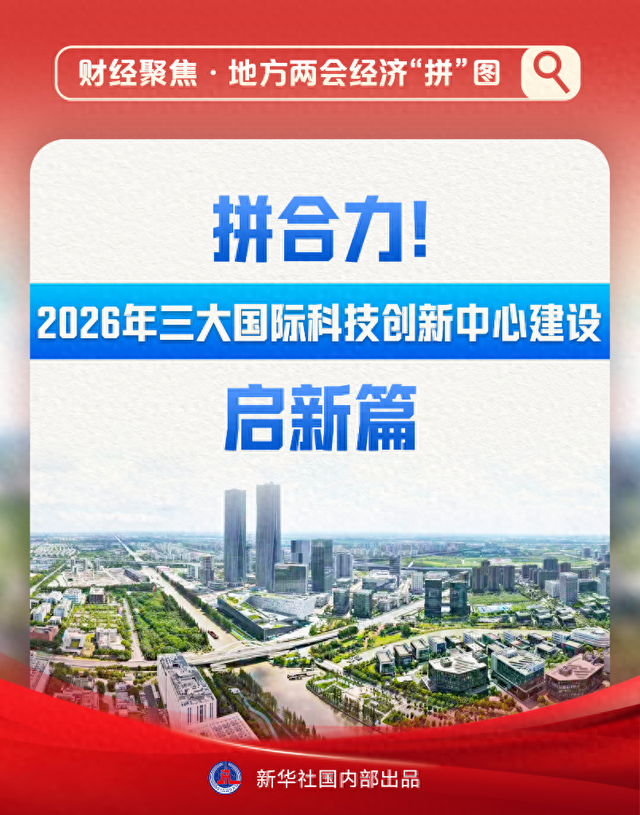
科产创新跨区域协同

Search documents
财经聚焦·地方两会经济“拼”图|拼合力!2026年三大国际科技创新中心建设启新篇
Xin Hua She· 2026-02-08 16:23
Core Viewpoint - The construction of three international technology innovation centers in Beijing (Jing-Jin-Ji), Shanghai (Yangtze River Delta), and the Guangdong-Hong Kong-Macao Greater Bay Area is set to enhance collaborative innovation and release innovation momentum across these regions [1][2][4]. Group 1: Jing-Jin-Ji Region - The three regions (Beijing, Tianjin, and Hebei) are focusing on their unique roles in the international technology innovation center, with Beijing as the source of original innovation, Tianjin as a manufacturing hub, and Hebei as a space for technology transfer [2][3]. - Specific initiatives for 2026 include enhancing the development of the Xiong'an New Area and establishing a talent innovation corridor between Beijing and Xiong'an [2]. - Tianjin plans to improve its innovation service ecosystem and establish 20 joint laboratories with universities [2]. Group 2: Yangtze River Delta - The Yangtze River Delta is emphasizing cross-regional collaboration in technology and industry innovation, with Shanghai facing challenges such as limited development space and high costs [4][5]. - Shanghai's government report highlights the need for a collaborative mechanism to facilitate the flow of talent, capital, and technology across regions [4]. - Anhui province aims to align with the Shanghai international technology innovation center, focusing on sectors like new energy vehicles and artificial intelligence [5]. Group 3: Guangdong-Hong Kong-Macao Greater Bay Area - The Greater Bay Area is recognized for its high level of openness and innovation, with plans to create a globally influential industrial technology innovation center by 2026 [6][7]. - The region has established numerous key laboratories and research institutions, enhancing its collaborative innovation capabilities [6]. - Guangdong aims to leverage its manufacturing base and international resources to support technological upgrades and transformation of traditional industries [7].
拼合力!2026年三大国际科技创新中心建设启新篇
Bei Jing Ri Bao Ke Hu Duan· 2026-02-08 12:06
Group 1: Beijing-Tianjin-Hebei Region - The Beijing-Tianjin-Hebei region aims to establish an international technology innovation center, focusing on collaborative innovation and enhancing the efficiency of technology transfer [2][3] - Beijing will strengthen industrial linkages and improve the conversion efficiency of technological achievements, while Tianjin will leverage its high-end manufacturing capabilities [3] - Hebei will participate actively in the construction of the innovation center, focusing on becoming a preferred location for technology achievement trials [3] Group 2: Yangtze River Delta - The Yangtze River Delta, particularly Shanghai, faces challenges such as limited development space and high factor costs, necessitating cross-regional collaboration in technology and industry innovation [6][8] - Shanghai's government emphasizes the need for a collaborative mechanism to facilitate the flow of talent, capital, and technology across regions [6] - Anhui province plans to implement a construction scheme for the Shanghai international technology innovation center, focusing on sectors like new energy vehicles and artificial intelligence [8][9] Group 3: Guangdong-Hong Kong-Macau Greater Bay Area - The Greater Bay Area is recognized as one of the most open and economically vibrant regions in China, with a strong focus on building a globally influential industrial technology innovation center [9][10] - The region has attracted numerous key laboratories and research institutions, enhancing its innovation capabilities [10] - Guangdong province aims to leverage its manufacturing base and international resources to empower small and medium-sized enterprises through technological innovation [10][12]