
科学发现(Scientific Discovery)

Search documents
顶尖模型离“科学家”还差得远?AI4S亟待迈向2.0时代
机器之心· 2026-01-30 10:43
Core Insights - The article discusses the transition from AI for Science (AI4S) to AGI for Science (AGI4S), emphasizing the need for a specialized generalist model to enhance scientific discovery and reasoning capabilities [1][2][71]. Group 1: Current State of AI in Science - AI for Science, exemplified by AlphaFold, has achieved significant milestones in specific fields like protein folding and weather prediction, but reliance on existing deep learning models may limit the exploration of new knowledge and hinder innovation [1][71]. - A systematic evaluation involving 100 scientists from 10 different scientific fields revealed that cutting-edge models scored 50 out of 100 in general scientific reasoning tasks, but dropped to scores between 15 and 30 in specialized reasoning tasks [1][71]. Group 2: The Need for AGI4S - The transition from AI4S 1.0 to AGI4S 2.0 is necessary to integrate general reasoning with specialized capabilities, addressing the limitations of current models in scientific discovery [2][71]. - The concept of "Specialized Generalist" is proposed as a feasible path to achieve AGI, which combines deep specialization with general capabilities [2][90]. Group 3: Technological Framework - SAGE - The "SAGE" architecture is introduced as a synergistic framework for developing generalizable experts, consisting of three layers: foundational, collaborative, and evolutionary [3][18]. - The foundational layer focuses on decoupling knowledge and reasoning capabilities, while the collaborative layer employs reinforcement learning to balance intuitive and logical reasoning [27][28]. - The evolutionary layer aims to enable self-evolution of models through continuous interaction and feedback, addressing the challenges of adapting to complex tasks [55][56]. Group 4: Innovations in Reinforcement Learning - The article highlights the development of the PRIME algorithm, which provides dense rewards for reinforcement learning without the need for extensive manual labeling, significantly improving model performance [38][39]. - FlowRL is introduced to enhance the diversity of reasoning paths in models, allowing them to explore multiple solutions rather than converging on a single answer [47][50]. Group 5: Applications and Case Studies - The Intern-S1 model is designed to be a deep specialized generalist for scientific applications, demonstrating superior performance in various scientific domains compared to existing models [77][79]. - The Intern-Discovery platform integrates the Intern-S1 model with extensive data and tools, facilitating a closed-loop system for hypothesis generation and experimental validation [80][84]. Group 6: Future Directions - The article calls for collaboration among researchers to fill the gaps in the current framework and advance the development of AGI4S, emphasizing the potential for AI to revolutionize scientific research [89][90].

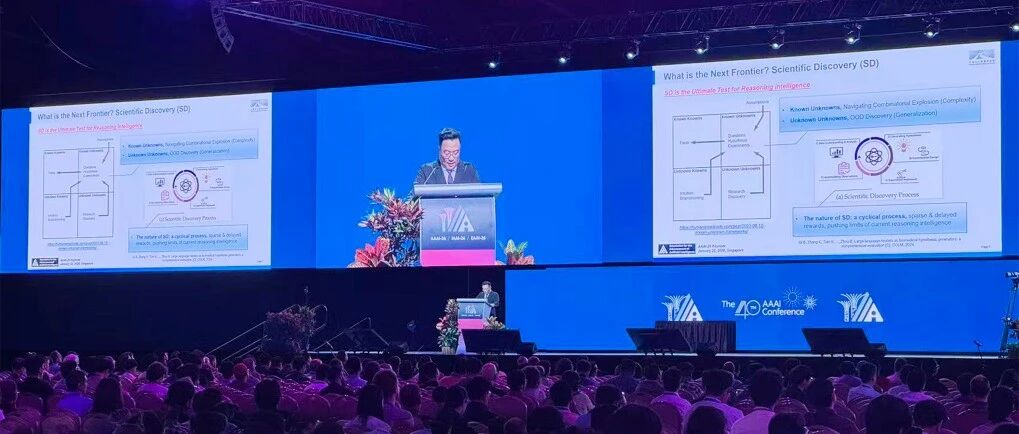
周伯文:缺乏专业推理能力是当下前沿模型的一大短板
Xin Lang Cai Jing· 2026-01-28 10:32
Core Insights - The next frontier for AI is scientific discovery, where large-scale deep reasoning will empower scientific advancements, and scientific discoveries will, in turn, enhance reasoning capabilities [1][4] - The transition from AI for Science (AI4S) to AGI for Science (AGI4S) is essential for achieving a more integrated form of intelligence that combines general and specialized capabilities [1][6] Group 1: AI Development Stages - AI development is not linear but exhibits distinct stages, with the current focus on transitioning from narrow AI (ANI) to general AI (AGI) through broad AI (ABI) [2][3] - The emergence of ChatGPT has validated the transition to the ABI stage, demonstrating significant advancements in self-supervised learning and generative models [2][3] Group 2: Challenges in Scientific Discovery - Scientific discovery presents three major challenges for AI: known unknowns, unknown unknowns, and sparse/delayed rewards, which test the limits of current AI models [4][5] - Over-reliance on existing deep learning models may hinder the exploration of new knowledge and innovation in scientific fields [4][5] Group 3: Need for Integration of General and Specialized Intelligence - There is a critical need to integrate general reasoning with specialized capabilities to enhance the effectiveness of scientific discovery processes [6] - The proposed SAGE technology architecture aims to bridge the gap between broad generalization and deep specialization, facilitating a unified cognitive ecosystem [3][6] Group 4: Future Directions - The evolution from AI4S to AGI4S is seen as a necessary step to foster collaboration among researchers, tools, and research subjects, leading to revolutionary advancements in scientific research [6] - The development of a Specializable Generalist model is identified as a feasible path towards achieving AGI, emphasizing the importance of scalable feedback and continuous learning [6]