
通专融合

Search documents
顶尖模型离“科学家”还差得远?AI4S亟待迈向2.0时代
机器之心· 2026-01-30 10:43
Core Insights - The article discusses the transition from AI for Science (AI4S) to AGI for Science (AGI4S), emphasizing the need for a specialized generalist model to enhance scientific discovery and reasoning capabilities [1][2][71]. Group 1: Current State of AI in Science - AI for Science, exemplified by AlphaFold, has achieved significant milestones in specific fields like protein folding and weather prediction, but reliance on existing deep learning models may limit the exploration of new knowledge and hinder innovation [1][71]. - A systematic evaluation involving 100 scientists from 10 different scientific fields revealed that cutting-edge models scored 50 out of 100 in general scientific reasoning tasks, but dropped to scores between 15 and 30 in specialized reasoning tasks [1][71]. Group 2: The Need for AGI4S - The transition from AI4S 1.0 to AGI4S 2.0 is necessary to integrate general reasoning with specialized capabilities, addressing the limitations of current models in scientific discovery [2][71]. - The concept of "Specialized Generalist" is proposed as a feasible path to achieve AGI, which combines deep specialization with general capabilities [2][90]. Group 3: Technological Framework - SAGE - The "SAGE" architecture is introduced as a synergistic framework for developing generalizable experts, consisting of three layers: foundational, collaborative, and evolutionary [3][18]. - The foundational layer focuses on decoupling knowledge and reasoning capabilities, while the collaborative layer employs reinforcement learning to balance intuitive and logical reasoning [27][28]. - The evolutionary layer aims to enable self-evolution of models through continuous interaction and feedback, addressing the challenges of adapting to complex tasks [55][56]. Group 4: Innovations in Reinforcement Learning - The article highlights the development of the PRIME algorithm, which provides dense rewards for reinforcement learning without the need for extensive manual labeling, significantly improving model performance [38][39]. - FlowRL is introduced to enhance the diversity of reasoning paths in models, allowing them to explore multiple solutions rather than converging on a single answer [47][50]. Group 5: Applications and Case Studies - The Intern-S1 model is designed to be a deep specialized generalist for scientific applications, demonstrating superior performance in various scientific domains compared to existing models [77][79]. - The Intern-Discovery platform integrates the Intern-S1 model with extensive data and tools, facilitating a closed-loop system for hypothesis generation and experimental validation [80][84]. Group 6: Future Directions - The article calls for collaboration among researchers to fill the gaps in the current framework and advance the development of AGI4S, emphasizing the potential for AI to revolutionize scientific research [89][90].

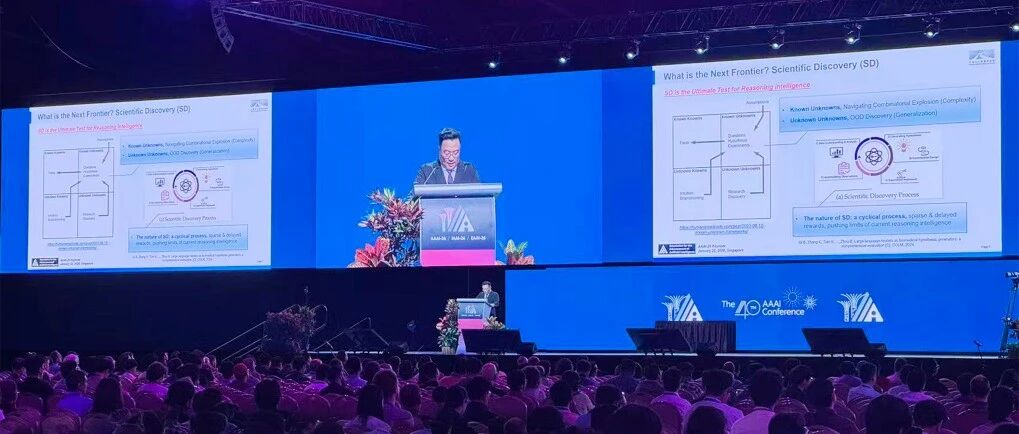
福州大学校长:对于高等教育,人工智能是“东风”
Xin Lang Cai Jing· 2025-12-11 10:21
Core Viewpoint - The article emphasizes that artificial intelligence (AI) is not a threat to higher education but rather an opportunity for transformation, with universities needing to adapt strategically to leverage AI for educational enhancement [1][19][20]. Group 1: AI's Role in Higher Education - AI is viewed as a "restart key" for the professional ecosystem, reshaping job roles rather than merely replacing them [2][10]. - The integration of AI capabilities into traditional disciplines is seen as a strategic necessity for universities aiming to become world-class institutions [2][20]. Group 2: Talent Development Strategies - The university aims to cultivate AI talent that is not only technically proficient but also aligned with national interests and ethical considerations [2][21]. - A systematic approach to curriculum reform is being implemented, focusing on the integration of AI across various disciplines and embedding ethical education within AI-related programs [3][21][22]. Group 3: Curriculum and Program Optimization - The university plans to optimize its undergraduate programs to around 80, enhancing traditional disciplines with AI-related content and creating new interdisciplinary programs [4][22]. - New programs such as "Sustainable Energy" and "Quantum Information Science" are being developed to meet future industry demands [4][22]. Group 4: Innovative Teaching Models - The university is promoting a cross-disciplinary curriculum that includes AI-related courses for all students, fostering a collaborative learning environment [5][23]. - A dual-pathway mechanism is being established to support both academic and industry-focused talent development, ensuring students are equipped to tackle real-world challenges [5][26]. Group 5: Digital Transformation in Education - The university is committed to creating a smart education ecosystem through digital transformation, enhancing personalized learning and teaching effectiveness [6][24]. - A significant number of graduate courses are being taught using smart classrooms, promoting interactive and diverse teaching methods [6][24]. Group 6: Response to Job Market Changes - The university is adapting its professional offerings to respond to the evolving job market, ensuring that traditional programs are enhanced rather than eliminated [10][29]. - The focus is shifting from knowledge transmission to cultivating core competencies that AI cannot easily replicate, such as critical thinking and problem-solving skills [10][18][29].
人工智能如何赋能科学研究(创新谈)
Ren Min Ri Bao· 2025-09-06 21:54
Core Insights - The integration of artificial intelligence (AI) is driving rapid advancements in scientific research, becoming a consensus in the scientific community [1][3] - The Chinese government has outlined six key actions to accelerate the implementation of "AI+" in science and technology, highlighting the importance of AI in various fields such as life sciences, mathematics, and materials science [1][4] Group 1: AI's Role in Scientific Research - AI helps researchers overcome cognitive limitations, formulate better questions, and identify valuable research directions [1][3] - AI optimizes existing research tools and can autonomously create new tools or innovative combinations [1][3] - AI enables researchers to comprehensively examine research subjects, uncovering overlooked potential connections [1][3] Group 2: Challenges and Opportunities - The complexity of scientific discovery has increased, making significant breakthroughs more challenging, often limited by researchers' cognitive levels and knowledge dissemination [2] - The transition from serendipitous discoveries to systematic ones is a critical issue that AI-driven research must address [2] - The emergence of large models in AI has improved generalization capabilities but has also highlighted the need for specialized depth, making "integration of general and specialized knowledge" essential for scientific discovery [2] Group 3: Practical Applications and Innovations - AI can generate cross-disciplinary ideas, assess the value of research hypotheses, and enhance cognitive levels for better scientific questioning [3] - The Shanghai AI Laboratory has developed and open-sourced the "Shusheng" multimodal scientific model, which integrates various scientific data types and has shown promising results in quantum computing and drug development [3] - The platform based on the "Shusheng" model has made advancements in quantum computing, drug research, and polymer chemistry [3] Group 4: Future Implications - AI is expected to play a crucial role in technological innovation and will serve as a significant engine for breakthroughs across disciplines and fields [4] - Accelerating the exploration of AI-driven research paradigms and building application-oriented scientific models will enhance AI's role in achieving high-level scientific breakthroughs [4]
WAIC 2025大黑马,一个「谢耳朵AI」如何用分子式超越Grok-4
机器之心· 2025-07-29 10:31
Core Insights - The article highlights the launch of the Intern-S1 multimodal model by Shanghai AI Laboratory, which is positioned as a leading open-source model in the field of scientific research, showcasing significant advancements in AI for science [5][12][17]. Group 1: Model Capabilities - Intern-S1 is recognized for its superior performance in scientific reasoning tasks, outperforming leading closed-source models like Grok-4, particularly in fields such as chemistry, materials science, and biology [12][17]. - The model integrates a 235 billion parameter MoE language model and a 6 billion vision encoder, trained on 5 trillion tokens, with over 2.5 trillion tokens specifically from scientific domains [25][21]. - Intern-S1 demonstrates a 70% improvement in compression rates for chemical formulas compared to previous models, indicating enhanced efficiency in processing complex scientific data [26]. Group 2: Technological Innovations - The model employs a dynamic tokenizer and temporal signal encoder to effectively handle various complex scientific modalities, addressing challenges posed by data heterogeneity and semantic understanding [26]. - Intern-S1's training costs for reinforcement learning have been reduced by tenfold due to collaborative breakthroughs in system and algorithm optimization [30]. - The model's architecture allows for a unique "cross-modal scientific analysis engine," enabling it to interpret complex scientific data such as chemical structures and seismic signals accurately [16][17]. Group 3: Open Source and Community Engagement - Since its initial release in 2023, the "ShuSheng" model family has been continuously upgraded and expanded, fostering an active open-source community with participation from hundreds of thousands of developers [32][33]. - The Shanghai AI Laboratory has launched a comprehensive open-source toolchain that includes frameworks for data processing, pre-training, fine-tuning, deployment, and evaluation, aimed at lowering barriers for research and application [32]. - The Intern-Discovery platform, based on Intern-S1, has been introduced to enhance collaboration among researchers, tools, and research subjects, promoting a new phase of scientific discovery [6][33].

神州数码董事长郭为: “通专融合”是AI应用落地的重要方向
2 1 Shi Ji Jing Ji Bao Dao· 2025-04-03 11:37
Core Insights - DeepSeek has sparked widespread discussions across various industries regarding the "AI+" movement since the beginning of this year [1] - Digital China (000034) reported a revenue of 29.65 billion yuan from its cloud services and software business, driven by AI, marking an 18.75% year-on-year increase [2] - The overall revenue for Digital China in 2024 reached 128.166 billion yuan, a 7.14% increase, achieving a five-year high [2] Financial Performance - Digital China's net profit decreased by 35.57% to 777 million yuan due to asset impairment related to the International Innovation Center (IIC) [3] - Excluding the negative impact from IIC, the net profit was 1.305 billion yuan, showing positive growth [3] - Revenue from traditional IT distribution and value-added services was 124.451 billion yuan, up 6.84% year-on-year [4] AI Strategy and Developments - AI has become the core of Digital China's cloud integration strategy, with significant investments in AI capabilities [4] - The company launched the Shenzhou KunTai AI-native empowerment platform, reinforcing its position in the AI application sector [5] - Digital China is focusing on process re-engineering and optimization through AI to drive continuous innovation and breakthroughs for enterprises [2][6] Market Trends and Future Outlook - The current phase of AI application is described as the "beginning," with many enterprises yet to fully leverage AI's potential [6] - The integration of AI into business processes is expected to redefine core competitiveness, transitioning from traditional static operations to dynamic systems centered around intelligent agents [6][7] - Future AI applications for enterprises will likely involve heterogeneous computing and the integration of various models, supported by extensive internal data [7]
