
科研领导力

Search documents
中国顶尖科学家数量已超越美国
3 6 Ke· 2025-11-05 01:02
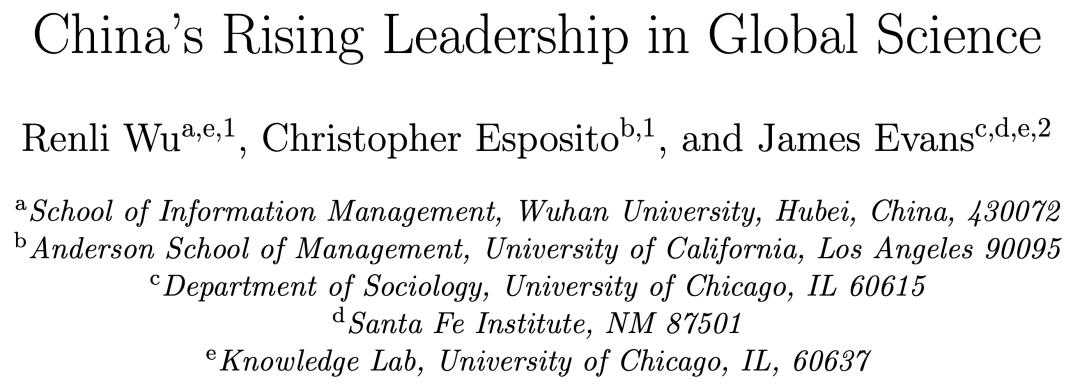
Core Insights - China's research landscape is transitioning from quantity-driven to quality-driven, with a significant increase in leadership roles in international collaborations, particularly with the US and Europe [1][3][5] - The country is rapidly advancing in key technological fields such as artificial intelligence, semiconductors, and quantum technology, narrowing the gap with Western nations [6][10][12] - The "Belt and Road" initiative is enhancing China's global scientific influence by fostering research collaborations and talent development in developing countries [15][17] Group 1: Research Leadership - The proportion of Chinese scientists in leadership roles in US-China collaborative papers has increased from approximately 30% in 2010 to about 45% in 2023, indicating a near doubling of leadership presence [3][5] - Predictions suggest that by 2027, the leadership roles in US-China research collaborations may reach parity, with similar trends expected in collaborations with the EU and the UK [3][5][8] Group 2: Technological Advancements - In eight out of eleven key technology areas defined by the US National Science Foundation, Chinese scientists are expected to match or exceed US leadership roles by 2030 [6][8] - China has become a recognized leader in 5G technology and is making significant strides in semiconductor research despite facing technological barriers [10][12] Group 3: Quality of Research Output - China has surpassed the US in the number of high-impact papers published in top journals like Nature and Science, becoming the largest contributor to high-level research output globally [20][22] - The number of highly cited papers from China has also exceeded that of the US, marking a significant shift in the perception of Chinese research quality [20][22][24] Group 4: International Collaboration and Education - China has invested over 32 billion RMB (approximately 4.5 billion USD) in supporting foreign students to study in China from 2012 to 2024, emphasizing its commitment to developing scientific talent in Belt and Road countries [15][17] - The proportion of foreign students from developing countries in China has increased significantly, indicating a strategic shift towards fostering scientific ties with these nations [15][17] Group 5: Future Outlook - The rise of Chinese scientists in leadership roles and the quality of research output suggests a transformative shift in the global scientific landscape, with potential for increased collaboration and innovation [27][28]

不好美国要捧杀了,新研究:中国正在成为全球科学领导者
3 6 Ke· 2025-10-29 10:26
Core Insights - The article discusses a recent study published in the Proceedings of the National Academy of Sciences, which indicates that China is emerging as a global leader in scientific research, surpassing the United States in certain areas by 2030 [2][4]. Group 1: Research Methodology - The study utilized machine learning models to analyze 6 million research papers, focusing on authorship patterns, corresponding author identities, and institutional influence to assess the "team leader" metric [2][4]. - Researchers defined leadership roles through a three-step process, categorizing scientists into three roles: leaders, direct supporters, and indirect supporters, based on their contributions to research [7][8]. - A scoring system was developed to quantify leadership, assigning scores based on various metrics such as citation counts, publication volume, and institutional ranking [10][11]. Group 2: Key Findings - As of 2023, the proportion of Chinese leaders in Sino-American collaborations has risen to 45%, with predictions indicating that this will equalize with the U.S. by 2027-2028 [14]. - The study predicts that by 2030, China will achieve parity with the U.S. in leadership positions in strategic fields such as AI, semiconductors, energy, and materials science [2][14]. - The research highlights a long-term challenge for China, as it may take until 2087 for China to achieve equal leadership premium compared to the U.S., indicating a disparity in "per capita leadership conversion" [14]. Group 3: Contextual Reactions - The findings have sparked significant discussion in the West, with some commentators expressing concern over the implications for the future of American scientific leadership [16][18]. - The article references recent funding issues faced by prominent scientists in the U.S., suggesting that bureaucratic challenges may hinder innovation and contribute to the shifting landscape of global scientific leadership [18]. Group 4: Author Backgrounds - The study includes contributions from researchers affiliated with Wuhan University and the University of Chicago, indicating a collaborative effort between Chinese and American institutions [19][20][22]. - The authors' research backgrounds span various fields, including information management, regional economic development, and collective knowledge systems, reflecting a diverse expertise in the study [21][22][25].
