稀土发光

Search documents
刚刚,利好传来!新突破!
券商中国· 2025-11-22 09:42
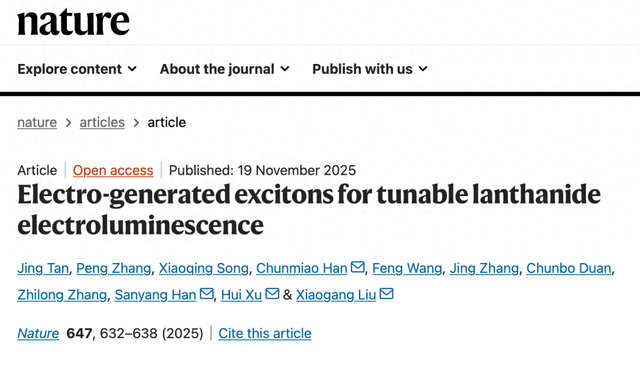
Core Viewpoint - Recent breakthroughs in rare earth research have led to the development of a unique "energy conversion coat" for rare earth nanocrystals, enhancing their application in electroluminescent devices [1][2]. Group 1: Research Breakthroughs - A collaborative team from Tsinghua University, Heilongjiang University, and the National University of Singapore has designed an innovative interface that efficiently transfers energy to rare earth nanocrystals, addressing challenges in electroluminescent device research [1][2]. - The research, titled "Capturing Electric Excitons for Tunable Rare Earth Nanocrystal Electroluminescence," was published in the journal Nature, marking a significant advancement in the field [1]. Group 2: Characteristics and Challenges of Rare Earth Nanocrystals - Rare earth nanocrystals possess advantages such as tunable emission colors, narrow emission spectra, and high stability, making them promising candidates for electroluminescent materials [2]. - However, their insulating properties hinder current injection and transmission, presenting a significant barrier to their application in modern optoelectronic technologies [2]. Group 3: Future Applications - The breakthrough is expected to facilitate the use of rare earth luminescence in flexible displays, near-infrared devices, and potentially in health monitoring, non-invasive testing, and agricultural lighting technologies [3]. Group 4: Market Outlook for Rare Earth Industry - Despite recent market adjustments, brokerage firms remain optimistic about the long-term prospects of the rare earth sector, given China's dominant position in the global rare earth supply chain [4]. - China holds approximately 40% of global rare earth resources and accounts for about 70% of global production, with significant advantages in refining and processing capabilities [4]. Group 5: Demand in Specific Sectors - The rare earth permanent magnet sector is experiencing rapid growth, particularly in the automotive industry, where demand for neodymium-iron-boron magnets is expected to rise significantly due to the increasing production of electric vehicles [5]. - By 2026, global electric vehicle production is projected to exceed 26 million units, leading to a demand for approximately 66,000 tons of neodymium-iron-boron materials [5]. Group 6: Robotics and Future Demand - The demand for high-performance rare earth magnetic materials is also anticipated to surge in the robotics sector, with each humanoid robot requiring 2-3 kg of rare earth permanent magnets [6]. - The market for humanoid robots could reach over 100 million units, further driving the demand for rare earth materials [6]. Group 7: Investment Recommendations - Analysts recommend maintaining a positive outlook on the rare earth magnetic materials industry, citing potential recovery in profitability and valuation for upstream rare earth resource companies as demand increases [7].


清华团队新突破!为稀土穿上“能量转换外衣”
Bei Jing Ri Bao Ke Hu Duan· 2025-11-21 00:31
Core Viewpoint - Rare earth nanocrystals are considered "insulating gems" in luminescent materials, possessing significant luminescent potential but facing limitations in direct electrical activation, which hinders their application in optoelectronic technology [1][3][5]. Group 1: Research Breakthrough - A research team led by Associate Professor Han Sanyang from Tsinghua University Shenzhen International Graduate School has developed a unique "energy conversion cloak" for rare earth nanocrystals, enabling efficient energy transfer to organic molecular interfaces [1][5]. - The research, titled "Electro-generated excitons for tunable lanthanide electroluminescence," was published in Nature, addressing the challenges of electroluminescent devices [2][3]. Group 2: Technical Challenges - Rare earth nanocrystals, despite their advantages such as tunable emission color and high stability, have been hindered by their insulating properties, making it difficult for electric current to be injected and transmitted [3][5]. - The insulating nature of rare earth materials has created a fundamental bottleneck in their research and application in modern optoelectronic technologies [3][5]. Group 3: Innovative Solutions - The research team utilized a hybrid strategy of surface modification to create an energy conversion cloak for lanthanide-doped nanocrystals, successfully addressing the core issues of exciton generation, transport, and injection in electroluminescence [5][7]. - This innovation allows for high color purity and tunable spectra in electroluminescent applications, opening new avenues for the use of rare earth luminescence in flexible displays and near-infrared devices [7][9]. Group 4: Future Applications - The findings not only enhance the application of rare earth materials in flexible displays and near-infrared devices but also hold potential for future applications in health monitoring and agricultural lighting technologies [7][9]. - The research emphasizes the importance of interdisciplinary collaboration, as the team includes members from various backgrounds such as chemistry, biomedicine, and artificial intelligence [12][14].