交叉融合

Search documents
“产教企”协同深耕“交叉融合”育人生态,合力托举汽车强国建设
Zhong Guo Qi Che Bao Wang· 2025-12-04 05:12
Core Viewpoint - The Chinese automotive industry is undergoing a significant transformation, necessitating the cultivation of interdisciplinary innovative talents to support its development towards becoming a strong automotive nation [1][5]. Group 1: Talent Development and Education - The 2025 Automotive Industry Talent Cultivation Forum emphasized the need for collaborative efforts among education, industry, and enterprises to develop innovative talents in the automotive sector [2][15]. - There is a mismatch between the skills and knowledge of students and the demands of the automotive industry, highlighting the need for a reformed talent cultivation system [4][11]. - The forum discussed the importance of integrating artificial intelligence and smart technologies into the curriculum to better prepare students for future industry needs [7][18]. Group 2: Industry Trends and Challenges - The global automotive industry is experiencing profound changes that reshape its technological pathways and competitive landscape, creating new challenges for talent cultivation [6][19]. - The demand for interdisciplinary and composite talents is increasing due to the rapid adoption of intelligent and connected vehicle technologies [7][8]. - The low-altitude economy is emerging as a significant area for talent development, with a reported talent gap exceeding one million in China [8]. Group 3: Collaborative Efforts and Innovations - The forum highlighted the importance of breaking down disciplinary barriers and fostering cross-disciplinary collaboration to build a talent cultivation system that aligns with industry needs [10][12]. - Various universities are actively engaging in partnerships with automotive companies to enhance practical training and curriculum development [12][17]. - The establishment of the "Vehicle Engineering Discipline Development Report" reflects a collaborative effort among multiple stakeholders to address current challenges and propose reforms in the discipline [10][11]. Group 4: Future Directions - The focus for the next five years includes accelerating the development of smart electric vehicle disciplines and establishing relevant standards for talent and professional training [5][11]. - Educational institutions are encouraged to adapt their curricula to meet the evolving demands of the automotive industry, particularly in areas like intelligent driving and electric vehicle technology [16][19]. - The integration of industry feedback into educational practices is essential for creating a responsive and effective talent development ecosystem [13][19].


清华团队新突破!为稀土穿上“能量转换外衣”
Bei Jing Ri Bao Ke Hu Duan· 2025-11-21 00:31
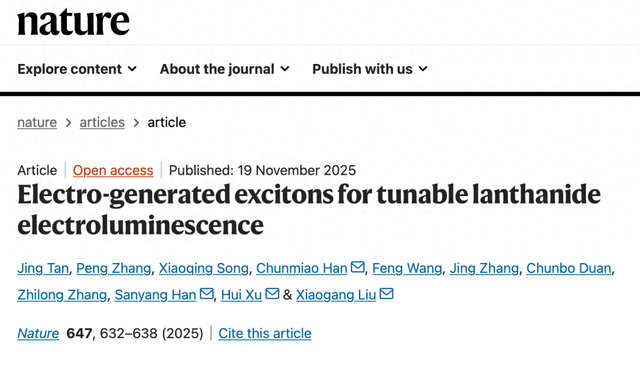
Core Viewpoint - Rare earth nanocrystals are considered "insulating gems" in luminescent materials, possessing significant luminescent potential but facing limitations in direct electrical activation, which hinders their application in optoelectronic technology [1][3][5]. Group 1: Research Breakthrough - A research team led by Associate Professor Han Sanyang from Tsinghua University Shenzhen International Graduate School has developed a unique "energy conversion cloak" for rare earth nanocrystals, enabling efficient energy transfer to organic molecular interfaces [1][5]. - The research, titled "Electro-generated excitons for tunable lanthanide electroluminescence," was published in Nature, addressing the challenges of electroluminescent devices [2][3]. Group 2: Technical Challenges - Rare earth nanocrystals, despite their advantages such as tunable emission color and high stability, have been hindered by their insulating properties, making it difficult for electric current to be injected and transmitted [3][5]. - The insulating nature of rare earth materials has created a fundamental bottleneck in their research and application in modern optoelectronic technologies [3][5]. Group 3: Innovative Solutions - The research team utilized a hybrid strategy of surface modification to create an energy conversion cloak for lanthanide-doped nanocrystals, successfully addressing the core issues of exciton generation, transport, and injection in electroluminescence [5][7]. - This innovation allows for high color purity and tunable spectra in electroluminescent applications, opening new avenues for the use of rare earth luminescence in flexible displays and near-infrared devices [7][9]. Group 4: Future Applications - The findings not only enhance the application of rare earth materials in flexible displays and near-infrared devices but also hold potential for future applications in health monitoring and agricultural lighting technologies [7][9]. - The research emphasizes the importance of interdisciplinary collaboration, as the team includes members from various backgrounds such as chemistry, biomedicine, and artificial intelligence [12][14].
记者手记:在中国科协年会感受学术会议新风
Xin Hua She· 2025-07-31 15:38
Core Insights - The 27th China Association for Science and Technology Annual Conference emphasized a return to academic essence, fostering an environment for open discussions on hot topics and controversial issues [1][2] - The conference featured 98 specialized forums focusing on high-risk, high-reward non-consensus topics that could lead to significant technological breakthroughs [1][2] - A notable shift towards youth engagement was observed, with over half of the 7,000 attendees being under 40 years old, highlighting the increasing role of young researchers in academic discussions [2][4] Group 1 - The conference atmosphere encouraged participants to focus on academic discussions rather than formalities, with traditional elements like red carpets and free giveaways being eliminated [2] - The integration of forums with academic journals provided new opportunities for young scholars to present and refine their research, enhancing the quality of their work [4] - The event facilitated cross-disciplinary collaborations, particularly in discussions surrounding the intersection of psychology and artificial intelligence [1][2] Group 2 - Young researchers took on active roles, such as academic secretaries, allowing them to shape discussions and engage directly with established experts [3][4] - The conference's design aimed to maximize academic intensity by streamlining the agenda and focusing on substantive content [2] - The presence of a significant number of young attendees indicates a generational shift in the academic landscape, with increased participation from emerging scientists [2][4]
本科扩招、文科缩减,顶尖大学的真相是什么?
21世纪经济报道· 2025-03-13 14:03
Core Viewpoint - The article discusses the expansion of high-quality undergraduate programs in China, highlighting the increase in enrollment numbers at top universities while also addressing the reduction of liberal arts programs, suggesting a shift towards interdisciplinary studies and the integration of liberal arts with science and technology [1][2][3]. Group 1: Expansion of Undergraduate Programs - The Chinese government aims to increase the enrollment of "double first-class" universities, with an additional 20,000 students planned for 2025, following a previous increase of 16,000 students [1]. - Tsinghua University and Peking University have announced plans to expand their undergraduate admissions by 150 students each, focusing on fields such as artificial intelligence and clinical medicine [5][6]. - Other 985 universities, including Shanghai Jiao Tong University and Xi'an Jiaotong University, are also expanding their enrollment, with a focus on emerging fields like AI, integrated circuits, and biomedical sciences [5][7]. Group 2: Reduction of Liberal Arts Programs - The trend of reducing liberal arts programs has sparked discussions, with Fudan University's president stating that the proportion of liberal arts admissions will decrease from 30-40% to 20% [2][9]. - Despite the reduction, data from the C9 university alliance indicates that liberal arts programs will not disappear, but rather undergo adjustments to better align with societal needs [9][11]. - The article emphasizes that while liberal arts may face cuts, they still hold significant importance in comprehensive universities, with a substantial number of students and faculty dedicated to these fields [11][13]. Group 3: Interdisciplinary Focus - The article suggests that the future of liberal arts lies in interdisciplinary integration, with universities developing programs that combine liberal arts with science and technology [3][15]. - Examples include Tsinghua University offering cross-disciplinary programs in political economy and creative design, and Fudan University launching new programs like neurolinguistics and data intelligence [18][19]. - The shift towards interdisciplinary studies is seen as a response to the evolving job market and societal demands, indicating a need for graduates who possess a blend of skills from both liberal arts and sciences [16][17].