税收效率

Search documents
Too many investors are forgetting 1 key element of their portfolio strategy. How to make sure you don’t miss out in 2026
Yahoo Finance· 2026-02-03 16:00
Core Insights - The article discusses the importance of tax-efficient investing strategies to maximize after-tax returns and minimize capital gains taxes for investors. Taxation and Income Levels - For the 2025 tax year, capital gains taxes are not applicable for individuals with taxable income at or below $48,350, married couples filing jointly at $96,700, and heads of household at $64,750. Above these thresholds, capital gains are taxed at 15% [1] - For individuals earning above $200,000 or married couples above $250,000, additional tax charges may apply, with the highest rate of 20% affecting those with incomes above $500,000 [6] Contribution Limits and Retirement Accounts - In 2026, the contribution limit for employer-sponsored 401(k) plans will increase to $24,500 from $23,500 in 2025, while the annual IRA contribution limit will rise from $7,000 to $7,500 [3] - Individuals aged 50 and over can contribute an additional $1,100 to their IRAs in 2025, up from $1,000 [2] Tax-Efficient Investment Strategies - Strategy 1 emphasizes maximizing contributions to tax-advantaged accounts first, such as traditional IRAs and Roth accounts, to reduce current taxable income and allow tax-deferred growth [9] - Strategy 2 focuses on asset location, recommending that higher-dividend stocks and interest-generating investments be held in tax-deferred accounts to minimize tax drag [11][12] - Strategy 3 advocates for favoring long-term capital gains by holding investments for over a year to benefit from lower tax rates [13] - Strategy 4 suggests choosing tax-efficient funds and being aware of surprise distributions, as fund structure can significantly impact taxable income [16][18] - Strategy 5 highlights the importance of being intentional about the type of income earned, such as municipal bond interest, which can be tax-exempt at the federal level [19] Implementation and Monitoring - Investors are encouraged to increase contributions to tax-advantaged accounts up to new limits and review their taxable versus protected account holdings to minimize taxable distributions [21] - Monitoring projected annual income is crucial for timing capital gains and other tax-related actions to fit within specific tax brackets [22]
两部门明确:个人每次挣钱低于1000元不用交增值税
Xin Lang Cai Jing· 2026-02-01 13:47
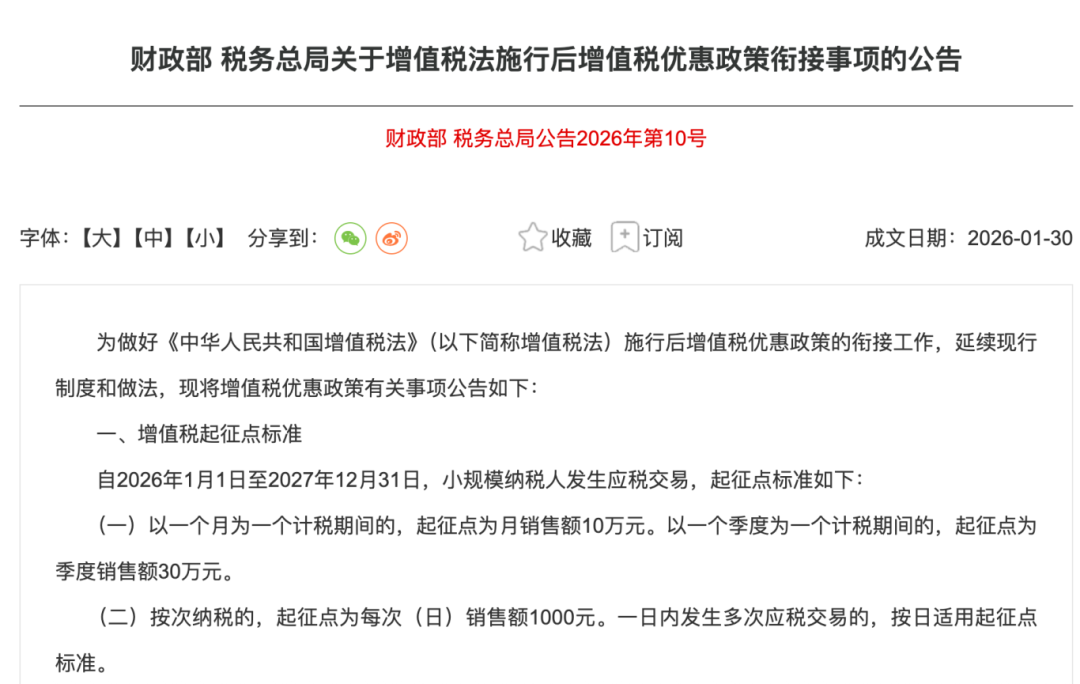
Core Viewpoint - The Ministry of Finance and the State Taxation Administration announced an increase in the value-added tax (VAT) threshold starting from January 1, 2026, aimed at reducing the tax burden on individuals [1][5]. Group 1: VAT Threshold Adjustments - From January 1, 2026, to December 31, 2027, the threshold for small-scale taxpayers will be set as follows: a monthly sales threshold of 100,000 yuan, a quarterly sales threshold of 300,000 yuan, and a per-transaction threshold of 1,000 yuan [4][10]. - Small-scale taxpayers can calculate their sales based on the net amount after deducting relevant costs, which will apply to the new threshold standards [4][10]. Group 2: Benefits for Individuals - The increase in the per-transaction VAT threshold to 1,000 yuan is a significant benefit for individuals, such as freelancers and gig workers, who will not need to pay VAT for services rendered below this amount [5][11]. - The new policy will exempt individuals providing services, such as tutoring or delivery, from VAT if their earnings are below the 1,000 yuan threshold per transaction [5][11]. Group 3: Administrative Clarifications - The State Taxation Administration issued a supplementary announcement to clarify the VAT management matters, including the application of the new threshold and tax incentives [5][11]. - The announcement also specifies that certain situations, such as renting out property or selling scrap products, will not qualify for the per-transaction threshold and will instead follow the monthly sales threshold of 100,000 yuan [7][13]. Group 4: Flexibility for Small-Scale Taxpayers - Small-scale taxpayers can choose to forgo tax exemptions for certain transactions to issue VAT special invoices, which is often necessary for their clients to claim input tax deductions [8][14]. - This flexibility allows small-scale taxpayers to manage their tax obligations according to their business needs without affecting other transactions that may still qualify for tax exemptions [8][14].

个人每次收入低于1000元不用交增值税!新规来了
Sou Hu Cai Jing· 2026-02-01 13:37
Core Points - The announcement from the State Taxation Administration clarifies the management of value-added tax (VAT), including the determination of the threshold standard and applicable tax incentives, aiming to implement the VAT law and its regulations effectively [1][3]. Group 1: VAT Threshold Adjustments - The new regulation raises the threshold for individual VAT taxpayers from 500 yuan to 1000 yuan per transaction (daily sales) starting this year [3]. - Specific scenarios, such as renting out real estate and "reverse invoicing" for scrapped products, will not apply to the 1000 yuan threshold but will instead use a monthly sales threshold of 100,000 yuan [3]. Group 2: Tax Efficiency and Fairness - The policy aims to balance tax efficiency and fairness by allowing a higher threshold for periodic taxpayers, which reduces the tax burden on individuals and lowers compliance costs [3]. - The regulation prevents the splitting of taxable transactions to exceed the threshold, promoting tax fairness by ensuring that all taxable transactions within a month are considered together [3]. Group 3: Small-scale Taxpayer Benefits - Small-scale taxpayers can flexibly enjoy tax exemptions; if their taxable sales do not reach the threshold, they can choose to waive the exemption for all or part of their taxable transactions and issue VAT special invoices [3].
NEOS Adds MLP & Energy Infrastructure Income ETF to Roster
Etftrends· 2025-12-19 20:01
Core Viewpoint - The introduction of the MLP & Energy Infrastructure High Income ETF (MLPI) by NEOS ETFs is timely in the current easing monetary policy environment, providing bond investors with an alternative income source through options income in the energy sector [1][2]. Group 1: Fund Overview - MLPI invests in master limited partnerships (MLPs) and energy infrastructure companies, generating income from premiums through writing call options on ETFs focused on energy infrastructure MLPs [2]. - The fund is actively managed with a management fee of 68 basis points, allowing portfolio managers to adjust holdings according to market conditions, which adds a risk management component [3]. Group 2: Market Context - The majority of capital markets are anticipating additional rate cuts, making the launch of MLPI and other income-focused ETFs by NEOS particularly relevant [2]. - NEOS has successfully gathered assets in 2025 by offering options-based high income strategies, expanding its lineup to include various investment styles [2][4]. Group 3: Tax Efficiency and Diversification - MLPI offers tax loss harvesting opportunities and tax efficiency through the pass-through benefits and tax deferrals associated with the MLP structure [3]. - NEOS provides a range of ETFs that cater to different investor needs, including options for income, tax efficiency, and diversification [4][5].

【有本好书送给你】税的荒唐与智慧:历史上的税收故事
重阳投资· 2025-06-05 07:00
Core Viewpoint - The article emphasizes the importance of reading as a pathway to growth and wisdom, highlighting the belief that knowledge acquisition is essential for intellectual development [2][3]. Summary by Sections Reading and Interaction - The company encourages readers to continue the practice of reading, offering book reviews, lists, and excerpts in each issue [4][6]. - Each issue will feature a discussion topic, inviting readers to engage through comments [5]. Featured Book - The selected book for this issue is "The Absurdity and Wisdom of Taxes: Historical Tax Stories," which aims to present tax history in an engaging manner [9][18]. - The authors, Michael Keen and Joel Slemrod, are noted economists who explore various tax policies and their implications throughout history [20][23]. Themes and Structure of the Book - The book discusses the common principles of taxation, such as measurability, fairness, efficiency, and the challenges faced in real-world applications [18]. - It is organized thematically rather than chronologically, covering various historical anecdotes related to taxation across different eras and regions [16][17]. Insights from Historical Taxation - The authors argue that historical tax stories can provide valuable insights into contemporary tax debates and principles [12][15]. - The book aims to illustrate that the challenges faced by past governments in taxation are still relevant today, emphasizing the creativity involved in tax policy design and evasion [14][15]. Target Audience - The book is designed to be accessible to both professional and non-professional readers, aiming to make the topic of taxation engaging and informative [19].