增值税起征点调整

Search documents
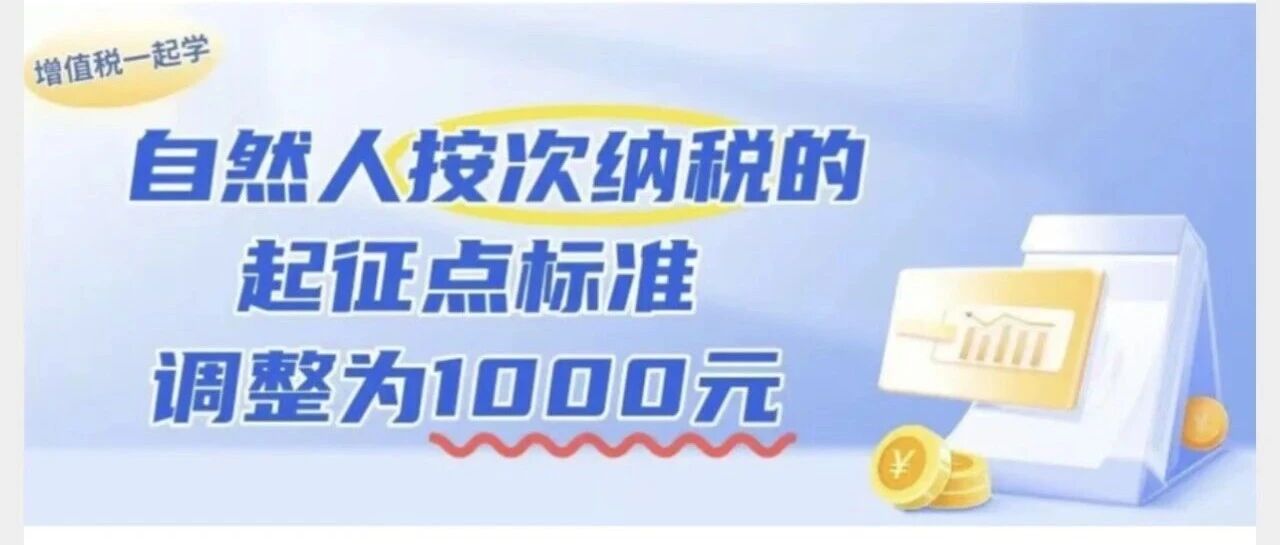
增值税一起学丨自然人按次纳税的起征点标准调整为1000元
蓝色柳林财税室· 2026-03-13 01:46
Core Viewpoint - The article discusses the new tax policy for small-scale taxpayers, specifically focusing on the increased threshold for value-added tax (VAT) for natural persons, which has been raised to 1,000 yuan per transaction from the previous range of 300-500 yuan [2][5]. Summary by Sections Tax Threshold for Natural Persons - The VAT threshold for natural persons who pay tax per transaction has been increased to 1,000 yuan per transaction from the previous 300-500 yuan range, effective from January 1, 2026, to December 31, 2027 [2]. Monthly and Quarterly Tax Thresholds - For small-scale taxpayers, the VAT threshold is set at 100,000 yuan for monthly sales and 300,000 yuan for quarterly sales during the same period [3]. Tax Payment Method - Generally, natural persons are required to pay tax per transaction unless they fall under specific categories that require monthly tax assessment, such as interest from newly issued bonds, rental income, and certain service incomes from internet platforms [4]. Tax Calculation Examples - If a natural person has a total income below the monthly threshold of 100,000 yuan, they are exempt from VAT. However, if their income meets or exceeds the threshold, they must calculate VAT based on the total income without splitting it into different categories [7]. Policy References - The article cites relevant policies, including the "Value-Added Tax Law of the People's Republic of China" and announcements from the Ministry of Finance and the State Taxation Administration regarding the implementation of VAT and related preferential policies [7].

个人增值税若按次缴 起征点提至千元 专家:此举将减轻小额、零星交易主体负担
Sou Hu Cai Jing· 2026-02-02 13:05
Core Viewpoint - The announcement of the new VAT exemption policies aims to adjust the tax burden for small-scale taxpayers and enhance the fairness of the tax system, particularly for individuals engaged in sporadic taxable transactions [1][3][4]. Group 1: VAT Exemption Policy Adjustments - The VAT exemption threshold for small-scale taxpayers is set at a monthly sales amount of 100,000 yuan, a quarterly sales amount of 300,000 yuan, and a per-transaction amount of 1,000 yuan starting from January 1, 2026 [1]. - The threshold for occasional taxpayers has been raised from 500 yuan to 1,000 yuan, allowing them to enjoy similar tax benefits as regular taxpayers [3][4]. - The adjustments are intended to reduce the tax burden on individuals providing occasional services, such as delivery or consulting, thereby improving living standards [4][6]. Group 2: Coverage of Special Cases - The new regulations specify that certain scenarios, such as rental income and reverse invoicing for scrap sales, will not be subject to the 1,000 yuan threshold but will instead follow the monthly sales threshold of 100,000 yuan [5][6]. - This change aims to prevent tax evasion and ensure fairness in tax administration by aligning the tax treatment with the nature of the income [6][7]. Group 3: Flexibility in Tax Administration - Small-scale taxpayers can choose to partially or fully waive their exemption and issue VAT invoices, enhancing their flexibility in transactions [8][9]. - This policy allows small-scale taxpayers to better meet the needs of their clients, particularly when dealing with general taxpayers who require VAT invoices [9]. Group 4: Long-term and Short-term Policy Balance - The VAT exemption projects are categorized into "long-term" (indefinite from 2026) and "temporary" (2026-2027), reflecting a balance between stability and flexibility in tax policy [10][11]. - Long-term exemptions focus on essential public services, while temporary exemptions target specific industries or groups to stimulate growth and adjust to economic conditions [11][12].
个人每次挣钱低于1000元不用交增值税→
Sou Hu Cai Jing· 2026-02-02 12:31
Core Viewpoint - The announcement by the Ministry of Finance and the State Taxation Administration regarding the adjustment of the VAT threshold aims to reduce the tax burden on individuals and small-scale taxpayers starting from January 1, 2026, to December 31, 2027 [2][3]. Group 1: VAT Threshold Adjustments - The new VAT threshold for small-scale taxpayers is set at a monthly sales amount of 100,000 yuan or a quarterly sales amount of 300,000 yuan [2]. - For transactions taxed on a per-instance basis, the threshold has been raised from 500 yuan to 1,000 yuan per transaction [3]. - The definition of small-scale taxpayers has been expanded to include those with annual taxable sales not exceeding 5 million yuan [3]. Group 2: Impact on Individuals and Freelancers - The increase in the per-transaction VAT threshold is a significant benefit for individuals, such as freelancers and gig workers, who earn less than 1,000 yuan per day from services like tutoring or delivery [3]. - This change allows individuals engaged in low-income activities to avoid VAT payments, thereby potentially increasing their net earnings [3].
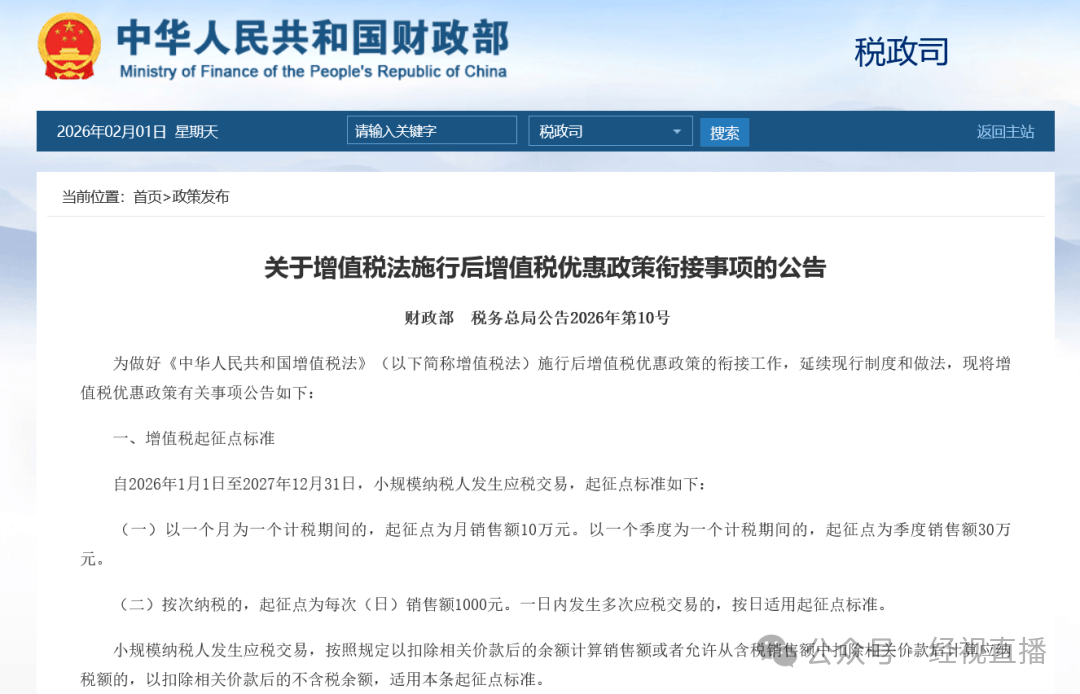
增值税税负再减!自然人按次纳税起征点翻倍至1000元
Mei Ri Jing Ji Xin Wen· 2026-02-01 22:45
Core Points - The Ministry of Finance and the State Administration of Taxation issued the "Announcement on the Connection of VAT Preferential Policies after the Implementation of the VAT Law," which clarifies the VAT threshold standards for small-scale taxpayers from January 1, 2026, to December 31, 2027 [1] - The announcement raises the threshold for individual taxpayers from 500 yuan to 1000 yuan per transaction, aiming to reduce the tax burden on small, sporadic transactions [3][4] - Specific scenarios, such as rental income and reverse invoicing for scrap sales, will now be subject to a monthly threshold of 100,000 yuan instead of the per-transaction threshold, expanding the coverage of preferential policies [5][6] VAT Threshold Adjustments - The monthly sales threshold for small-scale taxpayers is set at 100,000 yuan, while quarterly sales are set at 300,000 yuan, and per-transaction sales at 1000 yuan [1] - The increase in the per-transaction threshold is intended to alleviate the tax burden on individuals engaged in occasional taxable transactions, aligning their treatment more closely with regular small-scale taxpayers [3][4] Impact on Small-Scale Taxpayers - The adjustment allows small-scale taxpayers to "waive the exemption" for certain transactions, providing them with greater flexibility in tax management [8][9] - This flexibility is particularly beneficial for small-scale taxpayers whose clients are general taxpayers, as it allows them to issue special VAT invoices when necessary [8][9] Long-term and Short-term VAT Exemption Policies - The announcement categorizes VAT exemption projects into "long-term" (indefinite from 2026) and "temporary" (2026-2027), reflecting a balance between policy stability and flexibility [10] - Long-term exemptions focus on essential public services, while temporary exemptions target specific industries or groups to support economic stability [10] Tax Rate Clarifications - The announcement retains a 5% tax rate for certain industries, despite the VAT law stating a unified rate of 3%, as this is considered a tax incentive for specific sectors [11]
个人增值税按次纳税起征点提至千元
Xin Lang Cai Jing· 2026-02-01 19:22
Core Viewpoint - The National Taxation Administration has issued the "Announcement on Value-Added Tax Administration Matters such as the Standard for the Starting Point" to clarify and optimize the value-added tax (VAT) management, particularly regarding the starting point standards and tax incentives for individuals and small-scale taxpayers [1][2]. Group 1: Starting Point Standards - The starting point for individual taxpayers under the VAT system has been raised from 500 yuan to 1000 yuan per transaction starting from this year [1]. - Specific scenarios such as renting real estate and selling scrap products through "reverse invoicing" will not be subject to the 1000 yuan starting point but will instead follow a monthly sales threshold of 100,000 yuan [1]. Group 2: Tax Filing and Reporting - Individual taxpayers are required to report their taxes from the date the tax obligation arises until June 30 of the following year, providing ample time for compliance [2]. - For convenience, if individual taxpayers reach the starting point, applying for invoice issuance or having withholding agents deduct taxes will be considered as fulfilling the tax reporting requirement [2]. Group 3: Small-Scale Taxpayer Benefits - Small-scale taxpayers can choose to waive VAT exemptions for all or part of their taxable transactions even if their sales do not reach the starting point [3]. - This flexibility allows small-scale taxpayers to issue VAT special invoices to meet the needs of downstream clients for input tax deductions [3].
国税总局:自然人增值税按次纳税起征点提至1000元!
Xin Lang Cai Jing· 2026-02-01 15:14
Core Viewpoint - The announcement by the State Taxation Administration clarifies the management of value-added tax (VAT), particularly increasing the threshold for individual taxpayers from 500 yuan to 1000 yuan, effective from January 1, 2026, to December 31, 2027, while also detailing specific scenarios where different standards apply [1]. Group 1: Tax Threshold Adjustments - The VAT threshold for individual taxpayers is raised to 1000 yuan per transaction, effective from January 1, 2026, to December 31, 2027 [1]. - Certain specific situations, such as renting out real estate and reverse invoicing for scrapped products, will not be subject to the 1000 yuan threshold but will follow a monthly sales threshold of 100,000 yuan [1]. Group 2: Tax Efficiency and Fairness - The policy aims to balance tax efficiency and fairness by allowing a higher threshold for periodic taxpayers, which reduces the tax burden on individuals and lowers compliance costs [1]. - The announcement emphasizes that the new rules will help prevent the manipulation of tax thresholds by ensuring that all taxable transactions within a month are considered together [1]. Group 3: Small-scale Taxpayer Benefits - Small-scale taxpayers can choose to waive tax exemptions for certain taxable transactions to issue VAT special invoices, which is primarily to meet the needs of downstream clients for input tax deductions [1]. - This flexibility allows small-scale taxpayers to decide whether to forgo tax exemptions based on their operational circumstances without affecting other transactions' eligibility for tax benefits [1].
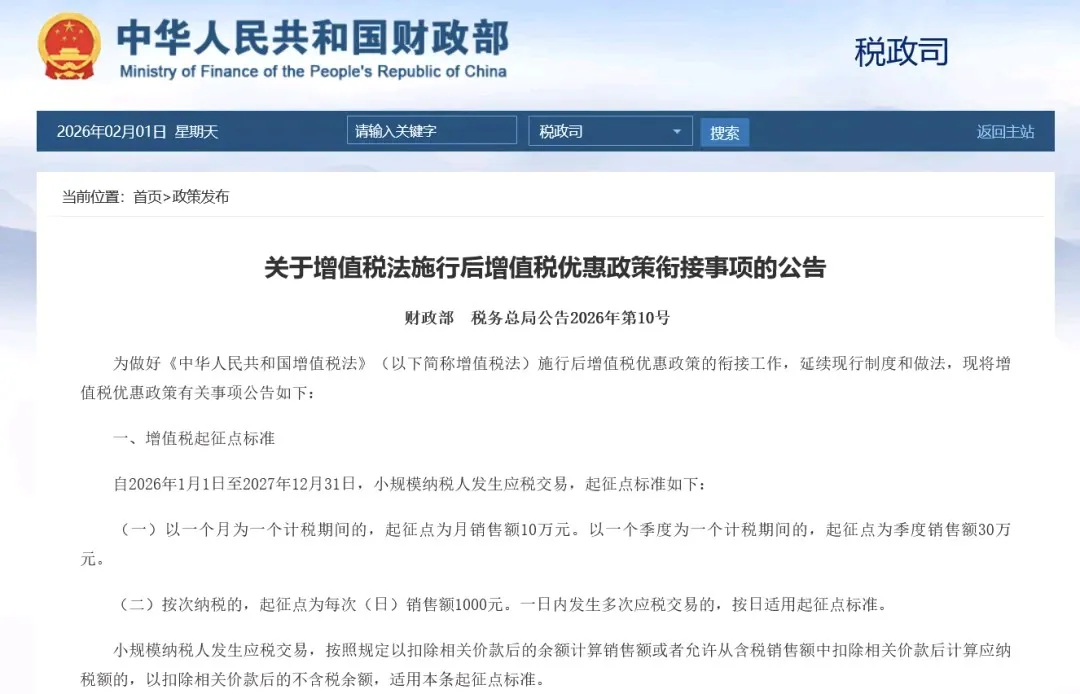
两部门明确:个人每次挣钱低于1000元不用交增值税
Xin Lang Cai Jing· 2026-02-01 13:47
Core Viewpoint - The Ministry of Finance and the State Taxation Administration announced an increase in the value-added tax (VAT) threshold starting from January 1, 2026, aimed at reducing the tax burden on individuals [1][5]. Group 1: VAT Threshold Adjustments - From January 1, 2026, to December 31, 2027, the threshold for small-scale taxpayers will be set as follows: a monthly sales threshold of 100,000 yuan, a quarterly sales threshold of 300,000 yuan, and a per-transaction threshold of 1,000 yuan [4][10]. - Small-scale taxpayers can calculate their sales based on the net amount after deducting relevant costs, which will apply to the new threshold standards [4][10]. Group 2: Benefits for Individuals - The increase in the per-transaction VAT threshold to 1,000 yuan is a significant benefit for individuals, such as freelancers and gig workers, who will not need to pay VAT for services rendered below this amount [5][11]. - The new policy will exempt individuals providing services, such as tutoring or delivery, from VAT if their earnings are below the 1,000 yuan threshold per transaction [5][11]. Group 3: Administrative Clarifications - The State Taxation Administration issued a supplementary announcement to clarify the VAT management matters, including the application of the new threshold and tax incentives [5][11]. - The announcement also specifies that certain situations, such as renting out property or selling scrap products, will not qualify for the per-transaction threshold and will instead follow the monthly sales threshold of 100,000 yuan [7][13]. Group 4: Flexibility for Small-Scale Taxpayers - Small-scale taxpayers can choose to forgo tax exemptions for certain transactions to issue VAT special invoices, which is often necessary for their clients to claim input tax deductions [8][14]. - This flexibility allows small-scale taxpayers to manage their tax obligations according to their business needs without affecting other transactions that may still qualify for tax exemptions [8][14].
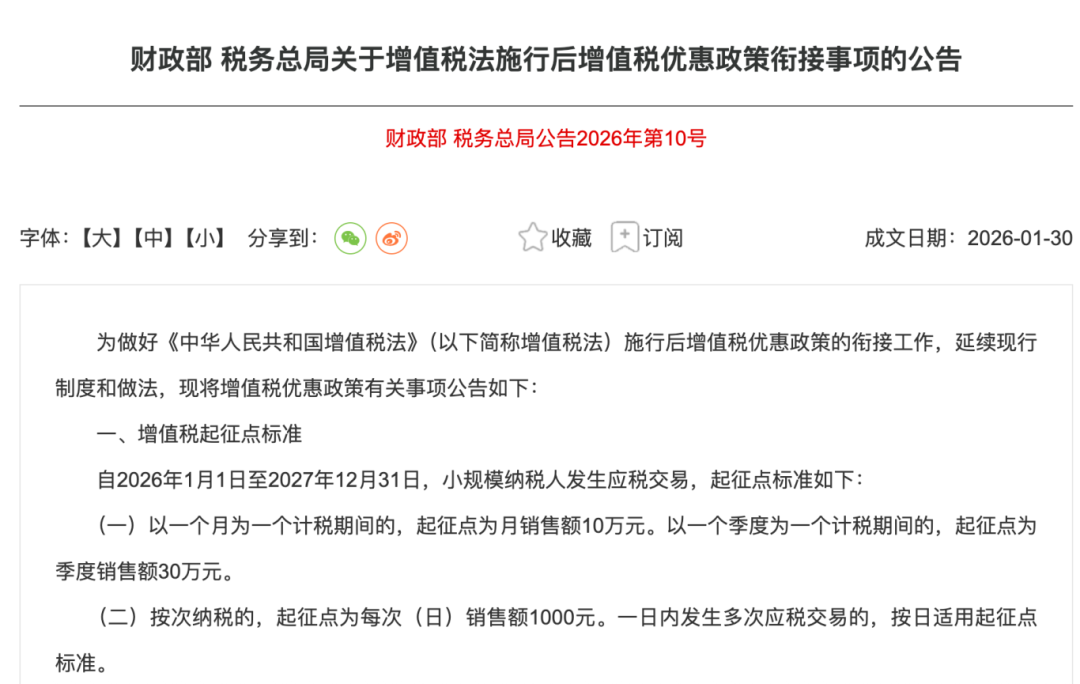
重磅!今后个人每次挣钱低于1000元不用交增值税
Sou Hu Cai Jing· 2026-02-01 05:48
Core Viewpoint - The announcement by the Ministry of Finance and the State Taxation Administration regarding the adjustment of the VAT threshold aims to reduce the tax burden on small-scale taxpayers, including small and micro enterprises, starting from January 1, 2026 [1][2]. Group 1: VAT Threshold Adjustments - The new VAT threshold for small-scale taxpayers will be set at a monthly sales amount of 100,000 yuan, a quarterly sales amount of 300,000 yuan, and a per transaction (daily) sales amount of 1,000 yuan [1][2]. - The per transaction VAT threshold has been increased from a maximum of 500 yuan to 1,000 yuan, benefiting individuals and small businesses [1][2]. Group 2: Impact on Small and Micro Enterprises - The adjustment of the VAT threshold is expected to provide significant relief to small-scale taxpayers, including individual businesses and micro-enterprises, by unifying previous rules and increasing the threshold for tax exemption [2]. - The increase in the VAT threshold aligns with previous adjustments, which have progressively raised the threshold to alleviate the tax burden on small-scale taxpayers [2].
每日观察!个人每次挣钱低于1000元不用交增值税
Mei Ri Jing Ji Xin Wen· 2026-02-01 05:11
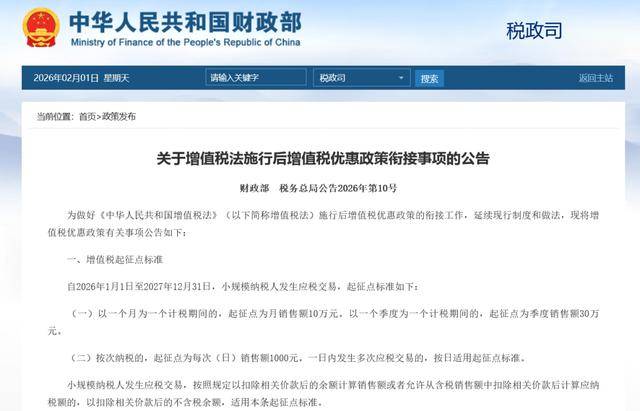
Core Viewpoint - The announcement by the Ministry of Finance and the State Taxation Administration regarding the adjustment of the value-added tax (VAT) threshold aims to reduce the tax burden on individuals starting from January 1, 2026, by raising the VAT exemption threshold for small-scale taxpayers [1][3]. Group 1: VAT Threshold Adjustments - From January 1, 2026, to December 31, 2027, the VAT exemption threshold for small-scale taxpayers will be set at a monthly sales amount of 100,000 yuan or a quarterly sales amount of 300,000 yuan [3]. - For transactions taxed on a per-instance basis, the threshold will be 1,000 yuan per transaction, allowing multiple transactions in a day to be assessed under this daily threshold [3][4]. Group 2: Benefits for Individuals - The increase in the per-instance VAT exemption threshold to 1,000 yuan is seen as a significant benefit for individuals, such as freelancers and gig workers, who earn below this amount per transaction, thus exempting them from VAT [3][4]. - The policy is expected to alleviate the tax burden on individuals providing services, such as educators and delivery workers, who typically earn less than the new threshold [3][4]. Group 3: Tax Administration Clarifications - The accompanying tax administration announcement clarifies the criteria for determining the VAT exemption threshold and outlines the application of tax incentives, ensuring effective implementation of the VAT law [3][4]. - The announcement also allows small-scale taxpayers to choose to forgo tax exemptions for certain transactions to issue VAT special invoices, catering to the needs of downstream clients who require these invoices for input tax deductions [5].

官方明确个人每次挣钱低于1000元不用交增值税
21世纪经济报道· 2026-02-01 04:30
Core Viewpoint - The Ministry of Finance and the State Administration of Taxation announced an increase in the value-added tax (VAT) threshold starting from January 1, 2026, aimed at reducing the tax burden on individuals [4]. VAT Threshold Adjustments - From January 1, 2026, to December 31, 2027, the VAT threshold for small-scale taxpayers will be set as follows: - Monthly sales threshold of 100,000 yuan for monthly tax periods - Quarterly sales threshold of 300,000 yuan for quarterly tax periods - Per transaction (daily) threshold of 1,000 yuan [4][5] - This adjustment means that individuals providing services, such as teaching or gig work, earning below these thresholds will not be required to pay VAT [4]. Tax Administration Clarifications - The tax administration announcement further clarifies the VAT threshold standards and tax exemption policies, ensuring effective implementation of the VAT law [4]. - The new regulations allow small-scale taxpayers to choose to forgo tax exemptions for certain transactions to issue VAT special invoices, which is beneficial for their clients [6]. Personal Income Tax Growth - In 2025, personal income tax revenue reached 1.62 trillion yuan, reflecting an 11.5% increase, attributed to steady growth in residents' income [8]. - The average disposable income per capita in 2025 was 43,400 yuan, showing a nominal growth of 5% compared to the previous year [8]. Taxpayer Demographics - High-income earners (annual income over 1 million yuan) constitute about 1% of the total number of taxpayers but contribute over 50% of total personal income tax revenue [9]. - The implementation of the "Golden Tax Phase IV" and enhanced tax administration measures have contributed to the steady growth of personal income tax revenue [9].