
增值税起征点标准

Search documents
你问我答|电子税务局如何开具无欠税证明?操作步骤
蓝色柳林财税室· 2026-03-08 02:23
Group 1 - The article provides a step-by-step guide on how to obtain a tax clearance certificate through the electronic tax bureau app and website [3][11]. - Users must log in to the electronic tax bureau app or website and navigate to the appropriate sections to initiate the process of obtaining the tax clearance certificate [3][11]. - If there are no pending tax issues, users can directly download the tax clearance certificate in PDF format after verification [7][13]. - In cases where there are unresolved tax matters, the system will notify users that the certificate cannot be issued, and they can view details of the pending issues [9][14]. Group 2 - The article outlines the criteria for small-scale taxpayers regarding the tax exemption threshold, effective from January 1, 2026, and December 31, 2027 [20][22]. - The exemption threshold for monthly sales is set at 100,000 yuan, while for quarterly sales, it is 300,000 yuan [24]. - For per-transaction taxation, the threshold is established at 1,000 yuan per transaction [24]. - Specific conditions under which individuals must adhere to the monthly sales threshold are also detailed, including income from newly issued government bonds and rental income [25][26].

增值税小规模纳税人、小型微利企业和个体工商户减半征收“六税两费”政策
蓝色柳林财税室· 2026-03-04 08:37
Core Viewpoint - The article discusses the "Six Taxes and Two Fees" reduction policy, which allows small-scale taxpayers, small and micro enterprises, and individual businesses to apply for tax reductions [2][4]. Group 1: Tax Reduction Policy - The "Six Taxes and Two Fees" policy provides a 50% reduction in the following taxes for eligible taxpayers: resource tax (excluding water resource tax), urban maintenance and construction tax, property tax, urban land use tax, stamp tax (excluding securities transaction stamp tax), arable land occupation tax, education surcharge, and local education surcharge [2]. Group 2: Taxpayer Eligibility - Eligible taxpayers for the "Six Taxes and Two Fees" reduction include small-scale value-added tax taxpayers, small and micro enterprises, and individual businesses [2].
政策小贴士|自然人在什么情形下适用以一个月为一个计税期间的起征点标准?
蓝色柳林财税室· 2026-02-11 10:06
Core Viewpoint - The announcement from the Ministry of Finance and the State Taxation Administration clarifies the VAT exemption policy for small-scale taxpayers, effective from January 1, 2026, to December 31, 2027, with specific sales thresholds for tax exemption [2][3]. Group 1: Tax Exemption Standards - For small-scale taxpayers, the monthly sales threshold for tax exemption is set at 100,000 yuan, while for quarterly assessments, it is 300,000 yuan [2]. - For transactions taxed on a per-instance basis, the threshold is 1,000 yuan per transaction [3]. Group 2: Specific Situations for Tax Exemption - Natural persons can apply the monthly sales threshold of 100,000 yuan under specific circumstances, including receiving interest from newly issued government bonds, renting out real estate, and earning service income from internet platforms [8][9]. - The announcement specifies that natural persons must consider all taxable transactions within the month to determine if they meet the exemption threshold, and cannot separate transactions to apply different thresholds [11]. Group 3: Examples of Taxable Transactions - An example illustrates that if a natural person rents out property and receives a total of 120,000 yuan in rent for the year, they must allocate this amount monthly to assess their sales for VAT exemption [12]. - Another example shows that if a natural person provides insurance agency services and has a total monthly sales amount exceeding the threshold, they are required to pay VAT on the total amount, as they cannot split the income types for different thresholds [12].

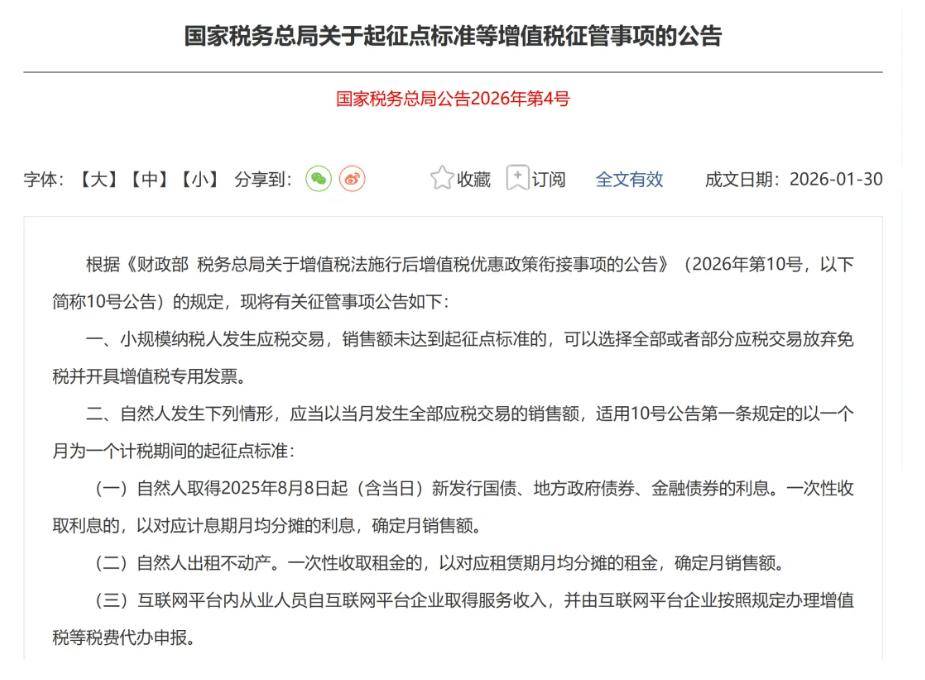
国家税务总局关于起征点标准等增值税征管事项的公告国家税务总局公告2026年第4号(附解读)
蓝色柳林财税室· 2026-02-06 01:47
Core Viewpoint - The announcement by the State Taxation Administration clarifies the management of value-added tax (VAT) regarding the threshold standards and options for small-scale taxpayers and individuals, ensuring the smooth implementation of related policies [3][5]. Group 1: Small-scale Taxpayers - Small-scale taxpayers can choose to waive tax exemptions and issue special VAT invoices for all or part of their taxable transactions if their sales do not reach the threshold standard [5][6]. - The applicable reduced VAT rate of 1% for small-scale taxpayers allows them to opt for waiving the reduction and issuing special VAT invoices [8]. Group 2: Individuals and Taxation Periods - Individuals can apply the monthly sales threshold of 100,000 yuan if they meet specific conditions outlined in the announcement, which allows them to benefit from the exemption policy [5][6]. - Individuals must consider their total taxable sales for the month when determining if they meet the threshold, and cannot separate sales to apply different thresholds [6][7]. Group 3: Specific Situations for Individuals - The announcement specifies six scenarios where individuals can apply the monthly sales threshold, including rental income, service income from internet platforms, and other defined situations [8]. - Individuals must report their taxable transactions according to the established rules, including applying for invoices through the tax authority or having withholding agents report on their behalf [9][13]. Group 4: Implementation Date - The announcement will take effect from January 1, 2026, and it will replace previous regulations regarding VAT management for small-scale taxpayers [8].
自然人按次纳税起征点提升至1000元
Xin Lang Cai Jing· 2026-02-01 22:24
Group 1 - The core viewpoint of the announcement is the adjustment and optimization of the value-added tax (VAT) threshold standards for individuals, increasing the per-transaction tax threshold from 500 yuan to 1000 yuan starting this year [1] - The announcement clarifies that individuals engaged in specific activities, such as renting out real estate or selling scrapped products through "reverse invoicing," will not be subject to the 1000 yuan per-transaction threshold but will instead follow a monthly sales threshold of 100,000 yuan [1] Group 2 - The policy arrangement balances tax efficiency and fairness by allowing a higher periodic tax threshold, which effectively reduces the tax burden on individuals and lowers tax compliance costs [2] - Small-scale taxpayers can flexibly enjoy tax reduction benefits, as they can choose to waive tax exemptions for all or part of their taxable transactions if their sales do not reach the threshold [2] - The main purpose for small-scale taxpayers to waive tax exemptions is to meet the demand from downstream clients for VAT special invoices to offset input tax [2]
个人每次收入低于1000元不用交增值税!新规来了
Sou Hu Cai Jing· 2026-02-01 13:37
Core Points - The announcement from the State Taxation Administration clarifies the management of value-added tax (VAT), including the determination of the threshold standard and applicable tax incentives, aiming to implement the VAT law and its regulations effectively [1][3]. Group 1: VAT Threshold Adjustments - The new regulation raises the threshold for individual VAT taxpayers from 500 yuan to 1000 yuan per transaction (daily sales) starting this year [3]. - Specific scenarios, such as renting out real estate and "reverse invoicing" for scrapped products, will not apply to the 1000 yuan threshold but will instead use a monthly sales threshold of 100,000 yuan [3]. Group 2: Tax Efficiency and Fairness - The policy aims to balance tax efficiency and fairness by allowing a higher threshold for periodic taxpayers, which reduces the tax burden on individuals and lowers compliance costs [3]. - The regulation prevents the splitting of taxable transactions to exceed the threshold, promoting tax fairness by ensuring that all taxable transactions within a month are considered together [3]. Group 3: Small-scale Taxpayer Benefits - Small-scale taxpayers can flexibly enjoy tax exemptions; if their taxable sales do not reach the threshold, they can choose to waive the exemption for all or part of their taxable transactions and issue VAT special invoices [3].
国家税务总局明确起征点标准等增值税征管事项
证券时报· 2026-02-01 08:29
Core Viewpoint - The announcement from the State Taxation Administration clarifies the management of value-added tax (VAT), particularly regarding the threshold standards and tax incentives, aiming to enhance tax efficiency and fairness in the system [1]. Group 1: VAT Threshold Adjustments - The threshold for individual taxpayers under the VAT system has been raised from 500 yuan to 1000 yuan per transaction, effective this year [1]. - Specific scenarios, such as renting out real estate or selling scrapped products through "reverse invoicing," will not apply to the 1000 yuan threshold but will instead follow a monthly sales threshold of 100,000 yuan [1]. Group 2: Small-scale Taxpayer Benefits - Small-scale taxpayers can choose to forgo tax exemptions for all or part of their taxable transactions if their sales do not reach the threshold, allowing them to issue VAT special invoices [2][3]. - This flexibility is primarily aimed at meeting the needs of downstream customers who require VAT special invoices for input tax deductions [2].

税务总局明确起征点标准等增值税征管事项
Xin Lang Cai Jing· 2026-02-01 07:59
Core Viewpoint - The announcement from the State Taxation Administration clarifies the management of value-added tax (VAT), particularly regarding the threshold standards and applicable tax incentives, aiming to enhance tax efficiency and fairness in the taxation process [1]. Group 1: VAT Threshold Adjustments - The threshold for individual taxpayers under the per-transaction VAT system has been raised from 500 yuan to 1,000 yuan starting this year [1]. - Specific scenarios, such as renting out real estate and reverse invoicing for scrapped products, will not apply to the 1,000 yuan threshold but will instead follow a monthly sales threshold of 100,000 yuan [1]. Group 2: Taxpayer Burden Reduction - The implementation of the VAT law allows individual taxpayers to report and pay taxes until June 30 of the following year if their sales reach the threshold, providing ample time for compliance [2]. - The announcement aims to minimize the need for individual taxpayers to self-report, with provisions for tax withholding by third parties [2]. Group 3: Small-scale Taxpayer Flexibility - Small-scale taxpayers can choose to waive tax exemptions for certain taxable transactions to issue VAT special invoices, catering to the needs of downstream clients who require these invoices for input tax deductions [3]. - This flexibility allows small-scale taxpayers to selectively forgo tax benefits without affecting other transactions that continue to enjoy exemptions [3].
关于《国家税务总局关于起征点标准等增值税征管事项的公告》的解读
Xin Lang Cai Jing· 2026-02-01 04:53
Core Viewpoint - The announcement by the Ministry of Finance and the State Taxation Administration clarifies the implementation of VAT preferential policies following the enactment of the VAT Law, ensuring smooth policy execution and providing guidance on tax management matters [1]. Group 1: Small-scale Taxpayers - Small-scale taxpayers can choose to waive VAT exemptions and issue special VAT invoices for taxable transactions, even if their sales do not reach the threshold [1]. - The announcement specifies that small-scale taxpayers can opt to waive tax reductions and issue special VAT invoices for all or part of their taxable transactions [1]. Group 2: Natural Persons and Taxation Standards - Natural persons can apply the monthly sales threshold of 100,000 yuan under specific circumstances, as outlined in the announcement [1]. - The announcement continues previous policies, allowing natural persons to enjoy the monthly sales exemption standard under certain conditions [1]. Group 3: Tax Reporting for Natural Persons - Natural persons must report all taxable transactions' sales amounts to apply the monthly sales threshold, and cannot separate sales amounts for different tax standards [2]. - The announcement provides different reporting paths for natural persons based on their transaction types, including immediate reporting through invoice issuance or withholding agents [4][5].