竞争逻辑重构

Search documents
2026车企目标大“PK”
Guo Ji Jin Rong Bao· 2026-01-29 12:48
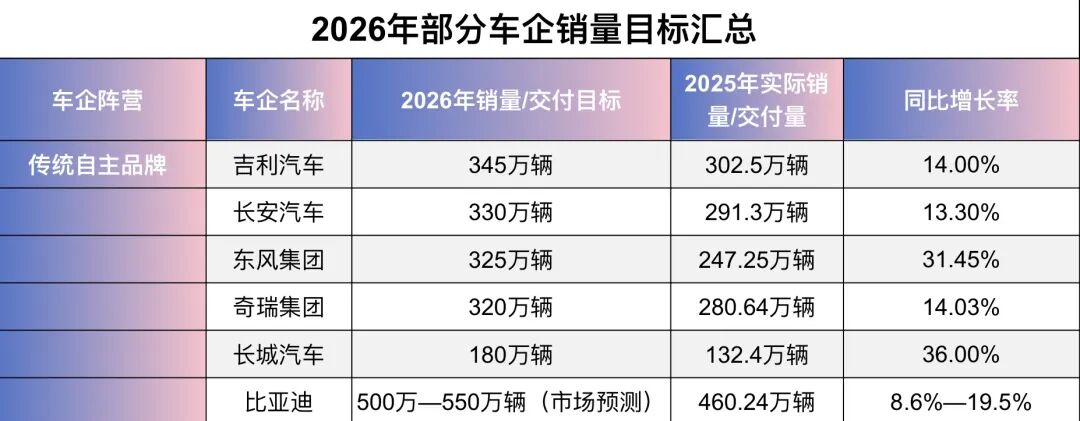
Core Insights - The Chinese automotive industry has shown impressive growth, with production and sales reaching 34.53 million and 34.40 million units respectively in 2025, marking a year-on-year increase of 10.4% and 9.4% [1] - New energy vehicle (NEV) sales reached 16.49 million units, achieving a penetration rate of 47.9% [1] - Major automakers have set ambitious sales targets for 2026, amidst challenges from policy changes, technological advancements, and global competition [1] Company Targets - Geely aims for a sales target of 3.45 million units in 2026, up 14% from 2025's 3.025 million units, with 64.3% of sales coming from NEVs [4] - Changan targets 3.3 million units, with NEV sales projected at 1.4 million units, reflecting a 26.2% increase [5] - Dongfeng Group's target is 3.25 million units, a 31.45% increase from 2025, with NEVs making up 52% of sales [6] - Great Wall Motors aims for 1.8 million units, a 36% increase, focusing on NEV and export markets [6] - BYD's projected sales for 2026 are between 5 million and 5.5 million units, with a growth rate of 8.5% to 19.5% [6] New Entrants and Growth - New entrants like Leap Motor and Hongmeng Zhixing are targeting sales of 1 million units, with significant growth rates of over 67% [7][9] - Leap Motor's sales target is 1 million units, up from 596,600 units in 2025 [9] - Hongmeng Zhixing is expected to reach between 1 million and 1.3 million units, with a growth rate of 70% to 120% [11] Industry Trends - The penetration rate of NEVs is expected to exceed 60% in 2026, driven by policy support and technological advancements [12] - The export model is shifting from "complete vehicle export" to "localized production and full industry chain layout," with significant growth in NEV exports [13] - The competitive landscape is transitioning from price wars to value-driven strategies, with a focus on technological innovation [15] - Market concentration is increasing, with leading brands capturing a larger market share, while weaker brands are likely to exit the market [15] Challenges and Uncertainties - The market faces uncertainties due to policy changes, such as the reduction of NEV purchase tax, which may affect consumer purchasing behavior [16] - Economic recovery is slower than expected, impacting consumer spending and demand for traditional vehicles [17] - Trade barriers and compliance risks are increasing for Chinese automakers expanding overseas, necessitating a balance between global operations and local compliance [17] Conclusion - The Chinese automotive market in 2026 is poised for significant transformation, emphasizing the shift towards NEVs and smart technologies, while navigating various uncertainties and competitive pressures [19]