简易计税方法

Search documents
增值税法上线后一般纳税人登记管理相关变化
蓝色柳林财税室· 2026-03-17 01:30
Group 1 - The announcement outlines the tax declaration deadlines for taxpayers with annual VAT sales exceeding 5 million, requiring them to declare within the specified period of the following month [3] - Taxpayers who need to adjust their sales figures due to self-correction, risk control checks, or audits must do so within 10 working days from the date of adjustment if their annual VAT sales exceed 5 million [3] - If taxpayers fail to comply with the specified deadlines, they will be managed as general taxpayers starting from the fifth working day after the deadline [3] Group 2 - For taxpayers who initially chose to be small-scale taxpayers but no longer meet the criteria, they must report this change to the tax authority in writing during the change period [3] - The effective date for general taxpayers is the first day of the period in which their annual VAT sales exceed the threshold [4] - For those who exceed the threshold in the fourth quarter of 2025, the effective date for general taxpayer status will be January 1, 2026 [4] Group 3 - General taxpayers must correct their VAT declarations if they previously declared as small-scale taxpayers, and they need to confirm the use of VAT deduction certificates obtained but not yet confirmed [5] - The announcement specifies that the new regulations will take effect on January 1, 2026, superseding any previous inconsistent regulations [14] - Taxpayers purchasing domestic passenger transport services can deduct input VAT based on specific criteria, including the type of invoice received [11]


个税专项附加扣除要点——大病医疗篇
蓝色柳林财税室· 2026-03-14 02:29
Group 1 - Taxpayers can deduct medical expenses incurred for themselves or their spouses, with a maximum deduction limit of 80,000 yuan per person, totaling 160,000 yuan for couples [5] - Medical expenses for minor children can be deducted by either parent, but the deduction method cannot be changed within a tax year [4][5] - Taxpayers must retain original or copied receipts for medical services and insurance reimbursements for reference during annual tax reconciliation [4] Group 2 - The tax obligation for sales transactions occurs on the day the payment is received or the sales receipt is issued [18][19] - For transactions involving donated goods, the tax obligation arises on the day the goods are dispatched [21] - The tax obligation for imported goods is established on the day of customs declaration [23]

个体户开票不用愁!简单几步轻松办
蓝色柳林财税室· 2026-03-12 01:40
Group 1 - The article discusses the option for general taxpayers to choose a simplified tax method for construction services provided in a clear contracting manner, applicable from January 1, 2026, to December 31, 2027, with a tax rate of 3% for VAT calculation [8] - It outlines the procedure for taxpayers who have declared but not yet received approval from the tax authority for export tax refunds to voluntarily withdraw their applications and confirms they will no longer apply for export tax refunds [10][11] - Taxpayers must submit a "Withdrawal Application for Export Tax Refund Declaration" and select the reason for withdrawal as "voluntarily no longer declaring" [11][13]

个税专项附加扣除要点——子女教育篇
蓝色柳林财税室· 2026-03-11 09:13
Core Viewpoint - The article discusses the tax deductions available for parents regarding their children's education expenses, highlighting eligibility criteria and the process for claiming these deductions. Group 1: Eligibility for Deductions - Parents can deduct education expenses for children in various educational stages, including compulsory education, high school, and higher education, at a standard rate of 2000 yuan per child per month [3]. - The deduction can be claimed by one parent at 100% or split between both parents at 50% each [3]. - The definition of "children" includes biological, non-biological, adopted, and stepchildren, as well as minors under guardianship [3]. Group 2: Types of Educational Institutions - Taxpayers can claim deductions regardless of whether their children attend public or private schools [4]. - Deductions are also applicable for children studying in overseas educational institutions [5]. Group 3: Multiple Children and Deduction Choices - Parents with multiple children can choose different deduction methods for each child [6]. Group 4: Submission Methods - Taxpayers can submit their claims through various methods, including the "Personal Income Tax" app, online tax services, or by delegating to third-party agencies [12].

公司刚注册还没业务,可以不报税吗?
蓝色柳林财税室· 2026-03-06 09:49
Group 1 - The article emphasizes that even if a taxpayer has no business or income, they are still required to file a tax declaration, referred to as a "zero declaration" [3] - The policy states that taxpayers enjoying tax reductions or exemptions must also file tax declarations during the applicable period [3] - The legal basis for this requirement is found in Article 32 of the Implementation Rules of the Tax Collection and Administration Law of the People's Republic of China [3] Group 2 - The announcement regarding the implementation of the VAT law specifies that general taxpayers who choose the simplified tax method cannot change it for 36 months [10] - After the 36-month period, they can switch to the general tax method but cannot revert to the simplified method for another 36 months [10] - This regulation will take effect starting January 1, 2026 [11] Group 3 - The article mentions that if a company needs to correct an error in their declared payroll after submission, they can adjust it by providing relevant documentation at designated service windows [13] - If the incorrect declaration leads to late or insufficient payment of social insurance fees, penalties will be imposed according to the Social Insurance Law of the People's Republic of China [14]

房土两税征期已到,申报攻略请查收!
蓝色柳林财税室· 2026-03-06 09:48
Group 1 - The article outlines the procedures for tax source information collection, including new entries, modifications, and declarations [3][4][6] - For new tax source collection, specific details such as property certificate types and addresses must be accurately filled out [4][5] - If there are changes in tax source information, the article provides guidance on how to modify the existing data [6][7] Group 2 - The article describes three methods for tax source collection: regular new collection, batch import, and pre-filled collection based on previous tax records [5][6] - It emphasizes the importance of confirming tax exemption conditions before submitting tax declarations [9] - The article details the steps for submitting tax declarations, including confirmation of information and payment processes [9]

自然人代开增值税发票丨建筑服务这样开!操作步骤
蓝色柳林财税室· 2026-03-04 08:39
Core Viewpoint - The article discusses the process for individuals engaged in construction services, such as labor and renovation, to issue invoices after temporarily receiving income, focusing on the steps involved in the electronic tax bureau system [2][3][4][5]. Group 1: Invoice Issuance Process - Step 1: Log into the electronic tax bureau and navigate to the invoice issuance section [2]. - Step 2: In the invoice issuance interface, select the type of invoice and specify "construction services" as the specific business type [3]. - Step 3: The system auto-fills the seller's information, and the buyer's information must be entered manually [3]. - Step 4: Fill in project name, amount, and indicate whether the project requires cross-regional tax reporting [4]. - Step 5: Select the construction service location and project name, then confirm the invoice details before issuing [5]. - Step 6: Upon successful issuance, the invoice is sent to the buyer's electronic tax account, with multiple delivery options available [5]. Group 2: Mobile Application Process - Step 1: Log into the electronic tax bureau app and access the invoice issuance menu [8]. - Step 2: Select "construction services" and create a new invoice application [9]. - Step 3: Enter buyer information, including whether they are an individual, and save the details [10]. - Step 4: Fill in project details, including administrative region, address, project name, and tax information, then proceed to confirm [12]. - Step 5: The system automatically loads tax information for confirmation before submission [13]. - Step 6: Depending on the application status, the invoice may be issued automatically or require payment and/or approval [14][15]. Group 3: Additional Notes - If prepayment of taxes is involved, users can navigate to the prepayment section after completing the invoice issuance [6]. - When providing construction services, the taxpayer must include the location and project name when issuing the VAT invoice [7].

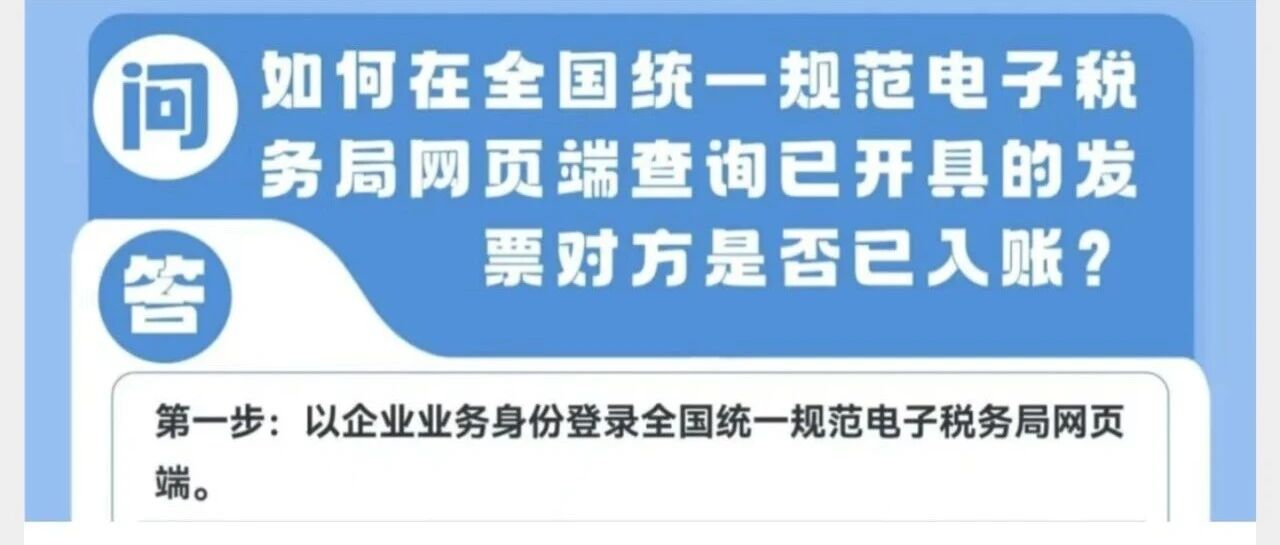
山西:如何在全国统一规范电子税务局网页端查询已开具的发票对方是否已入账?操作步骤
蓝色柳林财税室· 2026-03-04 01:48
Core Viewpoint - The article discusses the implementation of a simplified tax calculation method for certain taxable transactions, specifically in the public transportation sector, effective from January 1, 2026, to December 31, 2027, allowing general taxpayers to opt for a 3% VAT rate [7][8]. Group 1 - From January 1, 2026, to December 31, 2027, general taxpayers can choose to apply a simplified tax calculation method for specific taxable transactions [7]. - The simplified tax calculation method applies to public transportation services, which include ferry services, public bus transport, subways, urban light rail, taxis, long-distance passenger transport, and scheduled bus services [7].
你问我答|电子税务局如何进行一般纳税人登记?操作步骤
蓝色柳林财税室· 2026-02-12 14:30
Core Viewpoint - The article provides a detailed guide on the process of registering as a general VAT taxpayer through the electronic tax bureau, outlining the steps and options available for taxpayers. Group 1: Registration Process - Taxpayers must log in to the electronic tax bureau and navigate to the "General VAT Taxpayer Registration" section to begin the process [1]. - There are two modes for registration: "Confirmation Mode" and "Supplementary Mode" [2]. Group 2: Confirmation Mode - In Confirmation Mode, taxpayers need to confirm the results provided by the system [2]. - If there are no invoices issued or received in the current month, the effective date is automatically set to the first day of the current month, but can be changed to the first day of the next month [3]. - If invoices are involved, the system sets the effective date to the first day of the next month [4]. - After confirming, taxpayers can proceed to submit their registration [4][10]. Group 3: Supplementary Mode - In Supplementary Mode, the system pre-fills the effective date and other information based on taxpayer data, which can be manually adjusted [5]. - Taxpayers can preview the registration form to ensure all details are correct before submission [6][7]. - Once the form is completed and confirmed, taxpayers can submit it for processing [9][10].

【12366问答】2月热点税费政策可视答疑精选(应税交易、简易计税、进项抵扣)
蓝色柳林财税室· 2026-02-12 01:27
Core Viewpoint - The article focuses on the latest changes in the Value-Added Tax (VAT) law in China, providing insights into practical applications and common issues related to VAT compliance and obligations for taxpayers. Group 1: VAT Taxpayer Obligations - Taxpayers, including individuals and businesses, are required to pay VAT when selling goods, services, intangible assets, real estate, or importing goods within China [1][2]. - The definition of goods includes tangible movable property, electricity, heat, gas, etc., while services encompass various sectors such as transportation, telecommunications, and financial services [1][2]. Group 2: Consumption of Services and Intangible Assets - The VAT law specifies that services and intangible assets consumed within China include sales from foreign entities to domestic entities, excluding services consumed outside China [2][3]. - The destination principle has been refined to optimize the taxation rules for services and intangible assets, focusing on whether the seller is a domestic taxpayer and whether consumption occurs within China [3]. Group 3: Taxable Transactions - Certain transactions are deemed taxable, including the use of self-produced goods for personal consumption and the free transfer of goods or intangible assets [4]. - Employees receiving salaries and interest from bank deposits are not subject to VAT as these do not constitute taxable transactions [4]. Group 4: Zero Tax Rate for Cross-Border Services - Domestic entities providing certain services to foreign clients can apply a zero tax rate if the services are consumed entirely outside China, including R&D services, software services, and international transportation [4][5]. Group 5: Simplified Tax Calculation Methods - The simplified tax calculation method allows for a VAT rate of 3% for specific transactions, such as sales of self-extracted construction materials and public transportation services, from January 1, 2026, to December 31, 2027 [6][8]. - A 5% rate applies to transactions related to real estate and certain toll fees established before April 30, 2016 [9]. Group 6: Tax Rate Application for Mixed Transactions - When a taxpayer engages in multiple taxable transactions with different tax rates, they must separately account for each transaction; if not, the higher tax rate applies [9]. - For transactions involving both goods and services with different tax rates, the main business activity determines the applicable tax rate [9]. Group 7: VAT Filing for Foreign Entities - Foreign entities conducting taxable transactions in China are subject to VAT, with the purchasing party responsible for withholding and remitting the tax, unless a domestic agent is appointed for tax filing [10]. Group 8: Input Tax Deductions - Not all input tax can be deducted from output tax; specific categories, such as those related to simplified tax methods or exempt projects, are not eligible for deduction [10].