绿色工艺

Search documents
研判2025!中国高纯铟行业政策、产业链上下游、市场规模及发展趋势分析:短期承压后回暖,高纯铟行业迎稳健增长新阶段[图]
Chan Ye Xin Xi Wang· 2025-12-08 01:04
Core Insights - The high-purity indium industry in China has experienced rapid growth, becoming a crucial support for semiconductor materials, photovoltaic industries, and electronic device manufacturing. However, in 2023, the market faced a significant downturn due to a deep destocking cycle in the semiconductor market and a persistent slump in the consumer electronics market, leading to a 25% year-on-year decline in market size. A recovery is expected in 2024, with the market size projected to reach 2 billion yuan, a 6% increase year-on-year. The industry is anticipated to continue growing, driven by high-end manufacturing and the expansion of the new energy sector, particularly in semiconductor materials as reliance on high-purity indium increases with advancements in 5G communication, artificial intelligence, and data center construction [1][6]. Industry Overview - High-purity indium is a silver-white metal material purified through processes such as electrolysis, chemical cleaning, and vacuum distillation, achieving purity levels from 5N (99.999%) to 7N8 (99.999998%). It is primarily used in the preparation of III-V semiconductor compounds like indium phosphide (InP) and indium antimonide (InSb), as well as in ITO targets and high-purity alloys. The main production methods include electrolysis, vacuum distillation, zone melting, metal-organic compound methods, and low-halogen compound methods [2][3]. Industry Chain - The upstream raw materials for the high-purity indium industry include primary indium and recycled indium. Primary indium is mostly a byproduct of zinc mining, with China being rich in zinc reserves, particularly in Yunnan, Guangxi, and Hunan. Recycled indium is becoming increasingly important due to stricter environmental policies and tight primary indium supply, with secondary resources like waste ITO targets and liquid crystal panel dismantling waste becoming key supplements. The midstream refers to the high-purity indium industry, while the downstream includes applications in semiconductors, electronics, and new energy sectors [4][5]. Market Size and Trends - China is the largest producer of primary indium, holding 72% of the global reserves. In 2024, the production of primary indium in China is expected to reach 688 tons, a 6.5% year-on-year increase. This growth in primary indium production will ensure a stable supply of raw materials for high-purity indium production. The semiconductor industry, which has strict purity requirements, is projected to grow significantly, with the Chinese semiconductor market expected to reach $630.5 billion in 2024, a 43% increase from $440.4 billion in 2020 [5][6]. Competitive Landscape - The competitive landscape shows that overseas markets for high-purity indium and its oxides have advanced technology and established companies like Dowa and Rasa. In contrast, China's high-purity indium industry has been developing rapidly in recent years, with companies like Zhuzhou Keno New Materials Co., Ltd., Yunnan Tin Company Limited, and Henan Yuguang Gold and Lead Co., Ltd. making significant strides [6][7]. Development Trends 1. Recycled indium is becoming a critical support for supply, with the domestic recycled indium production accounting for about 30% of the total. The market share of recycled indium is expected to continue increasing, with companies focusing on improving recovery technologies for waste materials [10]. 2. The industry concentration is expected to rise, with smaller companies facing challenges due to outdated technology and increasing environmental costs. Leading companies are expanding capacity and securing stable raw material supplies through investments in overseas mines and long-term supply agreements [11][12]. 3. Domestic companies are advancing in high-purity indium production, particularly in the 7N grade, which has historically been dominated by Japanese and Korean firms. With government support and increased R&D investment, companies are expected to overcome key technological barriers and promote green processes to enhance purity stability while reducing energy consumption and emissions [13].


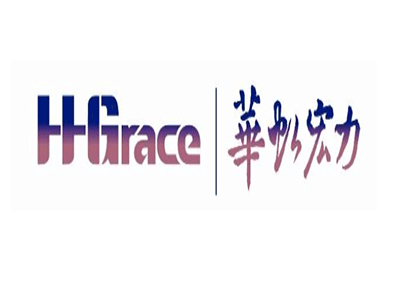



联合化学上半年净利润同比增长21.62%
Zheng Quan Ri Bao· 2025-08-26 04:39
Group 1: Industry Development - The organic pigment industry, particularly azo organic pigments, is evolving towards environmental protection, high performance, and functionality due to stricter environmental regulations, downstream industry upgrades, and growing demand in emerging markets [1] - The company has products that meet EU environmental regulations set for after 2028, positioning itself as a leader in compliance with high standards [1] - The company emphasizes R&D investment in green processes and high-value-added products, collaborating with downstream industries to innovate and maintain market share [1] Group 2: R&D Projects - The company has disclosed nearly 20 major R&D projects, including a new red pigment suitable for UV curing technology, which has completed validation and aims to penetrate the high-growth UV curing market [1] - A functional material that meets customer-specified spectral characteristics is currently in customer trials, achieving an absorption rate of ≥95% in target bands, enhancing the company's position in the specialty materials market [1] Group 3: New Ventures - The company has established a subsidiary, Qichen Semiconductor New Materials, to enter the photoresist field, focusing on the R&D and production of styrene-based photoresist monomers and resins, creating a new profit growth point [1] - The initial design capacity for this project is 200 tons per year, with plans to expand production based on market demand [1] Group 4: Investment Activities - In July, the company announced a 120 million yuan investment in Zhuoguangrui Technology, acquiring a 19.3548% stake to support the development of domestic projection exposure machines and related components [2] - The company has the option to invest an additional 120 million yuan within six months, potentially increasing its stake in Zhuoguangrui to 36.4977% [2] - Zhuoguangrui's subsidiary, Gangjing Optical Technology, has achieved significant sales growth this year, with advance payments exceeding 50 million yuan [2] Group 5: Financial Performance - In the first half of 2025, the company reported revenue of 269 million yuan, a year-on-year increase of 4.15%, and a net profit attributable to shareholders of 33.757 million yuan, up 21.62% year-on-year [4] - The report indicates that this marks the sixth consecutive quarter of year-on-year growth in both revenue and net profit [4]