高纯铟

Search documents
磷化铟-InP-衬底-CPO需求下的供需现状与产能实况
2026-03-01 17:23
Summary of InP Substrate Industry Conference Call Industry Overview - The InP substrate market is expected to reach approximately 700,000 pieces in sales by 2025, with a high market concentration where three companies—Sumitomo, Nippon Mining, and AXT—hold over 90% of the market share [1][5][30]. - Monthly shipment volumes are approximately 30,000 pieces for Sumitomo, 10,000 pieces for Nippon Mining, and 25,000 pieces for AXT, with other domestic suppliers shipping around 2,000 to 3,000 pieces [1][30]. Key Market Insights - The current mainstream sizes for InP substrates are 2, 3, and 4 inches, with prices ranging from 400-500 RMB for 2 inches, 1,500 RMB for 3 inches, and 5,000 RMB for 4 inches [1][6]. - Prices are expected to decline by about 10% annually from 2020 to 2024, but a demand surge in 2025-2026 may lead to a price increase of 20%-30% for exports, while domestic prices are stabilizing due to increased competition and supply [1][6][20]. Production Capacity and Expansion Plans - AXT plans to add 200 units of 4-inch and 50 units of 6-inch crystal growth furnaces by 2026, while Yunnan Zheye plans to add 100 units of 4-inch equipment [1][7]. - Guangdong XianDao is the most aggressive in expansion, planning to add 200 units of 4-inch and 100 units of 6-inch equipment [1][7]. - The expansion of the epitaxy segment is slower than that of the substrate segment, with MOCVD equipment delivery times reaching up to 10 months, creating a bottleneck [1][10]. Supply Chain and Raw Materials - The main suppliers of InP polycrystalline materials are UK-based IQE's WaveTech and domestic supplier Beijing Mingjia [1][8]. - Sumitomo, Nippon Mining, and AXT primarily use IQE/WaveTech's polycrystalline materials, while Guangdong XianDao has some self-synthesis capabilities [1][8]. Technological Insights - The manufacturing process of InP substrates can be divided into two main stages: crystal growth and substrate processing, with significant differences in defect density and crystal quality among various growth methods [3][4]. - The main growth methods include Liquid Encapsulated Czochralski (LEC), Vertical Gradient Freeze (VGF), and Vertical Bridgman (VB), with VGF and VB offering lower defect densities and higher crystal quality [4]. Market Dynamics and Challenges - The current market demand is around 2 million pieces, with a significant supply gap expected to persist until 2027 [10][27]. - The transition to 6-inch substrates is hindered by low yield rates (below 10%) and challenges in temperature control during the crystal growth process [11][13]. - Export controls are tightening, requiring businesses to obtain export licenses, with only AXT's subsidiary, Beijing Tongmei, currently holding such a license [20][31]. Pricing and Cost Structure - The cost structure is heavily influenced by raw material prices, which account for 50%-60% of production costs, with the price of high-purity indium nearly doubling to around 4,000-4,300 RMB/kg [19][21]. - The production cost for 3-inch substrates is approximately 600 RMB, while 4-inch substrates cost around 1,000 RMB [21]. Future Trends - The industry is expected to shift towards larger substrate sizes, with 4-inch and 6-inch becoming the focus, although the transition to 6-inch will take time due to existing technological and production constraints [18][25]. - The demand for 6-inch substrates is driven by applications in high-speed communication modules, but the current production capabilities are limited [12][18]. Conclusion - The InP substrate market is characterized by high concentration among a few key players, significant demand growth, and ongoing challenges related to production capacity and technological advancements. The industry is poised for growth, but careful attention to supply chain dynamics and regulatory environments will be crucial for navigating future opportunities and risks [1][20][27].

云南以创新成果引领区域产业发展
Ke Ji Ri Bao· 2026-02-08 04:05
Core Insights - Yunnan is leveraging technological innovation as a core engine to accelerate the transformation of its industrial structure towards high-end, intelligent, and green development [1] Group 1: Technological Advancements - Yunnan has achieved a 49.3% increase in total R&D investment since the start of the 14th Five-Year Plan, with over 4,100 high-tech enterprises established and a sevenfold increase in technology contract transaction volume compared to the end of the 13th Five-Year Plan [1][2] - The province has made significant breakthroughs in rare and precious metal materials, including the development of high-purity indium and silver nanowires, positioning Yunnan's rare metal cluster among the national advanced manufacturing clusters [2] - In the electronic information sector, Yunnan has overcome technical bottlenecks in indium phosphide radio frequency devices, achieving domestic production of optical module laser chips [2] Group 2: Industry Growth and Innovation Ecosystem - The number of industrial enterprises engaged in R&D activities has increased by 17% since the end of the 13th Five-Year Plan, with a 93% rise in enterprises establishing R&D institutions [3] - Yunnan has over 15,000 technology-based small and medium-sized enterprises, supported by a robust innovation platform system that includes nine national key laboratories and 281 provincial-level technology innovation platforms [3] Group 3: International Collaboration and Community Impact - Yunnan has expanded its international cooperation, establishing 38 international joint laboratories with 21 countries and signing 51 cooperation agreements with regions like Shanghai and Guangdong [5] - Technological innovations have positively impacted local communities, such as the promotion of drone technology in the Nujiang region, which has increased the entire industry chain's output value to over 3 billion yuan [5] - In the healthcare sector, AI-enabled natural drug screening technology has reduced R&D costs, while 3D printing and ultrasound-guided intervention techniques have enhanced patient care [5] Group 4: Future Directions - Yunnan is focusing on integrating artificial intelligence with key sectors such as new materials and biomedicine, aiming to deepen the synergy between technology and industry [6]
铜陵有色盈利波动经营现金流降68% 子公司年赚近15亿境外项目延期
Chang Jiang Shang Bao· 2026-01-05 23:57
Core Viewpoint - The company, Tongling Nonferrous Metals Group, has issued a warning regarding the delay of its subsidiary's overseas project, which is expected to impact its operating performance in 2026 [1][2]. Group 1: Project Delay and Impact - The subsidiary, China Railway Construction Tongguan Investment Co., Ltd. (referred to as "Tongguan"), reported a delay in the Mirador Copper Mine Phase II project, which was initially planned for completion in June 2025 [1][2]. - The project has faced uncertainties in its production timeline due to investment and operational environment factors, affecting the signing of the mining contract [3][2]. - The completion of the Mirador Copper Mine Phase II project is crucial for the company's performance, as its formal production is contingent upon the signing of the mining contract, which is currently uncertain [3][2]. Group 2: Financial Performance - In 2024 and the first eleven months of 2025, Tongguan achieved net profits of 1.487 billion yuan and 1.430 billion yuan, respectively [4]. - The company's net profit for the first three quarters of 2025 was 1.771 billion yuan, a decrease of 35.14% year-on-year, with operating cash flow net amounting to 1.180 billion yuan, down approximately 68% [1][6]. - Despite fluctuations, the company's overall profitability has improved significantly in recent years, with annual net profits exceeding 2 billion yuan since 2021 [6][8]. Group 3: Strategic Expansion and Asset Growth - Tongling Nonferrous has actively expanded its industry layout, acquiring a 70% stake in Tongguan for 6.67 billion yuan, which has enhanced its copper concentrate self-sufficiency and profitability [3][4]. - The company's total assets have grown from 50.84 billion yuan at the end of 2021 to 91.90 billion yuan by September 2025, reflecting its aggressive industrial layout strategy [6]. - The company has also engaged in additional acquisitions, such as obtaining exploration rights for the Jiguanshan-Hucun copper-molybdenum mine for approximately 3.204 billion yuan [6].

研判2025!中国高纯铟行业政策、产业链上下游、市场规模及发展趋势分析:短期承压后回暖,高纯铟行业迎稳健增长新阶段[图]
Chan Ye Xin Xi Wang· 2025-12-08 01:04
Core Insights - The high-purity indium industry in China has experienced rapid growth, becoming a crucial support for semiconductor materials, photovoltaic industries, and electronic device manufacturing. However, in 2023, the market faced a significant downturn due to a deep destocking cycle in the semiconductor market and a persistent slump in the consumer electronics market, leading to a 25% year-on-year decline in market size. A recovery is expected in 2024, with the market size projected to reach 2 billion yuan, a 6% increase year-on-year. The industry is anticipated to continue growing, driven by high-end manufacturing and the expansion of the new energy sector, particularly in semiconductor materials as reliance on high-purity indium increases with advancements in 5G communication, artificial intelligence, and data center construction [1][6]. Industry Overview - High-purity indium is a silver-white metal material purified through processes such as electrolysis, chemical cleaning, and vacuum distillation, achieving purity levels from 5N (99.999%) to 7N8 (99.999998%). It is primarily used in the preparation of III-V semiconductor compounds like indium phosphide (InP) and indium antimonide (InSb), as well as in ITO targets and high-purity alloys. The main production methods include electrolysis, vacuum distillation, zone melting, metal-organic compound methods, and low-halogen compound methods [2][3]. Industry Chain - The upstream raw materials for the high-purity indium industry include primary indium and recycled indium. Primary indium is mostly a byproduct of zinc mining, with China being rich in zinc reserves, particularly in Yunnan, Guangxi, and Hunan. Recycled indium is becoming increasingly important due to stricter environmental policies and tight primary indium supply, with secondary resources like waste ITO targets and liquid crystal panel dismantling waste becoming key supplements. The midstream refers to the high-purity indium industry, while the downstream includes applications in semiconductors, electronics, and new energy sectors [4][5]. Market Size and Trends - China is the largest producer of primary indium, holding 72% of the global reserves. In 2024, the production of primary indium in China is expected to reach 688 tons, a 6.5% year-on-year increase. This growth in primary indium production will ensure a stable supply of raw materials for high-purity indium production. The semiconductor industry, which has strict purity requirements, is projected to grow significantly, with the Chinese semiconductor market expected to reach $630.5 billion in 2024, a 43% increase from $440.4 billion in 2020 [5][6]. Competitive Landscape - The competitive landscape shows that overseas markets for high-purity indium and its oxides have advanced technology and established companies like Dowa and Rasa. In contrast, China's high-purity indium industry has been developing rapidly in recent years, with companies like Zhuzhou Keno New Materials Co., Ltd., Yunnan Tin Company Limited, and Henan Yuguang Gold and Lead Co., Ltd. making significant strides [6][7]. Development Trends 1. Recycled indium is becoming a critical support for supply, with the domestic recycled indium production accounting for about 30% of the total. The market share of recycled indium is expected to continue increasing, with companies focusing on improving recovery technologies for waste materials [10]. 2. The industry concentration is expected to rise, with smaller companies facing challenges due to outdated technology and increasing environmental costs. Leading companies are expanding capacity and securing stable raw material supplies through investments in overseas mines and long-term supply agreements [11][12]. 3. Domestic companies are advancing in high-purity indium production, particularly in the 7N grade, which has historically been dominated by Japanese and Korean firms. With government support and increased R&D investment, companies are expected to overcome key technological barriers and promote green processes to enhance purity stability while reducing energy consumption and emissions [13].





株洲科能冲刺IPO:预计上半年净利水平同比增幅较大,外销规模已超2023年全年
Sou Hu Cai Jing· 2025-11-25 07:39
Core Viewpoint - Zhuzhou Keno New Materials Co., Ltd. is advancing its IPO process on the Sci-Tech Innovation Board, with expectations of significant profit growth in the first half of 2024 due to increased domestic and overseas sales, particularly in semiconductor materials [2][3]. Financial Performance - The company has shown stable revenue and profit levels over the years, with revenues of 571 million, 679 million, and 609 million yuan from 2021 to 2023, and net profits of 28.5 million, 50.9 million, and 42.9 million yuan respectively [4]. - In 2023, domestic sales revenue increased by 31.57%, partially offsetting declines in overseas sales of gallium products [4]. Market Position - Zhuzhou Keno holds leading market shares in high-purity indium (47%), high-purity gallium (22%), and refined indium (25%) in China [3]. - The company is a major supplier of high-purity gallium and indium materials globally, serving key semiconductor manufacturers [6]. IPO Fund Utilization - The total investment for the IPO fundraising is 618 million yuan, with 588 million yuan allocated for projects including a 500-ton semiconductor high-purity materials production project and an advanced materials R&D center [3][4]. Growth Strategy - The company plans to enhance production capacity and market share for high-purity metals, focusing on the semiconductor and renewable energy sectors [5]. - It aims to diversify its product offerings by developing new high-purity materials based on existing technologies and market demands [5]. Export Control Impact - The recent export control policies on gallium have led to increased prices and heightened demand for the company's gallium products, with prices rising from 1685 yuan/kg to 2585 yuan/kg, a 53.4% increase [7]. - The company has successfully obtained export licenses for gallium products from multiple countries, indicating a strong recovery in overseas orders post-policy implementation [7][8].

塑造高精尖锡材竞争力
Jing Ji Ri Bao· 2025-11-10 22:02
Core Insights - Yunnan Tin Industry New Materials Co., Ltd. focuses on the development of high-end tin materials and deep processing, aiming to become a globally competitive enterprise in the tin new materials sector [1][3] - The demand for tin solder materials is increasing due to the rapid development of consumer electronics and automotive electronics in China, with tin solder accounting for approximately 70% of the country's refined tin consumption [1][3] Group 1: Product Development - The company produces various forms of tin solder to meet different welding technology requirements, including syringe solder paste and BGA solder balls, which are essential for high-end chip packaging [2] - The smallest particle size of BGA solder balls produced by the company can reach 80 microns, reflecting the industry's trend towards miniaturization [2] Group 2: Innovation and Research - The company has established several innovation platforms, including a postdoctoral research workstation and various engineering research centers, to drive technological innovation [3] - The company has developed new products such as low-radiation tin, gold-tin balls, and high-purity indium, and holds over 110 authorized invention patents and 20 utility model patents [3] Group 3: Strategic Goals - The company aims to achieve a global market share of 20% for major single products, with a revenue target of 10 billion yuan and a profit target of 1 billion yuan [3] - The vision is to be a leading force in the supply of tin and indium materials in China and an innovator in the global tin and indium materials market [3]
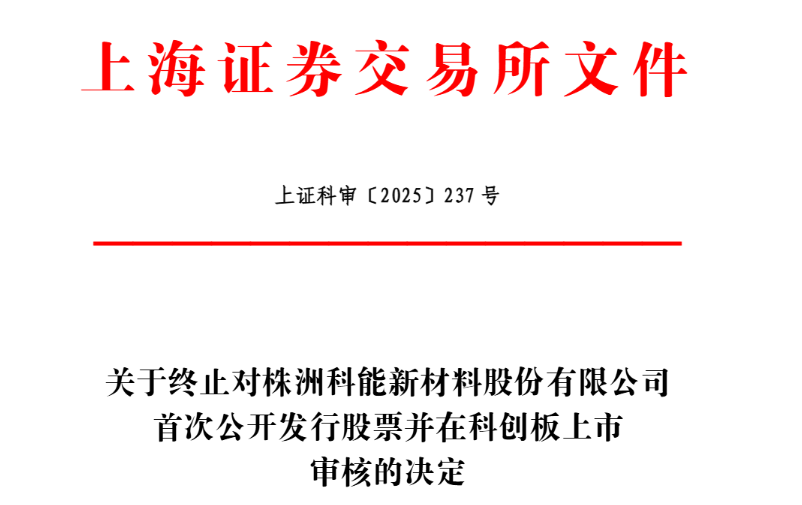
株洲科能终止科创板IPO 原拟募5.88亿元申港证券保荐
Zhong Guo Jing Ji Wang· 2025-11-02 08:06
Core Viewpoint - Zhuzhou Keno has withdrawn its application for an initial public offering (IPO) on the Sci-Tech Innovation Board, leading to the termination of the review process by the Shanghai Stock Exchange [2] Company Overview - Zhuzhou Keno focuses on the development and industrialization of III-V group chemical element material purification technology, primarily engaged in the research, production, and sales of high-purity gallium, indium, bismuth, tellurium, and their oxides [2] - The company's products include high-purity gallium, high-purity indium, refined indium (4N5-5N), indium oxide, gallium oxide, industrial gallium, bismuth, and bismuth oxide, with applications in compound semiconductors, solar cell P-type silicon wafers, ITO target material synthesis, and high-end product manufacturing in pharmaceuticals and chemicals [2] Shareholding Structure - As of the signing date of the prospectus, Zhao Kefa directly holds 23.74% of the company's shares, while Keno Advanced holds 27.05%, collectively controlling 50.80% of the company [3] - Zhao Kefa and Tang Yan, as a couple, directly and indirectly control a total of 61.05% of the company's shares, making them the common actual controllers [3] - Zhao Kefa's brother and sister hold 2.78% and 0.19% of the shares, respectively, forming a concerted action relationship, resulting in a total control of 64.01% of the shares by Zhao Kefa, Tang Yan, and their concerted actors [3] IPO Details - Zhuzhou Keno initially planned to issue up to 36,000,000 shares, accounting for no less than 25% of the total share capital after issuance [3] - The company aimed to raise 588.278 million yuan for projects including an annual production of 500 tons of semiconductor high-purity materials, advanced materials research center construction, and working capital supplementation [3][5] Project Investment - The total investment for the annual production of 500 tons of semiconductor high-purity materials project is 500 million yuan, with an intended funding usage of 470 million yuan [5] - The advanced materials research center for rare metals has a total investment of 68.278 million yuan, with the same amount allocated for funding [5] - The working capital supplementation is planned for 50 million yuan [5]
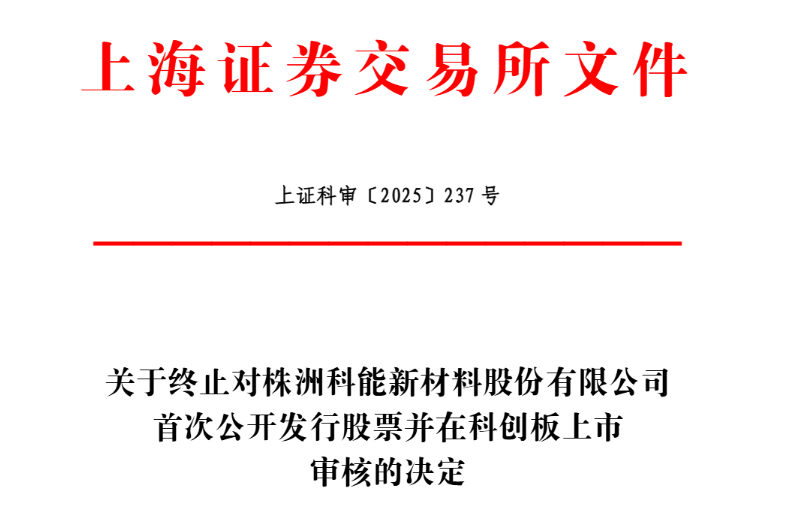
株洲科能终止科创板IPO 原拟募5.88亿元申港证券保荐
Zhong Guo Jing Ji Wang· 2025-11-02 08:00
Core Points - The Shanghai Stock Exchange has decided to terminate the review of Zhuzhou Keno New Materials Co., Ltd.'s application for an initial public offering (IPO) on the Sci-Tech Innovation Board [1][3] - Zhuzhou Keno specializes in the purification technology and industrialization of III-V group chemical element materials, focusing on the research, production, and sales of high-purity gallium, indium, bismuth, and tellurium [3][4] Company Information - As of the signing date of the prospectus, Zhao Kefa directly holds 23.74% of the company's shares, while Keno Advanced holds 27.05%, giving them a combined control of 50.80% of the company [4] - Zhao Kefa and Tang Yan, as a couple, directly and indirectly control a total of 61.05% of the company's shares, making them the actual controllers [4] - The company originally planned to issue up to 36,000,000 shares, aiming to raise approximately 588.28 million yuan for projects related to semiconductor high-purity materials and advanced materials research [4] Underwriting Information - The lead underwriter for the IPO was ShenGang Securities Co., Ltd., with representatives Li Qiang and Ye Hua [5]
株洲科能科创板IPO“终止” 致力于Ⅲ-Ⅴ族化学元素材料提纯技术开发及产业化
Zhi Tong Cai Jing· 2025-10-31 12:33
Core Viewpoint - Zhuzhou Keno New Materials Co., Ltd. has had its IPO review status on the Shanghai Stock Exchange's Sci-Tech Innovation Board changed to "terminated" due to the withdrawal of its listing application by the company and its sponsor [1] Company Overview - The company focuses on the development and industrialization of purification technology for III-V group chemical element materials, primarily engaged in the R&D, production, and sales of high-purity gallium, indium, bismuth, tellurium, and their oxides [1] - Main products include high-purity gallium, high-purity indium, refined indium (4N5-5N), indium oxide, gallium oxide, industrial gallium, bismuth, and bismuth oxide, with applications in compound semiconductors, solar cell P-type silicon wafers, ITO target material synthesis, and high-end product manufacturing in pharmaceuticals and chemicals [1] Market Position - The high-purity gallium and indium produced by the company are critical materials for compound semiconductors and ITO targets, with significant quality impact on their synthesis [2] - The industry is characterized by international competition, with major market shares held by foreign companies such as Indium Corporation, Dowa, Rasa, and 5N Plus, alongside a few domestic players like Zhuzhou Keno [2] - Despite starting late in the high-purity rare metal materials field, the company has leveraged China's position as the largest primary source of rare metals and the rapid rise of domestic downstream manufacturers to enhance its market presence [3] Competitive Advantages - The company has become a major global supplier of high-purity gallium and indium, achieving domestic leadership in product technology and performance [4] - It serves as a primary or sole supplier of high-purity gallium and indium for leading global compound semiconductor manufacturers in China [4] - The company holds a dominant position in the domestic market for ITO and IGZO refined indium, covering major global ITO and IGZO target material manufacturers [4] Financial Performance - The company reported revenues of approximately 679 million RMB, 609 million RMB, and 787 million RMB for the years 2022, 2023, and 2024, respectively, with net profits of 50.82 million RMB, 43.04 million RMB, and 72.07 million RMB during the same periods [5][6]

株洲科能IPO:专科以下占76%的“科技企业”,债务1年激增77倍
Sou Hu Cai Jing· 2025-10-09 01:07
Core Viewpoint - Zhuzhou Keno's debt has surged from 5.27 million to 405 million within a year, marking a staggering increase of 77 times, raising concerns about its IPO application on the Sci-Tech Innovation Board, which is not aligned with its "technology" label [1][3]. Financial Performance - Revenue for Zhuzhou Keno from 2022 to 2024 was reported at 679 million, 609 million, and 787 million respectively, with net profits of 50.82 million, 43.04 million, and 70.82 million, indicating a potential recovery in 2024 [5]. - However, the company has a concerning cash flow situation, with a net cash flow from operating activities of -427 million over the same period, despite a total net profit of approximately 165 million [10][11]. Ownership and Governance Issues - The actual controllers of the company, Zhao Kefu and Tang Yan, have a 14-year history of shareholding proxy arrangements, raising questions about corporate governance and transparency [6][8]. - The company has signed performance-based agreements with all strategic investors except for Zhoushan Gaoshang, which could reactivate if the company fails to complete a qualified IPO by December 2026 [9]. Debt and Cash Flow Concerns - The asset-liability ratio increased dramatically from 10.27% in 2023 to 41.81% in 2024, significantly exceeding the industry average of 40.4% [15][16]. - The company’s interest-bearing debt constitutes 81.69% of total liabilities, indicating a high dependency on debt financing [16]. Inventory and Operational Efficiency - Inventory has surged from 156 million at the end of 2020 to 641 million by the end of 2024, a 420% increase, with inventory accounting for 52.74% of total assets [12][21]. - The inventory turnover days increased from 147.02 days in 2020 to 242.95 days in 2024, with a turnover rate dropping from 3.64 times to 1.45 times, well below the industry average of 3.02 times [12][14]. Research and Development - R&D expenditures from 2022 to 2024 were 29.81 million, 28.53 million, and 30.32 million respectively, with R&D expense ratios declining from 4.39% to 3.85%, falling below the implicit 5% threshold for Sci-Tech Innovation Board companies [30][31]. - The educational background of employees is concerning, with 76.02% holding a diploma or lower, which raises doubts about the company's technological capabilities [32]. Market Position and Risks - The company has a high customer concentration risk, with significant reliance on a few major clients, which could pose a threat to its business stability [37]. - The cyclical nature of the rare metal industry, coupled with the company's substantial debt, increases operational risks, especially in a potential downturn [24][26].