
绿色经济合作

Search documents
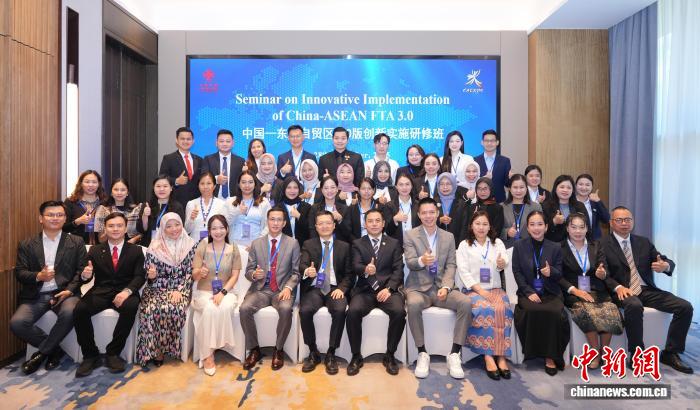
中国—东盟自贸区3.0版创新实施研修班开班
Guang Xi Ri Bao· 2025-11-28 02:25
Group 1 - The China-ASEAN Free Trade Area (FTA) 3.0 version training program has been launched in Nanning, attracting 41 participants from ASEAN countries and the ASEAN Secretariat [1] - The training program is part of the efforts to enhance the implementation of the FTA 3.0 version, which has seen significant progress from previous versions [1] - The 22nd China-ASEAN Expo has focused on the FTA 3.0 version theme, releasing the "China-ASEAN Economic and Trade Cooperation Outlook Report (2025-2026)" for two consecutive years [1] Group 2 - During the training program, government officials and experts will conduct lectures on the FTA 3.0 version and green economy cooperation prospects [2] - Participants will visit the China-ASEAN Artificial Intelligence Application Cooperation Center and the China-Vietnam Friendship Pass to explore practical paths for development opportunities [2] - The training program aims to build consensus and strengthen the foundation for the innovative implementation of the FTA 3.0 version [2]
中国—东盟自贸区3.0版创新实施研修班在南宁启动
Zhong Guo Xin Wen Wang· 2025-11-24 13:12
Core Viewpoint - The China-ASEAN Free Trade Area 3.0 Innovation Implementation Training Course has been launched in Nanning, aimed at enhancing understanding and cooperation among ASEAN countries regarding the upgraded free trade agreement [1][3]. Group 1: Training Course Details - The training course, organized by the Ministry of Commerce and the China-ASEAN Expo Secretariat, commenced on November 24 and will last for five days [1][4]. - It attracted 41 participants from nine ASEAN countries, including Brunei, Cambodia, Indonesia, Laos, Malaysia, Myanmar, the Philippines, Thailand, and Vietnam, as well as representatives from the ASEAN Secretariat [1][3]. Group 2: Objectives and Activities - The course will cover new opportunities for cooperation under the China-ASEAN Free Trade Area 3.0 and the prospects for green economic collaboration [4]. - Participants will visit various sites, including the China-ASEAN Artificial Intelligence Application Cooperation Center and the Chongzuo High-tech Industrial Development Zone, to explore how to effectively leverage the benefits of the 3.0 version of the free trade area [4]. Group 3: Context and Significance - The 22nd China-ASEAN Expo has focused on the theme of the 3.0 version of the free trade area, releasing the "China-ASEAN Economic and Trade Cooperation Outlook Report (2025-2026)" for the second consecutive year [3]. - The signing of the upgrade protocol for the China-ASEAN Free Trade Area 3.0 marks a new chapter in the partnership, with expectations for accelerated cooperation and regional prosperity [3][4].

中国与东盟携手打造周边命运共同体新范式
Jing Ji Ri Bao· 2025-05-29 22:03
Core Viewpoint - The completion of the China-ASEAN Free Trade Area 3.0 negotiations marks a significant step towards signing the upgraded protocol by the end of this year, aiming to foster a mutually beneficial cooperation model amidst unprecedented global trade challenges [1][2]. Group 1: Trade and Economic Cooperation - The China-ASEAN Free Trade Area 3.0 aims to counteract rising global trade protectionism and unilateralism, with 169 new trade restrictive measures reported by the WTO, affecting approximately $887.6 billion in goods trade [2]. - The trade value between China and ASEAN is projected to reach 6.99 trillion yuan in 2024, reflecting a growth of 9.0%, which constitutes 15.9% of China's total foreign trade [3]. - China and ASEAN have committed to enhancing supply chain connectivity, ensuring the free flow of key products and services, and improving infrastructure connectivity to stabilize regional supply chains [3]. Group 2: Market Integration and Consumer Protection - The combined population of China and ASEAN exceeds 2 billion, creating a significant internal market that is crucial for addressing external risks [4]. - In 2024, China's retail sales are expected to reach 48.8 trillion yuan, while ASEAN's consumer spending is projected to hit $2.2 trillion, highlighting the region's importance as a consumer market [4]. - New rules in the Free Trade Area 3.0 include online consumer protection and tourism consumer protection, aimed at optimizing the market environment and fostering new consumption patterns [4]. Group 3: Digital Economy and Innovation - China and ASEAN are enhancing digital economic cooperation by improving digital infrastructure and aligning standards for digital trade, which is essential for building an open innovation ecosystem [5]. - The collaboration in the digital economy is expected to empower ASEAN's manufacturing transformation and provide extensive market opportunities for digital technology applications [5]. Group 4: Green Economy and Sustainable Development - The Free Trade Area 3.0 emphasizes green economic cooperation, focusing on green trade, investment, and standards to promote sustainable energy and reduce carbon emissions [6]. - The partnership aims to create a mutually beneficial electric vehicle ecosystem, leveraging China's technological advantages to enhance regional automotive industry competitiveness [6]. Group 5: Inclusive and Practical Cooperation - The negotiations reflect a commitment to inclusive and practical economic cooperation, addressing development imbalances and supporting less developed ASEAN countries [7]. - China has maintained its position as ASEAN's largest trading partner for 16 consecutive years, while ASEAN has been China's largest trading partner for five years, indicating a resilient economic relationship [7].