网络安全法规

Search documents
受中国市场需求疲软及欧盟网络安全新规影响 保时捷2025年交付量下滑10%
Xin Lang Cai Jing· 2026-01-16 08:19
德国跑车制造商保时捷于周五发布公告称,公司2025年全球汽车交付量同比下滑10%,与奔驰、 BMWYY>宝马等德国同行一道陷入业绩疲软的局面。 该车企表示,尽管北美市场销量保持稳定增长,但公司在中国、德国及欧洲其他地区的销量分别大幅下 滑26%、16%和13%。 该车企在一份声明中表示,欧洲市场销量下滑是受欧盟网络安全法规的影响;而在中国市场,保时捷不 仅面临豪华车细分市场的严峻竞争环境,还需应对纯电动车型领域的激烈角逐。 该车企在一份声明中表示,欧洲市场销量下滑是受欧盟网络安全法规的影响;而在中国市场,保时捷不 仅面临豪华车细分市场的严峻竞争环境,还需应对纯电动车型领域的激烈角逐。 保时捷称,2025年其全球交付量中,纯电动车型占比达22.2%,插电式混合动力车型占比为12.1%。 该公司指出:"这使得纯电动车型的全球销量占比达到了2025年20%至22%既定目标区间的上限。" 责任编辑:李肇孚 德国跑车制造商保时捷于周五发布公告称,公司2025年全球汽车交付量同比下滑10%,与奔驰、 BMWYY>宝马等德国同行一道陷入业绩疲软的局面。 保时捷2025年共交付汽车279449辆,而2024年的交付量为310 ...
物联网企业出海必须关注的20+数据/网络安全/AI/可持续法规
3 6 Ke· 2025-09-05 13:30
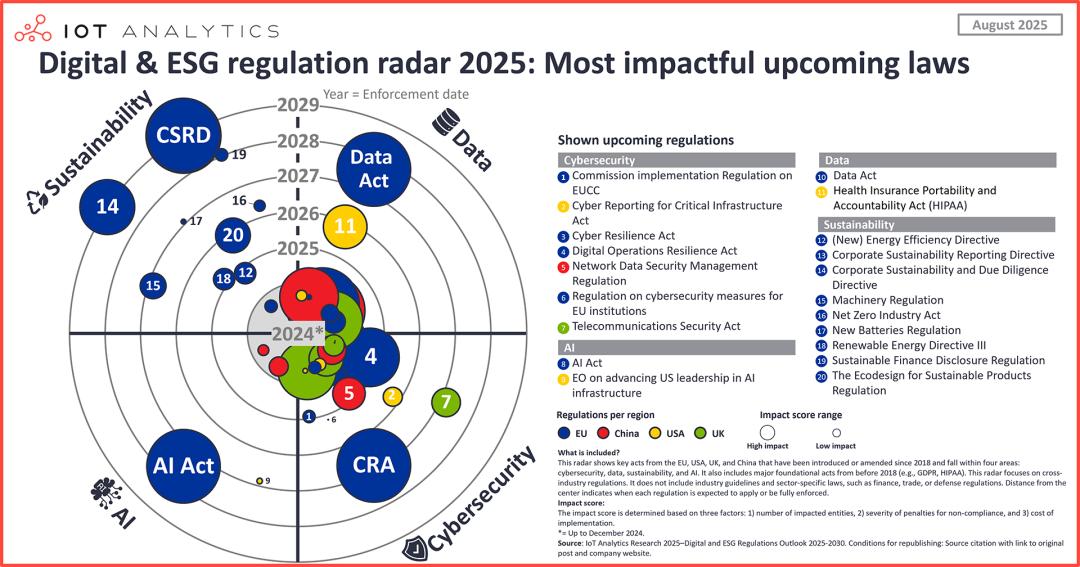
Core Insights - Recent regulations from the EU, US, China, and the UK regarding data governance, ESG disclosure, and cybersecurity have significantly impacted IoT companies, particularly those from China aiming for global expansion [1][3]. Regulatory Overview - Compliance with regulations has become a prerequisite for market entry, with higher demands for data security, device safety certification, and personal privacy protection. Failure to establish compliance mechanisms can lead to hefty fines, sales bans, and loss of access to key markets [1][3]. - New ESG and sustainability regulations are rapidly raising the reputation and trust thresholds for companies, making compliance a competitive advantage in the context of increasing geopolitical regulatory scrutiny [1][3]. Key Regulations to Monitor - The article outlines 20+ critical regulations that IoT companies must pay attention to, categorized into four main areas: data regulations, cybersecurity regulations, artificial intelligence regulations, and sustainability regulations [3][6]. Data Regulations - The EU's General Data Protection Regulation (GDPR) is the global benchmark for personal data protection, imposing strict user rights and severe penalties for non-compliance, including fines up to €20 million or 4% of global revenue [4][5]. - The EU Data Act, effective from September 12, 2025, mandates fair access and sharing of data among businesses and individuals, with penalties for non-compliance [7][8]. Cybersecurity Regulations - The US's Critical Infrastructure Cyber Incident Reporting Act (CIRCIA) requires critical infrastructure entities to report significant cyber incidents within 72 hours, with penalties determined through civil litigation [19]. - The IoT Cybersecurity Improvement Act mandates federal agencies to procure IoT devices that meet specific security standards, with penalties for non-compliance [21][22]. Artificial Intelligence Regulations - The EU's AI Act, effective from August 1, 2024, introduces a comprehensive regulatory framework for AI systems, categorizing risks and imposing strict obligations on high-risk AI applications [35][36]. - China's interim measures for generative AI services emphasize compliance with data training requirements and respect for intellectual property rights [32][34]. Sustainability Regulations - The EU's Corporate Sustainability Reporting Directive (CSRD) requires companies to disclose their environmental impact and sustainability goals, with third-party audits mandated for accuracy [42]. - The Carbon Border Adjustment Mechanism (CBAM) aims to equalize carbon costs for imported high-carbon products, with implementation phases starting from October 2023 [40][41]. Conclusion - The evolving regulatory landscape necessitates that IoT companies proactively adapt to these changes to maintain market access and competitive positioning in a global context [1][3].