美元创造

Search documents
Arthur Hayes 博文:SRF 的启用与隐性量化宽松
Sou Hu Cai Jing· 2025-11-05 04:25
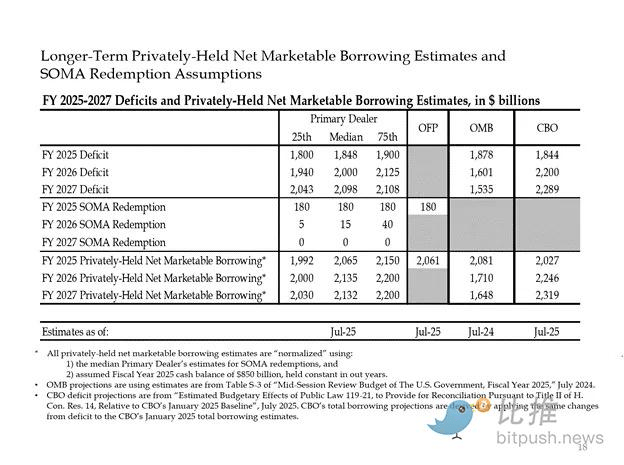
Group 1 - The article discusses the inevitability of government debt and the political incentives behind it, emphasizing that governments prefer to issue debt rather than raise taxes to fund expenditures [2][3] - It highlights the relationship between government borrowing and the Federal Reserve's balance sheet, suggesting that an increase in government debt will lead to an increase in the money supply, benefiting the liquidity of the dollar and potentially driving up the prices of Bitcoin and other cryptocurrencies [3][32] - The article outlines the projected federal deficits, estimating around $2 trillion annually, and discusses the implications for U.S. Treasury bond issuance and financing [6][7] Group 2 - The article identifies the primary buyers of U.S. debt, including foreign central banks, the private sector, and commercial banks, concluding that the marginal buyers are RV hedge funds, particularly those based in the Cayman Islands [9][14][12] - It explains the trading strategies of RV funds, which involve buying U.S. Treasury bonds and financing these purchases through repurchase agreements (repos) [19][21] - The article discusses the role of the Federal Reserve in managing short-term interest rates and how it influences the liquidity in the market, particularly through tools like the Standing Repo Facility (SRF) [22][28] Group 3 - The article warns of a potential liquidity crisis if RV funds cannot secure financing at favorable rates, which would hinder their ability to purchase U.S. debt and impact government financing [27][26] - It introduces the concept of "stealth quantitative easing," suggesting that the SRF will become a primary channel for injecting liquidity into the financial system without being labeled as traditional quantitative easing [32][31] - The article concludes that the current market stagnation presents opportunities, particularly as the government prepares to release additional liquidity once operations resume, which could reignite interest in cryptocurrencies [33]