
量化紧缩

Search documents
美联储6.6万亿资产负债表“瘦身”将是漫长苦战,华尔街急评四大路径!
Jin Shi Shu Ju· 2026-02-18 03:26
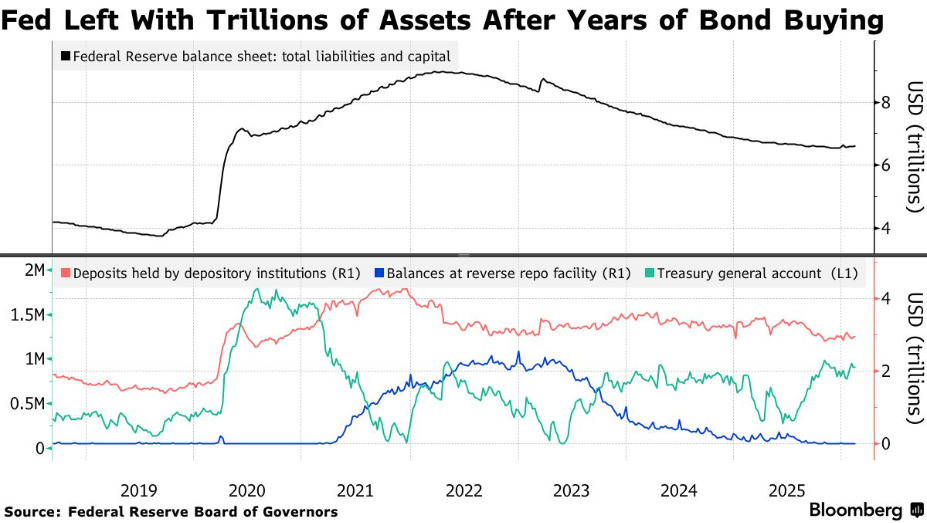
Core Viewpoint - The potential paths for Federal Reserve Chairman candidate Kevin Warsh to reduce the central bank's $6.6 trillion balance sheet are numerous, but the process will be costly and time-consuming [1] Group 1: Current Situation - The Federal Reserve's balance sheet has expanded significantly after years of bond purchases [3] - The upcoming January policy meeting minutes are expected to reveal policymakers' latest views on the balance sheet [1] Group 2: Proposed Paths for Reduction - Possible paths include relaxing regulations that encourage banks to hold large cash reserves, shortening the average maturity of the Fed's asset holdings, stopping short-term Treasury purchases, or even directly selling securities [4] - A less likely option is to restart the asset reduction process, known as quantitative tightening, which the Fed abandoned in December due to increased government borrowing leading to market tensions [4] Group 3: Challenges and Considerations - Analysts suggest that even if the Fed stops purchasing short-term Treasuries by June, reserves may not significantly decline by December 2026 [6] - Regulatory adjustments to reduce banks' demand for reserves could take time, with potential reforms not expected until mid-2027 [8] - If the Fed chooses to reinvest a portion of its maturing assets into short-term Treasuries, it could align its asset maturity with the Treasury's issuance schedule by mid-2029 [9] Group 4: Asset Sales - Policymakers have discussed the possibility of selling assets, particularly mortgage-backed securities, which could lead to increased operational losses for the Fed [10] - However, over time, the Fed's profitability may improve as it would stop receiving interest below its paid rates [10]

华尔街推演沃什上台后美联储缩表路径 预计央行将付出高昂代价
Sou Hu Cai Jing· 2026-02-17 21:36
Core Viewpoint - Wall Street strategists believe that Kevin Warsh, the Federal Reserve chairman nominated by Trump, has multiple avenues to reduce the Fed's $6.6 trillion balance sheet, but the process is costly and time-consuming [1] Group 1: Potential Strategies for Balance Sheet Reduction - Possible strategies for balance sheet reduction include relaxing regulations that encourage banks to hold large amounts of cash reserves at the central bank [1] - Another option is to shorten the average maturity of the Fed's holdings [1] - The Fed could also cease purchasing Treasury securities or even directly sell securities [1] Group 2: Challenges and Timeframe - A less likely option is to resume balance sheet reduction through quantitative tightening, which was abandoned in December due to increased borrowing by the government leading to pressure in the money markets [1] - Following this, the Fed shifted to purchasing Treasury securities to inject reserves back into the system [1] - Regardless of the path taken under Warsh's leadership, it may take several years to implement any of these strategies [1]
特朗普提名沃什接任美联储主席 缩表主张遇多重阻力 美联储资产负债表从9万亿峰值降至6.6万亿后重启扩表
Sou Hu Cai Jing· 2026-02-17 13:22
Core Viewpoint - The potential nomination of Kevin Warsh as the next Federal Reserve Chair raises questions about the future direction of monetary policy, particularly regarding the reduction of the Fed's balance sheet and interest rates [1][2]. Group 1: Kevin Warsh's Position - Kevin Warsh, a former Fed governor, has been critical of the Fed's use of bond and cash holdings as policy tools and advocates for a significant reduction in the Fed's balance sheet to avoid market distortions [1]. - Despite Warsh's views, Treasury Secretary Yellen indicated that the Fed would not quickly implement a balance sheet reduction, suggesting it could take up to a year to make decisions on adjustments [1]. Group 2: Current Fed Balance Sheet Context - The Fed's balance sheet expanded significantly during the global financial crisis and the COVID-19 pandemic, peaking at $9 trillion in the summer of 2022, before being reduced to $6.6 trillion by November 2025 [1]. - The Fed is expected to restart balance sheet expansion in December 2025, initiating a short-term Treasury purchase program to maintain control over interest rate targets [1]. Group 3: Market Reactions and Predictions - Goldman Sachs noted that the market may misinterpret Warsh's stance, suggesting that under his leadership, the Fed may not necessarily raise interest rates and could still consider rate cuts and quantitative easing [2]. - Citigroup strategists highlighted that the threshold for restarting quantitative tightening is high, which could pressure the $12.6 trillion repurchase market, and the FOMC is likely to prefer a gradual approach to balance sheet management to avoid market volatility [2]. - Concerns exist that tightening liquidity could increase long-term Treasury yields and mortgage rates, conflicting with the White House's affordability goals for housing [2].
别被“鹰派”标签骗了!沃什执掌美联储,结局比你想的要更温和!
Sou Hu Cai Jing· 2026-02-14 10:27
Core Viewpoint - The nomination of Kevin Warsh as the next Federal Reserve Chair has raised concerns in the market due to his reputation as a hawkish figure who may aggressively reduce the Fed's balance sheet, potentially impacting monetary policy and market expectations [1][3]. Group 1: Federal Reserve's Balance Sheet Management - Warsh's core belief is that the Fed's balance sheet is too large, and aggressive reduction could create room for more significant interest rate cuts, achieving a combination of tightening assets while loosening rates [3][5]. - The Fed recently completed a tightening cycle, reducing its total assets from approximately $8.9 trillion to around $6.5 trillion, a decrease of about $2.2 trillion, with securities held dropping from 33% to 20% of nominal GDP [5][6]. - The Fed has entered a phase of technical expansion, purchasing about $35-40 billion in short-term Treasury securities monthly to maintain bank reserves, indicating that a rapid reduction of the balance sheet is unlikely [5][6]. Group 2: Current Monetary Policy - The Fed's quantitative tightening began in June 2022, with a maximum reduction of $95 billion per month, which was maintained for over two years before slowing down [6][8]. - As of mid-January 2026, the Fed's total assets are approximately $6.58 trillion, with expectations to rise to between $6.9 trillion and $7.1 trillion by the end of 2026 [8]. - Interest rates were reduced significantly in 2024, but the Fed has since adopted a wait-and-see approach, with no immediate plans for further cuts, indicating a stable interest rate environment for at least the first half of 2026 [8][9]. Group 3: Future Outlook - The upcoming FOMC meeting is expected to maintain the current stance, with a majority of voting members favoring a wait-and-see approach [9][11]. - Warsh's potential strategies may include a gradual reduction of the balance sheet, adjusting the scale and pace of reserve management purchases rather than a direct resumption of large-scale reductions [11][14]. - The Fed's balance sheet has expanded significantly since the 2008 financial crisis, and while there is room for reduction, the pace and path will depend on various factors, including economic data and financial stability [14][16].
为什么比特币近期对流动性状况的反应大于对降息的反应?
Sou Hu Cai Jing· 2026-02-13 04:50
Core Viewpoint - The relationship between interest rate cuts by the Federal Reserve and Bitcoin (BTC) price movements has weakened, with Bitcoin's volatility increasingly reflecting actual liquidity in the financial system rather than just changes in borrowing costs [2][4]. Group 1: Interest Rates vs. Liquidity - Bitcoin's recent price changes are more influenced by actual cash supply and risk capital in the system rather than solely by interest rate adjustments [4]. - Liquidity and interest rates are distinct; liquidity reflects the total amount and flow of money in the market, while interest rates measure the cost of funds [4][11]. - Even when interest rates are lowered, if liquidity is being drained through other channels, such as quantitative tightening or U.S. Treasury operations, overall liquidity can still tighten [2][4]. Group 2: Market Dynamics - Bitcoin is increasingly seen as a "canary asset" that signals tightening liquidity ahead of traditional markets, often leading to declines in stocks and commodities [3]. - During periods of ample liquidity, risk appetite expands, leading to higher Bitcoin prices; conversely, when liquidity tightens, rapid deleveraging occurs, often resulting in simultaneous declines across Bitcoin, stocks, and commodities [10][11]. - The market's response to liquidity changes is more pronounced than to marginal changes in interest rates, indicating that Bitcoin acts as a real-time barometer of liquidity conditions [6][13]. Group 3: Federal Reserve and Treasury Actions - The Federal Reserve's balance sheet policies and the U.S. Treasury's cash management directly influence liquidity, often having a greater impact on Bitcoin than interest rate changes [11][13]. - Unexpected liquidity shocks can have a more significant effect on the market than anticipated interest rate changes, as liquidity changes are less predictable and transparent [11][13]. - The Treasury General Account (TGA) balance and cash flow from the Treasury serve as indicators of liquidity pressure or easing in the market [14].

如何看待特朗普提名沃什担任美联储主席?
Hua Yuan Zheng Quan· 2026-02-11 09:09
Group 1: Nomination and Background - President Trump nominated Kevin Warsh as the next Federal Reserve Chairman after months of competition, highlighting his strong ties to Wall Street and alignment with Trump's low-interest rate agenda[2] - Warsh's unique supply-side economic framework connects traditional Republican monetary principles with Trump's aggressive growth objectives, proposing that inflation can be managed through productivity enhancements without raising rates[2] - His criticism of quantitative easing and the Fed's large balance sheet suggests a potential shift towards quantitative tightening if appointed[2] Group 2: Economic Philosophy and Policy Implications - Warsh's economic philosophy has evolved from a crisis pragmatist to a supply-side advocate, emphasizing that true economic growth stems from productivity improvements rather than monetary stimulus[5][8] - He argues against the Phillips Curve trade-off, asserting that the U.S. can achieve high growth and low inflation simultaneously through proper policy reforms[8] - Warsh's radical proposal includes significantly reducing the Fed's $7 trillion balance sheet, which he believes distorts market signals and contributes to financial repression[10] Group 3: Regulatory and Market Impact - His stance on financial regulation favors market discipline over administrative oversight, criticizing the Dodd-Frank Act for creating a false sense of security and hampering banks' ability to serve the economy[12] - Warsh's opposition to the Basel III finalization could lead to reduced capital requirements for banks, potentially unlocking significant buyback capacity[12] - The market anticipates that his leadership may result in a loosening of regulations, particularly concerning major financial institutions[2] Group 4: Risks and Uncertainties - There are concerns about the uncertainty of Fed policies under Warsh, particularly regarding potential political interference in the Fed's independence[15] - Investors are wary of the risks associated with accelerated balance sheet reduction, which could disrupt the supply-demand balance in U.S. Treasuries[16] - The fear of premature interest rate cuts under political pressure could lead to a resurgence of inflation, increasing financing costs for the real economy[16]
巴克莱:美联储缩表将耗时多年 或需降息对冲 五年市场需额外吸收1.7万亿美元10年期等价债务推高成本40——50基点
Sou Hu Cai Jing· 2026-02-10 23:36
Group 1 - The core viewpoint is that the transition to a smaller Federal Reserve balance sheet requires close coordination between the central bank and the Treasury to avoid excessive market volatility [1] - The normalization of the balance sheet is expected to be a multi-year process, with potential risk premiums demanded by investors during the transition [1][3] - The Federal Reserve's balance sheet peaked at approximately $8.9 trillion in June 2022, significantly expanded from $800 billion two decades ago, and is projected to decrease to $6.6 trillion by November 2025 [1] Group 2 - Barclays notes that the Federal Reserve could reduce its balance sheet by stopping the Reserve Management Purchases (RMP), but this may lead to renewed funding pressures [2] - To achieve meaningful balance sheet reduction, the demand for reserves by banks must be lowered, with current bank reserves at $2.94 trillion and a suggested reduction in the reserve ratio from 12% to 8-9% [2] - An alternative approach involves reinvesting maturing long-term government bonds and mortgage-backed securities into short-term government debt, which requires close coordination with the Treasury to avoid increasing long-term bond issuance costs [2] Group 3 - Both proposed outcomes are not ideal for the Treasury, and the Federal Reserve may ultimately need to lower policy rates to counteract the tightening market environment [3] - Significant balance sheet reduction is feasible, provided that the Federal Reserve and the Treasury have clear and aligned objectives to stabilize market expectations [3]

经济大游泳池:美联储如何管理“水位”?
Sou Hu Cai Jing· 2026-02-10 13:39
Group 1 - The core concept of "balance sheet reduction" (缩表) is to decrease the Federal Reserve's balance sheet by withdrawing excess liquidity from the market to combat inflation [6][7][8] - The assets on the balance sheet primarily consist of U.S. Treasury securities and mortgage-backed securities (MBS) [4] - The liabilities include the dollars printed and circulated in the market, as well as reserves held by commercial banks at the Federal Reserve [5] Group 2 - The Federal Reserve employs two main methods for balance sheet reduction: passive reduction by stopping reinvestment of maturing bonds and active reduction by directly selling assets [7][8] - The goal of balance sheet reduction is to recover excess liquidity created during the pandemic and to raise long-term interest rates, which can suppress total demand by increasing borrowing costs for businesses and individuals [9][10] Group 3 - The impact of balance sheet reduction is felt globally, as it can lead to a decrease in market liquidity, potentially raising borrowing rates and putting pressure on asset prices in the U.S. [11][12] - The Federal Reserve's recent announcement to end the current round of quantitative tightening by December 1, 2025, marks a significant shift in monetary policy [13] Group 4 - The combination of interest rate cuts and balance sheet reduction is seen as a "policy paradox," aiming to shift the economy from reliance on external monetary expansion to internal credit creation [15][16] - The proposed reforms aim to redirect capital from financial speculation to real investment, supporting small businesses and technological innovation [18] Group 5 - The anticipated effects of these policies include a healthier, market-driven interest rate system that enhances resource allocation efficiency [21] - The strategy involves a phased approach: first lowering interest rates, then easing financial regulations, and finally implementing gradual balance sheet reduction [25][27] Group 6 - The potential global impact of these policies includes increased capital outflows from emerging markets and pressures on foreign currency debt repayment [29] - The success of the proposed policies hinges on the ability to recover liquidity without triggering economic contraction, relying on advancements in productivity and cost control measures [30]
贝森特重磅表态,事关美联储缩表
美股研究社· 2026-02-10 11:10
Core Viewpoint - The U.S. Treasury Secretary, Becerra, indicated that the Federal Reserve is unlikely to quickly reduce its balance sheet, even with the nomination of a critic of the bond-buying program, suggesting a cautious and wait-and-see approach to balance sheet management [2][4][7]. Group 1: Policy Expectations - Becerra emphasized that any adjustments to the balance sheet will depend on the Federal Reserve's own decisions, and if a "plentiful reserves" policy is adopted, a larger balance sheet will be necessary [4][7]. - He projected that the Federal Reserve might take at least a year to decide on its future course of action regarding the balance sheet, providing a longer buffer for investors to assess the liquidity environment [4][7]. Group 2: Historical Context of the Balance Sheet - The Federal Reserve's balance sheet expanded significantly during the global financial crisis and the COVID-19 pandemic, peaking at $9 trillion in the summer of 2022 [9]. - Following this peak, the Fed initiated a quantitative tightening process, allowing its assets to mature without reinvestment, which is expected to reduce the balance sheet to $6.6 trillion by the end of 2025 [9]. Group 3: Nominee's Position and Policy Goals - The focus on the new Fed Chair nominee, Waller, reveals a potential conflict between aggressive balance sheet reduction and the goal of lowering mortgage rates, as a reduction typically exerts upward pressure on long-term rates [12][13]. - Becerra's comments suggest that even with Waller's hawkish stance, a more cautious strategy may prevail due to multiple policy objectives and real-world constraints [13].

关于美联储缩表的常见问题-Federal Reserve Monitor-FAQs on a smaller Fed footprint
2026-02-10 03:24
Summary of Key Points from the Conference Call Industry Overview - The focus of the conference call is on the Federal Reserve's balance sheet policies and the implications of a smaller Fed footprint in the financial markets. Core Insights and Arguments - **Balance Sheet Reduction Tools**: The Federal Reserve can reduce its balance sheet through two methods: passive quantitative tightening (QT) and active QT. Passive QT involves allowing securities to mature without reinvestment, while active QT involves selling selected securities directly, which can lead to increased market volatility and potential losses [5][9][12]. - **Liquidity Implications**: Reducing the balance sheet drains liquidity from the financial system. A decrease in assets leads to a reduction in Fed liabilities, tightening financial conditions and increasing volatility as reserves transition from "ample" to "scarce" [5][11][13]. - **Mortgage-Backed Securities (MBS) Runoff**: The runoff of MBS is expected to be slow due to elevated mortgage rates, which have limited prepayment speeds. The Fed's MBS portfolio may take years to decline naturally without active sales, which would require significantly lower mortgage rates [10][24][27]. - **Regulatory Considerations**: To effectively shrink the balance sheet, there must be a reduction in banks' demand for reserves, potentially requiring changes to liquidity regulations such as the Liquidity Coverage Ratio (LCR) and Internal Liquidity Stress Test (ILST). Lower liquidity buffers could increase financial stability risks [11][64][67]. - **Treasury Coordination**: Adjustments to Treasury General Account (TGA) targets or the issuance mix can influence how balance sheet reduction flows through the system and affect the maturity structure of the Fed's portfolio [11][87]. Additional Important Insights - **Impact of New Fed Chair**: The nomination of Kevin Warsh as the new Chair of the Board of Governors has renewed focus on the Fed's balance sheet policies. Warsh has criticized the Fed for its large footprint in financial markets, emphasizing the need for a smaller balance sheet and less market intervention [6][7]. - **Profitability Concerns**: The Fed has faced operating losses since September 2020, as interest earned from low-yielding securities has not covered the interest paid on reserves. Active sales of MBS could exacerbate these losses but may lead to improved profitability in the long run [32][41][38]. - **Market Volatility**: A smaller Fed footprint could lead to higher volatility in macro markets, as reduced communication and guidance from the Fed may result in less consensus among investors and more policy surprises [87][88]. Conclusion - The Federal Reserve's approach to balance sheet reduction is complex and involves significant trade-offs between liquidity, market functioning, and financial stability. The implications of these policies will be closely monitored as the Fed navigates its new leadership and economic conditions.