
美国国家利益

Search documents
美媒曝光特朗普国情咨文 提及住房、成本、国家安全等内容
Ge Long Hui· 2026-02-25 02:04
2月25日,据华尔街日报透露的特朗普国情咨文节选,特朗普将表示,美国实现了前所未有的变革,实 现了划时代的转变。再也不会回到不久前的境地了。 美股频道更多独家策划、专家专栏,免费查阅>> 责任编辑:山上 特朗普将表示,展望未来,工厂、就业、投资和数万亿美元将继续涌入美国,"因为我们终于有了一位 真正把美国放在首位的总统。"此前的情况恰恰相反。从贸易到医疗保健,从能源到移民,一切都被窃 取和操纵,目的就是榨干那些辛勤工作、为国家运转做出贡献的人民的财富。特朗普将表示,要终结处 方药价格的飞涨,请求国会永久实施禁止华尔街大型投资公司大量收购独栋住宅的禁令,因为房屋是属 于人的,而不是企业的。特朗普将表示,美国也在恢复美国在西半球的安全和主导地位,采取行动维护 国家利益,保卫国家免受暴力、毒品、恐怖主义和外国干涉的侵害。 ...
美国启动66个国际组织和多边机制退出程序 包括《联合国气候变化框架公约》
Zhong Guo Xin Wen Wang· 2026-01-08 08:14
Core Viewpoint - The article discusses President Trump's memorandum directing the U.S. government to initiate the withdrawal from 66 international organizations, UN agencies, and multilateral mechanisms, citing that these entities "contradict U.S. national interests" [1] Group 1: International Organizations and Multilateral Mechanisms - The memorandum lists 35 international organizations or multilateral institutions and 31 UN framework agencies and multilateral mechanisms, including those related to climate change [1] - Key organizations mentioned include the Intergovernmental Panel on Climate Change and the United Nations Framework Convention on Climate Change, along with various renewable energy and climate cooperation platforms [1] Group 2: Actions and Implications - Trump instructed relevant U.S. government departments to take immediate action to withdraw from these organizations within the shortest legal timeframe [1] - The memorandum specifies that withdrawal from UN framework agencies means stopping participation or ceasing funding to these entities as legally permissible [1] Group 3: Climate Change Agreements - Upon starting his second term, Trump signed an executive order on January 20, 2025, to withdraw from the Paris Agreement aimed at addressing climate change and to continue the withdrawal process from the World Health Organization (WHO) [1]
美国副总统万斯:委内瑞拉只有在“符合美国利益”的情况下才能出售其石油
Xin Lang Cai Jing· 2026-01-08 04:34
Core Viewpoint - The U.S. Vice President stated that Venezuela can only sell its oil if it aligns with U.S. interests, indicating a significant influence of U.S. policy on Venezuela's oil sales [1] Group 1: U.S. Policy on Energy Resources - The U.S. claims control over energy resources and communicates to the Venezuelan regime that oil sales are contingent upon alignment with U.S. national interests [1] - The statement reflects a broader strategy of the U.S. to leverage its influence over global energy markets, particularly in relation to countries like Venezuela [1]

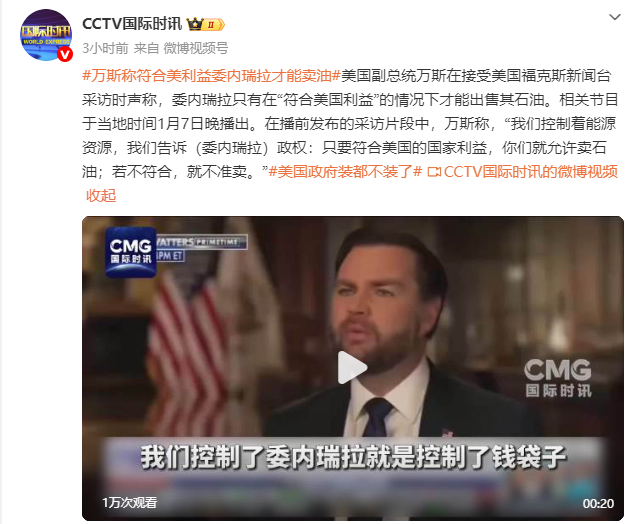
美国副总统:委内瑞拉想卖石油 必须符合美国利益
Zhong Guo Xin Wen Wang· 2026-01-08 03:15
Core Viewpoint - The U.S. Vice President stated that Venezuela can only sell oil if it aligns with U.S. interests, indicating a strong influence of the U.S. over Venezuela's economic activities [1]. Group 1: U.S. Influence on Venezuela's Oil Sales - The U.S. currently "holds the economic lifeline" of Venezuela, emphasizing its control over the country's energy resources [1]. - The Vice President articulated that the Venezuelan regime must serve U.S. national interests to be allowed to sell oil [1]. - There is a clear message from the U.S. government that any oil sales from Venezuela are contingent upon their alignment with U.S. interests [1].
特朗普签署备忘录 启动66个国际组织和多边机制退出程序
Zhong Guo Xin Wen Wang· 2026-01-08 02:31
Group 1 - The core point of the article is that President Trump signed a memorandum to initiate the withdrawal of the United States from 66 international organizations and multilateral mechanisms, citing that these entities "contradict U.S. national interests" [1] - The memorandum lists 35 international organizations or multilateral mechanisms and 31 UN-related entities, including the Intergovernmental Panel on Climate Change and the United Nations Framework Convention on Climate Change, which are related to climate change [1] - Trump directed U.S. government departments to take immediate action to withdraw from these organizations in the shortest legal timeframe possible, which includes stopping participation and funding to these entities [1] Group 2 - Following his second term inauguration on January 20, 2025, Trump signed an executive order to withdraw the U.S. from the Paris Agreement aimed at addressing climate change and to continue the withdrawal process from the World Health Organization (WHO) [2]
全球瞭望丨澳媒:美国军事支出庞大且热衷逐利
Xin Hua Wang· 2025-04-29 05:20
Core Viewpoint - The articles highlight the significant military spending by the United States, emphasizing that it prioritizes its own interests over international cooperation, leading to destabilization in various regions, particularly the Middle East [1][2][3]. Group 1: Military Spending and Historical Context - The U.S. has spent enormous amounts on wars over the decades, often driven by imperial needs or misinterpretations of historical contexts [1]. - From 1965 to 1976, U.S. military spending in the Southeast Asian conflict reached a total of $138.9 billion [1]. - The Iraq War, justified by false claims of weapons of mass destruction, resulted in at least 187,000 civilian deaths and a direct budget cost of approximately $2.31 trillion for the U.S. [1]. Group 2: U.S. Foreign Policy and International Relations - The U.S. has been criticized for undermining stability in the Middle East, with the Israeli-Palestinian conflict serving as a prime example of its failure as a peace broker [1]. - American policies often prioritize national interests over international cooperation, as noted by scholars who argue that the U.S. avoids treaties that might limit its power in favor of protecting corporate rights and national security actions [2]. - The Trump administration's actions have further exposed the U.S. stance of acting primarily in its own interests [3].