美国霸权行径

Search documents
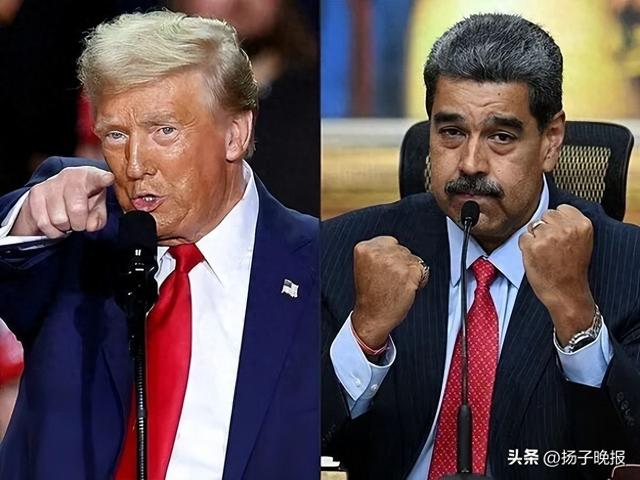
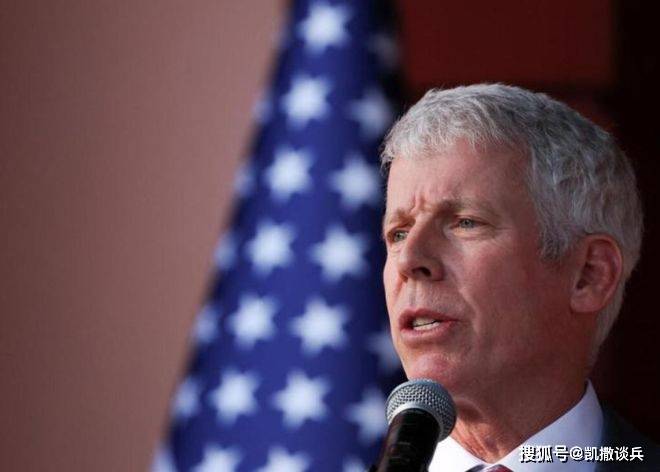
美能源部长兴奋透露,称中国已买委石油,外交部给出6字回应!
Sou Hu Cai Jing· 2026-02-13 02:53
Group 1 - The core point of the article is that U.S. Energy Secretary Chris Wright claimed that China has purchased some Venezuelan oil sold by the U.S. government, but this information remains unverified and has been met with a vague response from the Chinese Foreign Ministry [1][3]. - The U.S. has not explicitly prohibited China from purchasing Venezuelan oil but has imposed conditions that require China to buy at higher prices set by the U.S., with revenues deposited into a U.S. "special account" [3]. - China has asserted that Venezuela is a sovereign nation and should decide to whom it sells its oil, indicating that any transactions between China and Venezuela are independent of U.S. influence [3][5]. Group 2 - Wright's claims about China having paid for the oil lack specific details such as the timing and quantity of the purchase, raising doubts about the credibility of his statements [5]. - There is a possibility that the U.S. and China have made some progress in negotiations, but the lack of concrete information suggests that Wright may have exaggerated the situation [5]. - Regardless of whether China has indeed purchased Venezuelan oil, it is clear that China will not support U.S. dominance in this matter, emphasizing that any dealings are strictly between China and Venezuela [5].

美国拿格陵兰只是第一步?专家警告:欧盟若再退东欧能源必易主
Sou Hu Cai Jing· 2026-01-17 05:46
Core Argument - The article discusses the interconnected diplomatic issues of Ukraine, Venezuela, and Greenland, highlighting how the EU often sacrifices its own interests to align with U.S. actions in a U.S.-dominated world order [1][3]. Group 1: EU's Role and Challenges - The EU has been portrayed as awkwardly supporting U.S. interests while undermining its own, particularly in the context of U.S. sanctions and military actions [3][5]. - The EU's attempts to resist U.S. sanctions on the Nord Stream gas pipeline ultimately failed, leading to increased dependency on U.S. decisions [3][9]. - The EU's leadership has been criticized for failing to condemn U.S. actions that undermine international law, such as the treatment of Venezuelan President Maduro [5][7]. Group 2: U.S. Actions and EU Responses - The U.S. strategy towards Venezuela has left the EU in a passive position, where it publicly respects Venezuela's sovereignty while tacitly supporting U.S.-led actions [5][9]. - The EU's response to U.S. ambitions regarding Greenland has been characterized by vague statements rather than strong opposition, reflecting a pattern of avoidance in confronting U.S. aggression [11][14]. - U.S. officials have openly questioned Denmark's sovereignty over Greenland, indicating a disregard for historical agreements and international norms [15]. Group 3: Implications for EU Sovereignty - The EU's continuous concessions to the U.S. have led to a loss of sovereignty, likened to a traditional housewife dependent on her partner's whims [9]. - The EU's hope for U.S. support in Ukraine is complicated by Russia's firm stance against NATO's involvement, raising concerns about potential repercussions for Europe [9][11]. - The article suggests that the EU's political elite have crafted a self-destructive strategy that may soon backfire, as they fail to assert their interests against U.S. pressures [14][15].
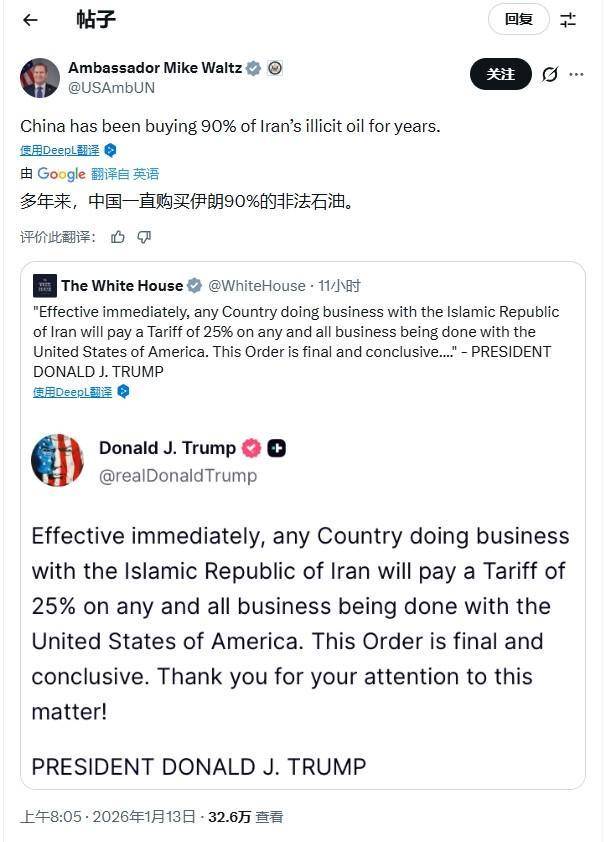
美国驻联合国大使:伊朗石油合不合法,我们说了算!
Sou Hu Cai Jing· 2026-01-15 08:21
Group 1 - The article highlights the shift in U.S. foreign policy under the Trump administration, which openly embraces a more aggressive stance, labeling the U.S. as a "bully" rather than masking its actions under the guise of democracy and international order [1][4] - U.S. Ambassador to the UN, Mike Wallace, made a controversial statement claiming that China purchases 90% of Iran's "illegal" oil, raising questions about the legitimacy of such a classification [1][3] - The article argues that Iran, as a sovereign nation, has the right to sell its oil, and the U.S. lacks the authority to unilaterally determine the legality of international trade between countries [3][4] Group 2 - The article points out that the UN Security Council has never authorized the U.S. to impose a global ban on Iranian oil, suggesting that U.S. sanctions are extensions of domestic law without international legitimacy [6] - It criticizes the U.S. for applying double standards in its foreign policy, where it promotes a rules-based international order while disregarding principles of sovereignty and free trade [4][6] - The narrative emphasizes that the so-called international order is merely a facade for U.S. interests, revealing the underlying nature of American hegemony [6]
美军要对伊朗动武?
Xin Lang Cai Jing· 2026-01-14 16:31
Group 1 - Protests and unrest have erupted in multiple cities in Iran, leading to casualties and prompting U.S. President Trump to threaten military intervention and cancel talks with Iranian officials [2][5] - The U.S. State Department has issued repeated warnings for American citizens to leave Iran immediately, suggesting land routes to Turkey or Armenia [3][6] - The Pentagon is reportedly preparing a broader range of military options against Iran than previously reported [2][5] Group 2 - Iranian officials are actively engaging in diplomatic efforts with neighboring countries to garner support amid the unrest [6][7] - Iran's Defense Minister stated that the country is prepared to respond with full force if its territory is violated, indicating a heightened state of military readiness [9][10] - The United Nations has expressed concern over the increasing rhetoric surrounding military action against Iran, urging member states to pursue diplomatic solutions instead [11][12] Group 3 - Gulf Arab states, including Saudi Arabia and Qatar, are lobbying the U.S. to refrain from military action against Iran, citing potential disruptions to the oil market and domestic stability [13] - Iran's Foreign Minister has indicated a willingness to negotiate with the U.S. based on mutual respect, while simultaneously preparing for potential conflict [13] - The Iranian military has reported an increase in missile stockpiles and improved defense capabilities since previous conflicts [10]
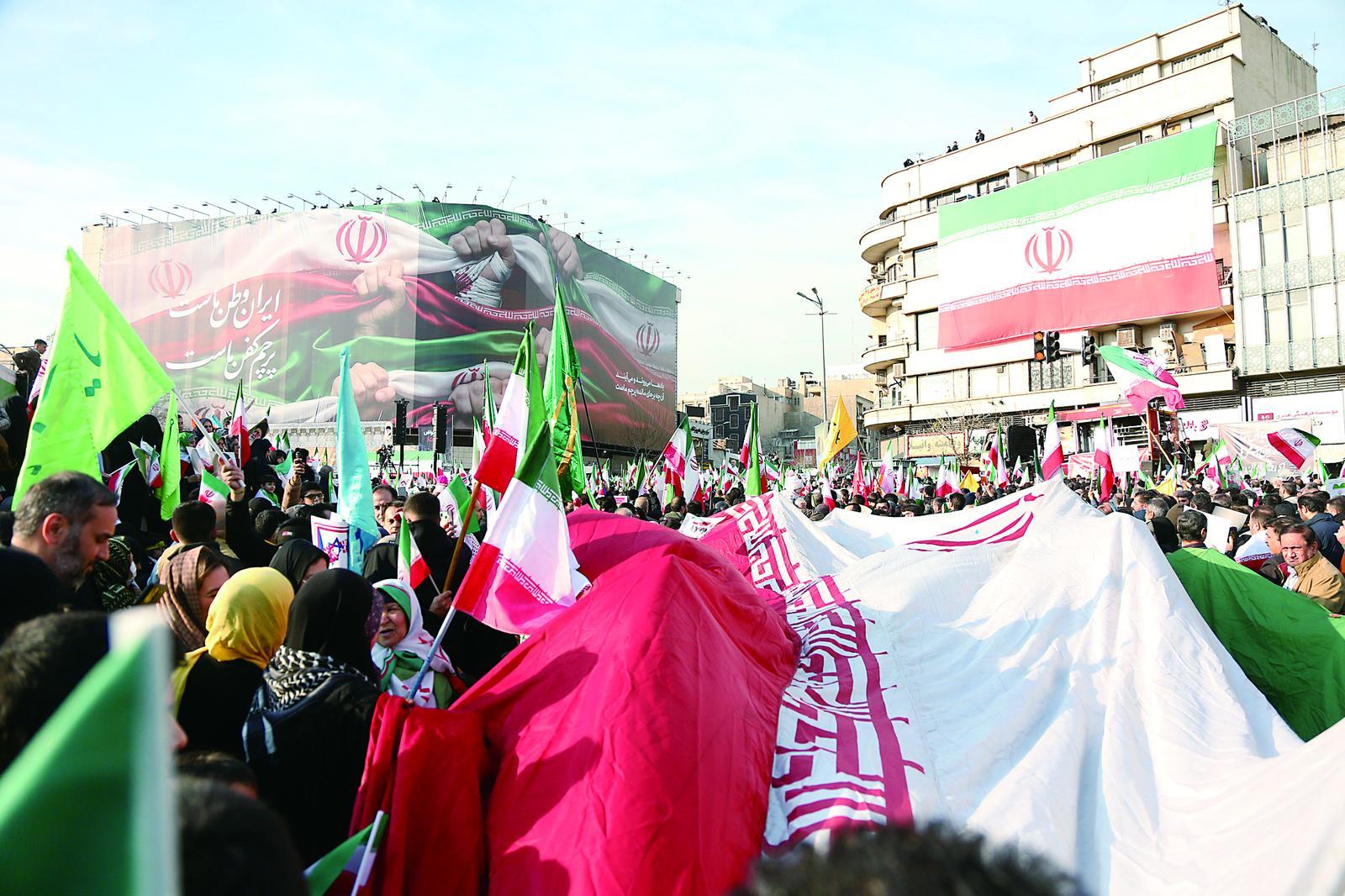
“格陵兰岛绝不出售!”——丹麦民众强烈抗议美国霸权行径
Xin Hua She· 2026-01-09 00:31
Core Viewpoint - The Danish public strongly opposes the United States' attempts to "purchase" Greenland, viewing it as an act of American hegemony and a violation of Danish sovereignty [1][2][3]. Group 1: Public Sentiment - Citizens in Copenhagen express firm resistance to the idea of the U.S. acquiring Greenland, emphasizing Denmark's independence and sovereignty [1]. - Local residents articulate their anger towards the U.S. government's intentions, with statements reflecting a belief that Greenland is an integral part of Denmark [1][2]. Group 2: Government Response - The Danish government, along with other European nations, has voiced strong opposition to U.S. claims regarding Greenland, asserting that only Denmark and Greenland can determine their own affairs [3]. - Danish Prime Minister Mette Frederiksen warns that any military action against Greenland could jeopardize the NATO alliance, highlighting the seriousness of the situation [3]. Group 3: International Implications - The ongoing tensions surrounding Greenland are viewed in the context of U.S. military actions in Venezuela, leading to heightened concerns in Denmark and Europe about American intentions [3]. - Analysts suggest that the current situation indicates a lack of European autonomy in security matters, with the U.S. holding significant influence over European security decisions [3].
记者手记|“格陵兰岛绝不出售!”——丹麦民众强烈抗议美国霸权行径
Xin Hua Wang· 2026-01-08 08:12
Core Viewpoint - The Danish public strongly opposes the United States' attempts to "purchase" Greenland, viewing it as an infringement on Denmark's sovereignty and a display of American hegemony [1][2]. Group 1: Public Sentiment - Citizens in Copenhagen express a firm stance against the idea of the U.S. acquiring Greenland, emphasizing Denmark's independence and territorial integrity [1]. - Local residents articulate their anger towards the U.S. government, with statements reflecting a belief that such actions would lead to severe consequences [1][2]. Group 2: Government Response - The Danish government, along with other European nations, has voiced strong opposition to U.S. claims regarding Greenland, asserting that only Denmark and Greenland can determine their own affairs [3]. - Danish Prime Minister Mette Frederiksen warns that any military action against Greenland could jeopardize the longstanding NATO alliance [3]. Group 3: International Implications - The situation is viewed as a serious threat to Denmark's sovereignty, with implications for U.S.-Danish relations and broader European security concerns [2][3]. - Analysts suggest that the recent U.S. rhetoric regarding Greenland is taken seriously in the context of U.S. military actions in other regions, indicating a potential shift in European security dynamics [3].
专家:美国袭击委内瑞拉是对国际法的野蛮践踏
Yang Shi Xin Wen Ke Hu Duan· 2026-01-04 12:05
Group 1 - The core viewpoint of the articles highlights the condemnation of the U.S. military action against Venezuelan President Maduro by multiple Latin American countries, viewing it as a violation of international law and a challenge to international relations [1][2] - The military action is expected to exacerbate security risks in the region, potentially leading to an increase in the refugee crisis, which could impact neighboring Latin American countries and even the U.S. immigration issues [1] - The economic and social implications for Venezuela and the broader Latin American region are significant, with increased trade and investment risks, as well as rising costs that could hinder economic development [1] Group 2 - The U.S. government's actions post-attack indicate a desire to maximize its interests, showcasing its military capability and attempting to rationalize the operation through legal proceedings against Maduro [3] - The military operation is perceived as creating a climate of fear in the region, leading to potential instability within Venezuela and long-term negative impacts on its development [4] - There are widespread concerns among international observers regarding the implications of U.S. actions for global security and development, particularly in Latin America and the Caribbean [4]
强烈谴责!美国霸权行径终将反噬自身
Xin Lang Cai Jing· 2026-01-04 10:44
Core Viewpoint - The article highlights the recent military action by the United States against Venezuela, which has led to the arrest of President Maduro and his wife, sparking widespread international condemnation, particularly from China, which criticizes U.S. hegemony and calls for a return to international law for conflict resolution [1]. Group 1: U.S. Military Action - On January 3, the U.S. launched a large-scale military operation in Venezuela, targeting the capital Caracas [1]. - The operation resulted in the arrest of President Maduro and his wife, indicating a significant escalation in U.S. intervention in Venezuela [1]. Group 2: International Reactions - Countries around the world have expressed immediate protests against the U.S. actions, emphasizing the need for respect for sovereignty and international law [1]. - The Chinese government has strongly condemned the U.S. for its actions, labeling them as a threat to peace and security in Latin America and the Caribbean [1]. Group 3: Implications for Venezuela - The article warns that if the political situation in Venezuela remains unstable in the short term, it could lead to profound disasters for the country and its people [1]. - It argues that U.S. hegemonic actions will only exacerbate regional turmoil and ultimately backfire on the U.S. itself [1].
总统马杜罗被带离委内瑞拉,有五个关键问题
Xin Lang Cai Jing· 2026-01-03 16:08
Core Viewpoint - The article discusses the recent military operation by the United States that resulted in the capture of Venezuelan President Nicolás Maduro and his wife, highlighting the implications for U.S. foreign policy and regional stability [1][3][7]. Group 1: Capture of Maduro - Maduro and his wife were captured by U.S. Delta Force during a nighttime raid at their military camp residence [3]. - The operation was authorized by President Trump, who had previously confirmed CIA involvement in tracking Maduro's movements [3][4]. - Trump described the operation as well-planned and executed, likening it to a "television show" due to the real-time monitoring of the event [4]. Group 2: Current Status of Maduro - Following their capture, Maduro and his wife are reported to be on a U.S. Navy ship [5]. - The Venezuelan government, represented by Vice President Delcy Rodríguez, has expressed ignorance about their whereabouts and demanded proof of their well-being [6]. Group 3: Legal Proceedings Against Maduro - Maduro faces multiple charges in the U.S., including drug trafficking and possession of firearms [7]. - Plans are underway to transfer him to New York for prosecution, with a potential court appearance as early as January 5 [7]. Group 4: U.S. Strategic Interests - The U.S. aims to exert control over the Caribbean region, particularly in light of Venezuela's significant oil reserves, which are crucial for U.S. energy needs [8][9]. - Venezuela holds the world's largest proven oil reserves, estimated at 300 billion barrels, which presents a strategic interest for the U.S. [9][10]. Group 5: International Reactions - The military action has drawn strong condemnation from various countries and international organizations, including the UN and several Latin American nations [10][11][12]. - Critics argue that the U.S. action violates international law and undermines Venezuela's sovereignty, with calls for immediate cessation of military aggression [12][13].