美妆企业IPO

Search documents
近40美妆企业IPO激战:上游卡位,品牌求生,技术叙事能否换回溢价?
Sou Hu Cai Jing· 2026-01-29 09:54
Core Insights - The beauty industry is experiencing a surge in IPO activities, with nearly 40 companies targeting A-shares, Hong Kong, and US markets from 2025 to January 2026, indicating a collective push across the entire industry chain [5][9][12] - Despite the enthusiasm, many companies remain in the lengthy process of IPO counseling or filing, highlighting the competitive nature of the market and the challenges in meeting capital thresholds [5][9] - The Hong Kong Stock Exchange has emerged as a primary capital outlet for beauty brands, with a significant increase in IPO issuance and fundraising amounts in 2025 [16][9] Industry Trends - The upstream segment of the beauty industry, including packaging and raw material suppliers, is actively entering the capital market, with companies like Jiangtian Technology and Heyuan Biological successfully listing on A-shares [8][9] - Midstream players, such as brand operators and manufacturers, are diversifying their listing strategies, with some opting for dual listings in Hong Kong and A-shares to enhance capital access [9][12] - Downstream service providers, including e-commerce and digital service companies, are also participating in the IPO wave, with several firms already filing for listings [12][9] Market Dynamics - The competitive landscape is shifting towards a focus on sustainable growth and risk management, with companies needing to demonstrate structural resilience and the ability to replicate success across multiple brands [17][19] - The pressure on profitability is increasing, with major players like Huaxi Biological facing significant revenue declines, prompting a reevaluation of industry valuations [20][22] - Companies are increasingly focusing on R&D investments to enhance their competitive edge, as marketing alone is insufficient for long-term sustainability [26][27] Capitalization Strategies - The trend of domestic substitution in raw materials is gaining traction, supported by government policies aimed at fostering innovation in the cosmetics sector [23][25] - Companies are adopting dual strategies of self-research capabilities and brand diversification to build competitive barriers and enhance market presence [28][27] - The current IPO wave signifies a transition for Chinese beauty companies from rapid growth to more refined management practices, emphasizing the importance of balancing short-term gains with long-term resilience [28][27]


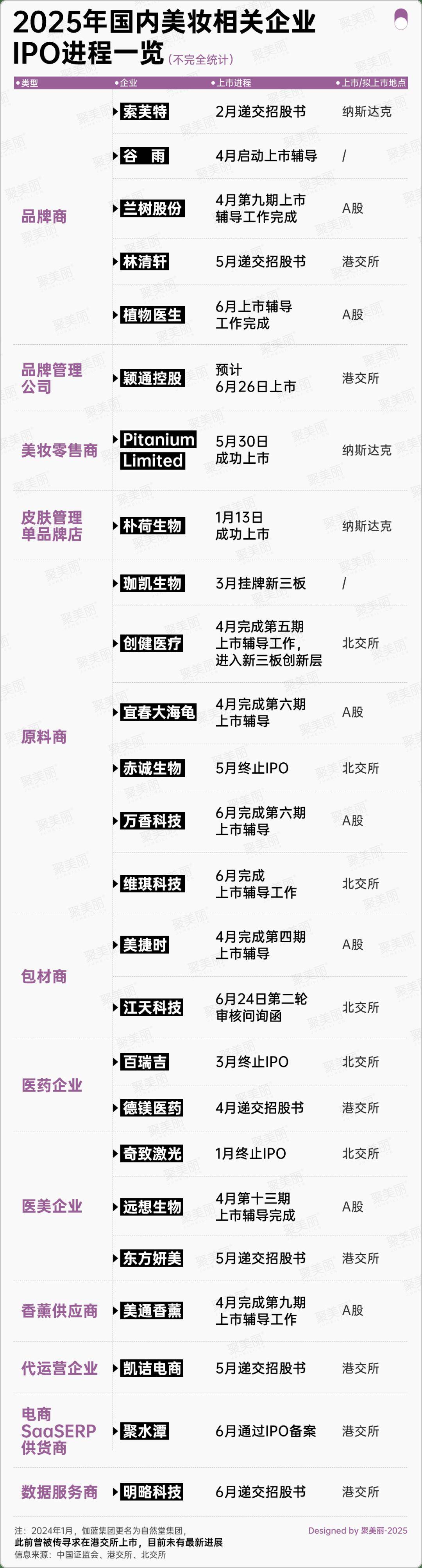
“全链”上市!美妆企业争做“第一股” 去年40多家相关企业冲刺IPO,也有10家告别资本市场
Shen Zhen Shang Bao· 2026-01-15 17:43
Core Insights - The beauty industry is experiencing a surge in IPO activity, with over 41 beauty-related companies aiming for IPOs since 2025, covering various segments of the supply chain [1][2] - The trend of companies seeking to become the "first stock" in their respective niches is prominent, with several brands targeting specific categories such as whitening and anti-hair loss [3] - Despite the IPO enthusiasm, there are challenges as 10 beauty-related companies have exited the capital market, indicating a stricter selection process by investors [4] IPO Activity - Numerous companies are preparing for IPOs, with notable brands like Gu Yu, Lin Qingxuan, and Plant Doctor submitting applications in 2025 [2][3] - The IPO wave includes not only brand companies but also raw material suppliers and packaging companies, indicating a comprehensive industry interest [2] - Specific milestones include Lin Qingxuan becoming the first high-end domestic skincare stock in Hong Kong and other brands aiming for dual listings [1][2] Financial Performance - In the first three quarters of 2025, eight listed beauty companies reported a total revenue of 27.707 billion yuan and a net profit of 3.753 billion yuan [5] - The leading company, Proya, achieved a revenue of 7.098 billion yuan, showing only a slight year-on-year increase of 1.89%, while Shanghai Jahwa reported a 10.83% growth [5] Industry Challenges - The beauty industry faces significant challenges, including a heavy reliance on marketing over research and development, which could hinder long-term growth [6][7] - Companies like Natural Hall and Lin Qingxuan have shown a concerning trend of low R&D investment compared to their marketing expenditures, with R&D costs declining as a percentage of revenue [6][7] - The industry's dependency on flagship products poses risks, as seen with Lin Qingxuan's reliance on its essence oil for revenue [7]
上半年多家美妆企业“冲刺”IPO
Xin Lang Cai Jing· 2025-10-16 00:48
Core Insights - The beauty industry in China is experiencing a significant wave of capital activity, with over 20 beauty-related companies attempting IPOs in the first half of the year, marking a shift from the previous years' downturn [2][3] - The recent listing of Ying Tong Holdings on the Hong Kong Stock Exchange has made it the first publicly traded perfume company in China, highlighting the growing interest in beauty sector IPOs [1][2] Industry Trends - The number of beauty companies seeking IPOs has surged, with 8 companies making progress in June alone, indicating a potential window for listings due to consumer recovery and industry upgrades [1][2] - The capital market's attitude towards beauty companies has shifted from "indifferent" in 2023-2024 to more favorable, following regulatory changes that support quality enterprises in the consumption sector [2][3] Company Developments - Companies like Lin Qingxuan and Gu Yu are in the race for their respective "first stock" titles in niche segments, with Lin Qingxuan reporting a revenue of 1.21 billion yuan for 2024, positioning itself as a leading domestic high-end skincare brand [4] - The raw material sector is also active, with companies like Weiqi Technology and Jia Kai Biological pushing for IPOs, reflecting a comprehensive engagement across the beauty industry supply chain [4] Market Dynamics - The Hong Kong Stock Exchange has become a preferred listing venue for beauty companies, driven by favorable policies and higher international capital recognition, contrasting with previous preferences for the Shenzhen Stock Exchange [5][6] - In the first half of the year, the Hong Kong Stock Exchange raised a total of 106.71 billion HKD, a significant increase of 688.54% compared to the same period in 2024, indicating a robust market for new listings [6]
六部门发文!国货美妆产业将掀IPO 热潮?
Sou Hu Cai Jing· 2025-06-25 15:21
Core Viewpoint - The beauty industry in China is expected to experience a wave of IPOs, driven by recent supportive policies from the government aimed at encouraging quality consumer companies to go public [1][9]. Group 1: IPO Developments - A total of 25 domestic beauty-related companies have made progress in their IPOs this year, with 7 companies taking steps towards listing on the Hong Kong Stock Exchange [2][6]. - The Hong Kong Stock Exchange has become an ideal destination for beauty companies, with several firms, including Lin Qingxuan and Ying Tong Holdings, preparing for listings [6][7]. - The recent policy changes from six government departments are expected to accelerate the IPO processes for beauty companies that had previously faced stagnation [1][7]. Group 2: Market Trends - The emergence of "first stocks" in various segments of the beauty industry, such as "the first stock of hyaluronic acid" and "the first stock of Chinese perfume," indicates a rising competitive landscape and differentiation among companies [7][8]. - The current trend shows that while some companies are targeting Hong Kong for their IPOs, others are still in the advisory phase for A-share listings, reflecting a diverse approach to market entry [7][13]. Group 3: Policy Implications - The new guidelines from the government encourage equity financing for qualified consumer companies, which may lead to a more favorable environment for beauty brands to list [12][15]. - The shift from a restrictive IPO environment to one that supports consumer brands suggests a potential revitalization of the beauty sector, with expectations of increased activity in the capital markets [11][15].
又一家美妆头部企业准备上市
3 6 Ke· 2025-04-02 00:53
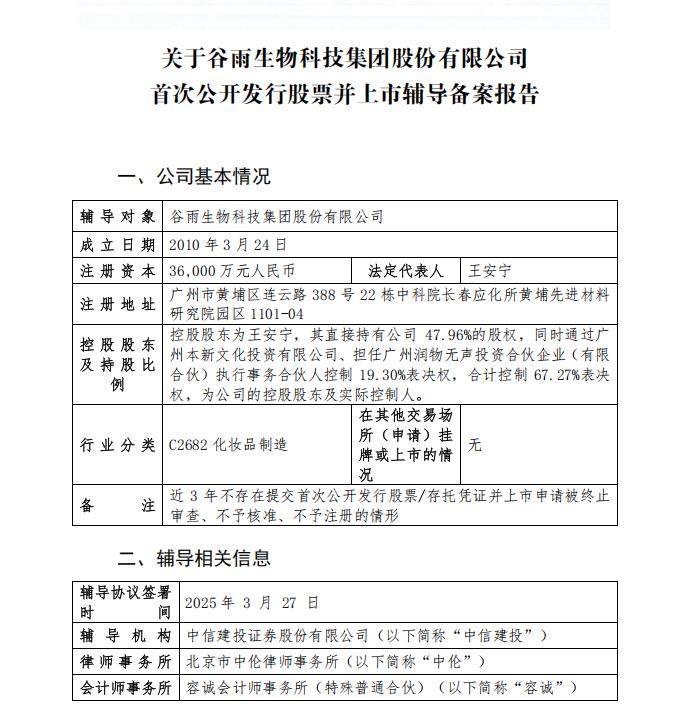
Core Viewpoint - Gu Yu Biotechnology Group Co., Ltd. has initiated its IPO process, marking a significant step in its growth trajectory within the beauty industry, leveraging unique product offerings and a strong online presence to capture market share [1][2][3]. Company Overview - Gu Yu was founded on March 24, 2010, with a registered capital of 36 million RMB, and is headquartered in Guangzhou [1]. - The company is primarily engaged in the manufacturing of cosmetics, specifically focusing on skincare products with unique ingredients like Glabridin [1][3]. - The founder, Wang Anning, has extensive experience in the cosmetics industry, having worked in his family's supply chain and developed numerous formulations before establishing Gu Yu [3][6]. IPO Progress - Gu Yu has signed a counseling agreement with CITIC Securities on March 27, 2025, to prepare for its IPO, officially starting the process for listing on the A-share market [1][10]. - The company has undergone a name change and shareholding restructuring in early 2024, indicating readiness for public offering [7][10]. Market Position and Performance - Despite being a latecomer compared to established brands like Proya and Han Shu, Gu Yu has rapidly gained recognition, ranking third in the Douyin beauty category in early 2023 [2][11]. - The brand's GMV (Gross Merchandise Volume) has shown significant growth, reaching 9 billion RMB in 2021, doubling to 22 billion RMB in 2022, and projected to reach 35 billion RMB in 2023 [11][13]. - Gu Yu's sales strategy focuses on multi-channel distribution, successfully leveraging platforms like Douyin, Kuaishou, and Tmall to maximize reach and sales [11][21]. Product Strategy - The company has developed a product matrix centered around its unique ingredient, Glabridin, with a focus on "big single products + gift sets" [23][24]. - Gu Yu's best-selling products include the third-generation snow skin water and cream sets, which have sold over 125,800 units [23]. Challenges and Future Outlook - Gu Yu faces challenges related to high dependency on a single brand for revenue, which poses risks compared to competitors with diversified brand portfolios [26][27]. - The company is also navigating the complexities of high-end market positioning, as it attempts to penetrate the premium segment while maintaining its value-oriented brand image [32][34]. - The ongoing development of its research capabilities and potential expansion into offline channels will be crucial for sustaining growth and competitiveness in the evolving beauty market [34][41].