
考研调剂

Search documents
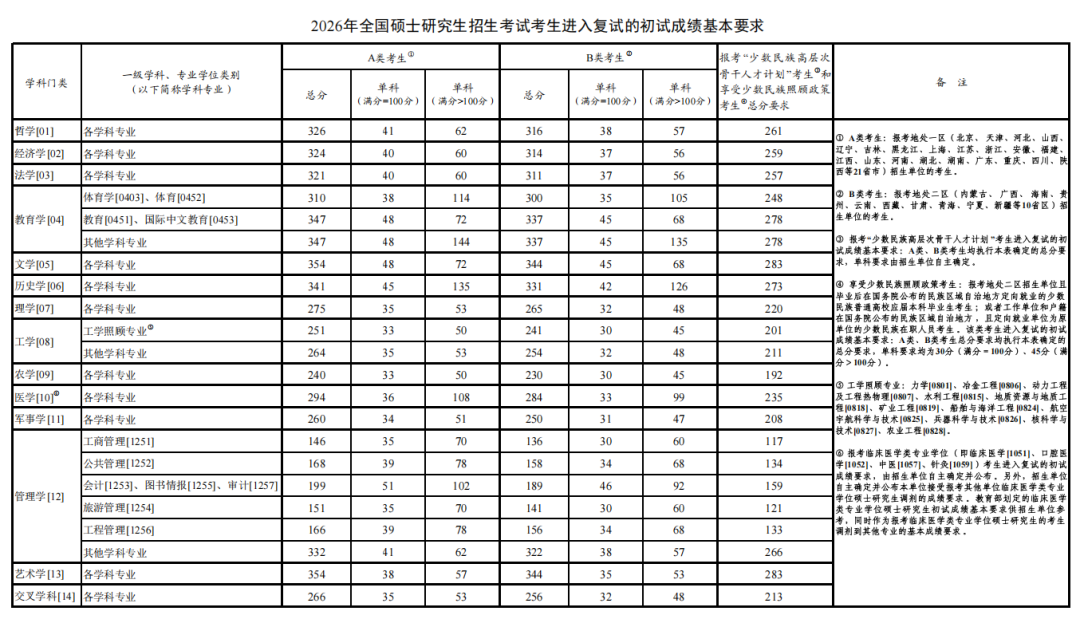
2026考研国家线发布,考研调剂3月27日起填报
Xin Lang Cai Jing· 2026-02-28 03:44
Group 1 - The 2026 National Master's Graduate Entrance Examination initial test scores will be available for candidates starting today [1] - The Ministry of Education has released the basic requirements for initial test scores for candidates to enter the re-examination [1] - Each admissions unit is required to determine and publish their own initial test score requirements based on the national score line [1] Group 2 - The "Adjustment Intention Collection System" will open on March 27, allowing candidates to check and fill in their intention information [4] - The "Adjustment Service System" will open on April 8, enabling admissions units to conduct adjustment work if there are insufficient qualified candidates from the first choice [4] - All candidates, including those applying for the "Veteran College Student Soldier Plan," must submit their adjustment applications through the Ministry of Education's "Adjustment Service System" [4]

考研,突然不卷了?
21世纪经济报道· 2025-04-10 13:35
Core Viewpoint - The increase in adjustment quotas for 985 universities in 2025 is attributed to the higher difficulty of public subjects in the entrance exams and the declining cost-effectiveness of non-full-time master's programs, leading to a mismatch in enrollment and a more rational choice among candidates [1][7][11]. Group 1: Adjustment Quotas - A significant number of 985 universities, including Xiamen University and Huazhong University of Science and Technology, have opened adjustment quotas for various programs, with Xiamen University planning to accept over 270 candidates across 30 departments [2][3]. - Notably, some programs, such as artificial intelligence and biomedical fields, have high demand for adjustment candidates, indicating a shift in student preferences towards more popular fields [2][3]. - The adjustment quota for non-full-time master's programs remains high, with Wuhan University and Xiamen University planning to accept a substantial number of candidates in their MBA and EMBA programs [10][11]. Group 2: Reasons for Increased Adjustment Quotas - The primary reason for the increase in adjustment quotas is the heightened difficulty of the entrance exams, which has resulted in some programs, including those at prestigious institutions like Tsinghua University, having zero candidates qualifying for the next round [7][8]. - Additionally, certain professional fields, particularly civil engineering, are experiencing a decline in candidate interest due to changing labor market demands, leading to fewer applicants and more adjustment opportunities [8][9]. - The non-full-time master's programs are facing challenges as their cost-effectiveness diminishes, with high tuition fees deterring potential candidates, especially in the current economic climate [11][12]. Group 3: Candidate Dynamics - The number of candidates participating in adjustments has reached hundreds of thousands annually, but the available adjustment spots remain limited compared to the demand, making successful adjustments increasingly competitive [4][6]. - Many candidates are now more strategic in their choices, with a noticeable increase in high-scoring candidates applying for adjustments, particularly from non-985 institutions [1][6]. - The adjustment process has become more stringent, with some universities requiring rapid confirmation from candidates regarding their adjustment offers, reflecting the competitive nature of the admissions landscape [4].
985高校调剂名额也增加了,考研突然不卷了?
2 1 Shi Ji Jing Ji Bao Dao· 2025-04-10 11:48
Core Insights - The increase in adjustment opportunities for graduate students at top universities indicates that first-choice admissions have not met enrollment targets, primarily due to the rising difficulty of public examination subjects and a declining value of non-full-time master's programs [1][5][7] Group 1: Reasons for Increased Adjustment Opportunities - The difficulty of public examination subjects has led to insufficient first-choice candidates in certain programs, with some prestigious universities reporting zero candidates qualifying for interviews in specific fields [5][6] - The declining attractiveness of non-full-time master's programs, particularly in fields like business administration and law, has resulted in fewer candidates opting for these expensive programs, leading to an increase in adjustment slots [7][8] Group 2: Specific Universities and Their Adjustment Plans - Xiamen University plans to accept over 270 adjustment candidates across 30 departments, with high demand in artificial intelligence and biomedical fields [2] - Other universities like Huazhong University of Science and Technology and China Ocean University are also accepting significant numbers of adjustment candidates, particularly in non-full-time programs [2][3] Group 3: Trends in Candidate Behavior - There is a growing trend among candidates to have clearer goals and more rational choices when applying for graduate studies, as evidenced by the increase in high-scoring candidates applying for adjustments at "double non" universities [1][3] - The competition for adjustment slots is becoming increasingly fierce, with some programs receiving multiple applications for every available spot [3] Group 4: Challenges Faced by Non-Full-Time Programs - Non-full-time programs, particularly MBA and EMBA, are facing a decline in enrollment due to high tuition costs and uncertain returns on investment, leading to an increase in adjustment slots being offered [8][9] - The requirement for non-full-time candidates to pass the same entrance exams as full-time candidates has further complicated the enrollment landscape, resulting in many potential candidates being unable to secure a spot [9]