
职业教育出海

Search documents
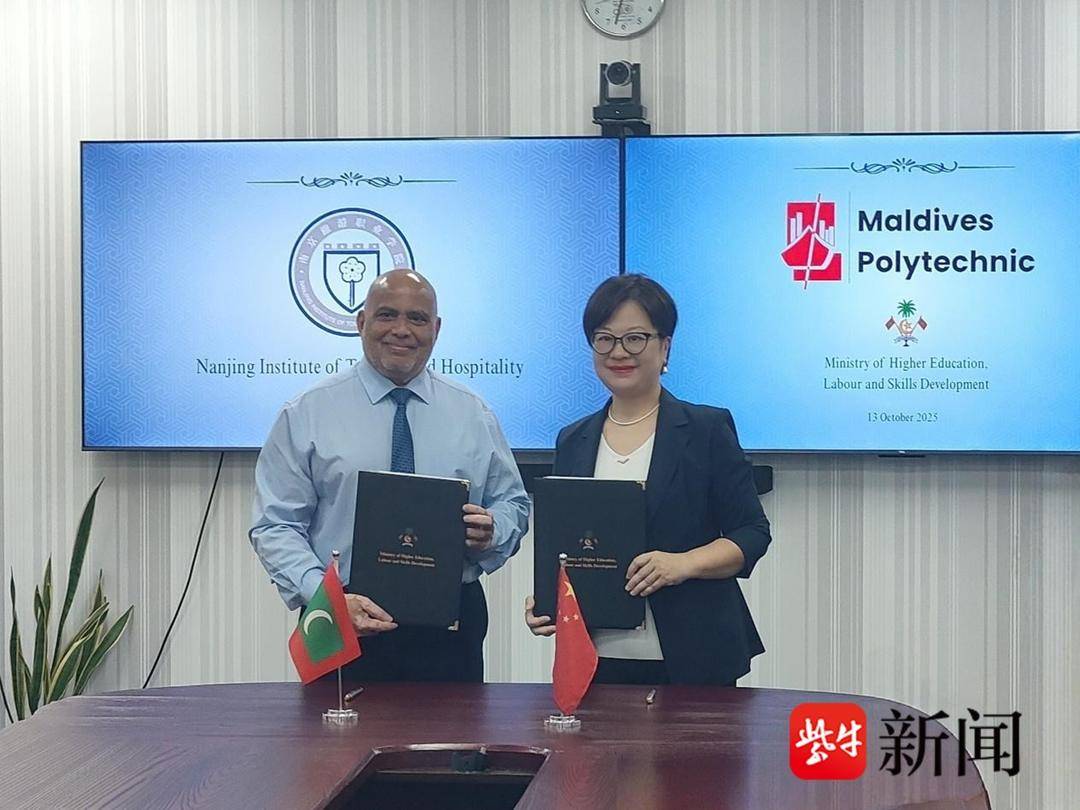
南旅院推动在马尔代夫建“旅游酒店管理国际学院”,打造“职教出海”新范式
Yang Zi Wan Bao Wang· 2025-10-20 11:10
Core Viewpoint - Nanjing Tourism Vocational College is collaborating with Maldives Polytechnic Institute to establish the China-Maldives International College of Tourism and Hotel Management, focusing on integrating Jiangsu's culture, tourism, hotel, and catering characteristics into the curriculum [1][3]. Group 1: Collaboration Details - The Vice President of Nanjing Tourism Vocational College, Hong Tao, led discussions with the Maldives Polytechnic Institute's president and core team to outline the college's construction plan, teaching system, and subsequent work advancement [3]. - The Maldives Polytechnic Institute aims to enhance its tourism and hotel training programs by collaborating with Nanjing Tourism Vocational College to develop a professional course framework and certification system [5]. Group 2: Educational Framework - Nanjing Tourism Vocational College offers 26 programs closely aligned with the cultural and tourism industry, boasting a strong "dual-teacher" faculty team that meets the needs of the Maldives tourism sector [5]. - The partnership will involve joint educational programs, research collaboration, student and faculty exchanges, study abroad support, and training in "Chinese + vocational skills," creating a talent cultivation ecosystem for hotel digital operation management [5][7]. Group 3: Implementation Strategy - The Chinese side will provide the curriculum framework, professional standards, assessment plans, and educational certification standards, while the Maldivian side will manage the educational venue and promotional activities [7]. - The initiative aims to establish a sustainable exchange platform between China and the Maldives, facilitating the joint training of talents and promoting long-term cooperation [7][9].

绘就“一带一路”本土化人才培养新图景
Xin Hua Ri Bao· 2025-09-01 23:55
Core Viewpoint - The development of localized talent in countries along the "Belt and Road" is essential for deepening cooperation and ensuring high-quality development, with vocational education playing a crucial role in addressing development challenges and innovating talent cultivation models [1][2]. Group 1: Talent Cultivation Strategies - The focus on goal-oriented talent cultivation aims to meet the new demands of various countries, ensuring that the training of localized talent aligns with the development needs of "Belt and Road" countries for mutual benefit and long-term collaboration [1][2]. - Customized training for practical professionals is essential to meet the needs of Chinese enterprises operating abroad, emphasizing deep integration of industry and education to enhance the coupling of education, talent, industry, and innovation [1][2]. - Establishing a collaborative international talent cultivation system with overseas partner institutions through joint programs, credit recognition, and resource sharing is vital for improving the quality of international talent training [2][3]. Group 2: Addressing Challenges in Talent Development - The challenges of mechanism integration, curriculum coherence, and resource convergence must be addressed to optimize talent cultivation models, as highlighted in the "Education Strong Nation Construction Plan Outline (2024-2035)" [2][3]. - The MOST talent cultivation model developed by Yangzhou Industrial Vocational Technical College includes a management community, operational mechanisms, support systems, and talent training, with active participation from government, industry associations, enterprises, and educational institutions [3][4]. - A three-dimensional curriculum system that integrates vocational skills, Chinese language, and cultural education is essential to overcome language barriers and cultural differences in localized talent training [3][4]. Group 3: Enhancing Talent Quality and Impact - A multi-channel growth pathway that includes digital classrooms, internships, social practices, and international competitions is crucial for providing comprehensive resources and platforms for overseas localized skilled talent [4][5]. - The effectiveness of localized talent cultivation should be measured by employment quality, with mechanisms for tracking feedback and dynamic evaluation to adjust training programs accordingly [4][5]. - The success of talent cultivation should translate into tangible contributions to local industry development, emphasizing the "seed effect" through the cultivation of local teachers and outstanding students [5][6].
中小盘主题:关注“鲁班工坊”引领的职业教育出海
KAIYUAN SECURITIES· 2025-09-01 09:24
Core Insights - "Luban Workshop" is a prominent brand in vocational education initiated in Tianjin, aiming to establish a global presence in vocational training and education, supported by the achievements of the "National Modern Vocational Education Reform and Innovation Demonstration Zone" [3] - As of now, China has established 36 Luban Workshops in 30 countries across Asia, Africa, and Europe, providing education to 33,800 individuals and conducting over 120,000 skill training sessions, positioning Luban Workshop as a "national business card" for China's vocational education on the global stage [3] Summary by Sections Overview of Luban Workshop - The first Luban Workshop was established in March 2016 in collaboration with Thailand, integrating various technical disciplines into the national education system [3] - President Xi Jinping has emphasized the importance of Luban Workshop in over 40 diplomatic occasions since 2018, highlighting its role in international cooperation [3] Cooperative Models - Various cooperative models have been developed for the Luban Workshop, including government-to-government strategic partnerships, collaborations between educational institutions and management departments, and deep integration with enterprises [4] - The workshops aim to create a comprehensive overseas vocational education output system covering multiple educational levels through a combination of technical training and academic education [4] Teaching Innovations - The Luban Workshop has introduced the Engineering Practice Innovation Project (EPIP) teaching model, which integrates theoretical and practical education, encouraging students to actively engage in problem-solving [4] - The first EPIP application and promotion institution in Africa was established in Ethiopia in 2021 through a partnership between Tianjin Vocational Technical Normal University and Ethiopian Technical University [4] Beneficiary Companies - Jiean High-tech has participated in the construction of Luban Workshops in Thailand and Laos, promoting Chinese vocational education through international cooperation [5] - China Wuyi signed a talent cooperation agreement with a local Luban Workshop in Ethiopia, aiming to jointly cultivate at least 500 technical talents in fields such as new energy and intelligent construction over the next three years [5] - Xueda Education Group was awarded a training practice base in Tianjin, leveraging the Luban Workshop to support the Belt and Road Initiative and international capacity cooperation [5]