
能源系统

Search documents
为全球经济注入更多确定性力量
Sou Hu Cai Jing· 2026-01-20 15:08
Core Viewpoint - The World Economic Forum 2026 aims to explore stability and direction for the global economy amidst multiple uncertainties, emphasizing inclusive and resilient global development to inject more certainty and positive energy into the world economy [1][3]. Group 1: Global Economic Challenges - The latest report from the World Economic Forum indicates that the global economy will face multiple uncertainties over the next year, including asset revaluation, debt accumulation, geopolitical restructuring, and risks from artificial intelligence [3]. - The International Monetary Fund (IMF) highlights that trade tensions and escalating geopolitical conflicts may exert greater pressure on global economic activities [3]. - The U.S. government's new round of tariffs in 2025 and additional tariffs on European countries opposing U.S. claims over Greenland have led economists to express pessimism about the global economic outlook for 2026 [3]. Group 2: China's Economic Contribution - China's GDP is projected to exceed 140 trillion yuan in 2025, marking a 5.0% increase from the previous year, contributing approximately 30% to global economic growth, making it a stable and reliable driver for the world economy [6][7]. - China's commitment to high-level opening-up and the establishment of free trade zones are enhancing long-term confidence in cross-border investments [7]. Group 3: Importance of Global Cooperation - The current global landscape shows a weakening of cooperation related to trade, climate, technology, and security, yet innovative and smaller-scale cooperative mechanisms are emerging, indicating resilience and potential for global collaboration [8]. - Dialogue is emphasized as a cornerstone for cooperation, with the need to find common ground to address global priorities [8][9]. - China's initiatives on global development, security, civilization, and governance stress the importance of prioritizing development, win-win cooperation, and inclusive dialogue to ensure equitable benefits for all nations [8][9].

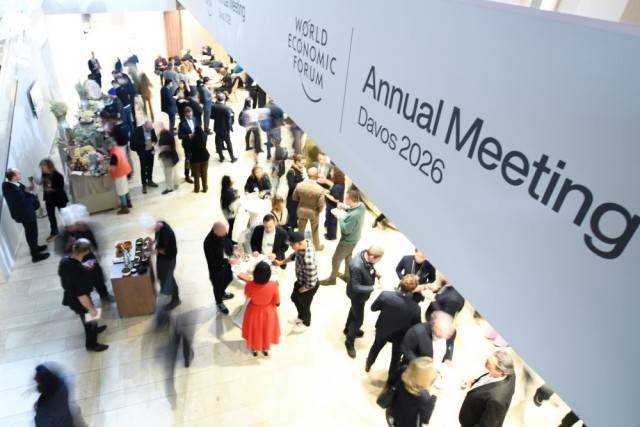
共同应对全球关键挑战
Xin Lang Cai Jing· 2026-01-19 23:20
Core Viewpoint - The World Economic Forum 2026 Annual Meeting emphasizes the need for international dialogue to address global challenges amid increasing geopolitical tensions and rapid technological advancements [1][5]. Group 1: Global Risks - The 2026 Global Risk Report identifies geopolitical economic confrontation as the primary risk, followed by armed conflict, extreme weather, social polarization, and misinformation [1]. - Economic risks are rising the fastest, with a growing concern over destructive global risks [1]. - 53% of chief economists surveyed expect multiple uncertainties to continue affecting the global economy, including asset revaluation and debt accumulation [1]. Group 2: Economic Growth and China's Role - China is recognized as a significant contributor to global economic growth, showcasing resilience amid ongoing global turmoil [3]. - The acceleration of China's frontier technology investments is expected to enhance productivity and growth opportunities in the coming years [3]. - China's investments in clean energy, infrastructure, and the digital economy are setting a new paradigm for sustainable investment, aligning with global economic recovery efforts [3]. Group 3: Multilateralism and Cooperation - The importance of multilateralism is highlighted as essential for addressing global challenges, with calls for enhanced cooperation and dialogue [4]. - The "Global Cooperation Barometer" indicates that despite challenges, global cooperation shows resilience, emphasizing the need for constructive dialogue in a complex geopolitical environment [6]. - The theme of the 2026 Annual Meeting, "The Spirit of Dialogue," focuses on collaboration in a competitive world and the scaling of innovative technologies [6].
【环球财经】共同应对全球关键挑战——世界经济论坛2026年年会聚焦对话与合作
Xin Hua She· 2026-01-19 08:38
Group 1: Core Insights - The World Economic Forum 2026 Annual Meeting has commenced in Davos, Switzerland, with nearly 3,000 representatives from over 130 countries discussing critical issues in economy, geopolitics, and technology [1] - The forum emphasizes the need for international dialogue to bridge divides and collaboratively address significant global challenges amid increasing geopolitical complexity and rapid technological advancements [1] Group 2: Global Risks - The 2026 Global Risks Report highlights that geopolitical economic confrontation is the primary risk, followed by armed conflict, extreme weather, social polarization, and misinformation [2] - Economic risks are rising the fastest, with 53% of chief economists surveyed anticipating continued uncertainty in the global economy over the next year, influenced by asset revaluation, debt accumulation, and the impact of AI technology [2][3] - The UN predicts a 2.7% growth in the global economy for 2026, slightly lower than the 2.8% forecast for 2025, citing low investment and limited fiscal space as factors hindering economic activity [2] Group 3: China's Role in Global Growth - China is recognized as a significant contributor to global growth, showcasing resilience in its economy amid ongoing global turmoil [4] - Experts note that advancements in China's frontier technology sectors are expected to drive productivity and growth opportunities in the coming years [4] - China's investments in clean energy, infrastructure, and the digital economy are setting a new paradigm for sustainable investment, aligning with global economic recovery efforts [4] Group 4: Importance of Dialogue - The theme of the 2026 Annual Meeting is "The Spirit of Dialogue," focusing on cooperation in a competitive world, unleashing new growth drivers, and scaling innovative technologies [6][7] - The forum stresses that constructive dialogue is essential for identifying potential cooperation paths that can promote common interests in a complex geopolitical environment [7] - The gathering of global leaders from government, business, and NGOs underscores the critical need for communication and mutual understanding to drive economic progress [7]