自动化测试

Search documents
燕麦科技:公司主业为FPC测试设备
Zheng Quan Ri Bao Wang· 2026-01-07 12:13
Core Viewpoint - The company focuses on FPC testing equipment and aims to maintain a leading market share in the automation and intelligent testing sector of the FPC industry [1] Group 1 - The company's main business is FPC testing equipment, which has a wide range of applications [1] - The company plans to continue deepening its involvement in the automation and intelligent testing field of the FPC industry [1] - The company aims to occupy a technological leadership position among top clients [1] Group 2 - The company holds a leading market share in the FPC industry [1] - The company will continue to monitor market dynamics in the future [1]

Z Potentials|专访TestSprite创始人,前AWS&Google工程师,打造全球4万开发者的测试Agent
Z Potentials· 2025-11-25 03:28
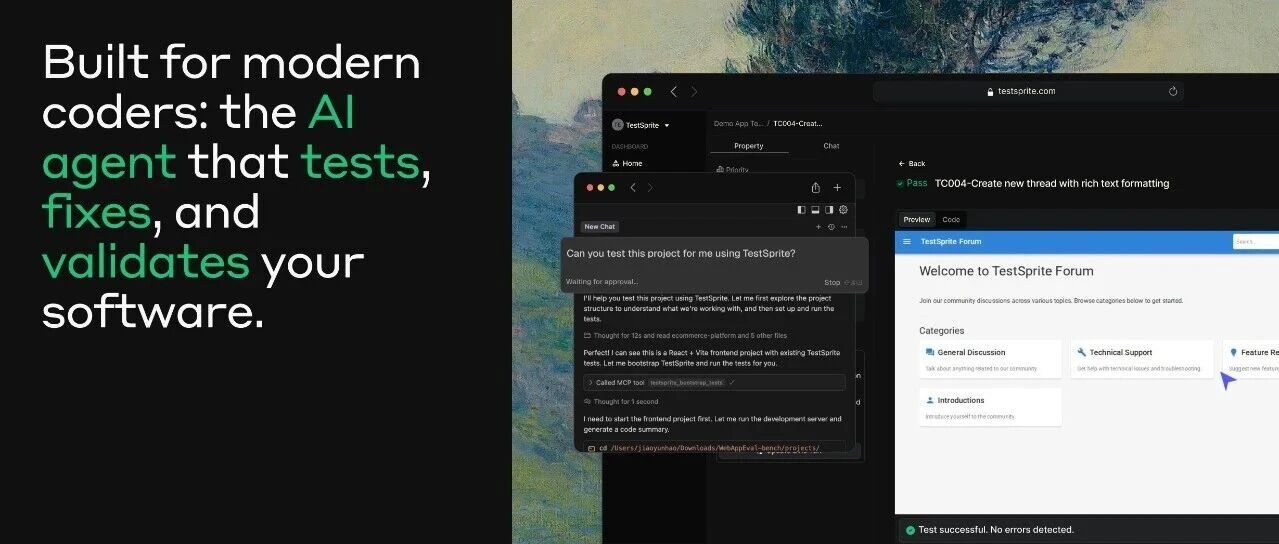
Core Insights - The article discusses the evolution of coding and testing in the AI era, highlighting how tools like TestSprite aim to automate the testing process, addressing the bottleneck created by increased code generation and the need for thorough testing [2][24]. Group 1: Company Overview - TestSprite targets the gap in automated testing by enabling AI to not only write code but also review and test it, transforming the testing phase into a comprehensive automated infrastructure [2][4]. - The founders, CEO Jiao Yunhao and CTO Li Rui, have extensive backgrounds in AI and software development, having worked at major tech companies like Amazon and Google, which informs their approach to software quality assurance [3][10]. - TestSprite has successfully integrated into engineers' workflows, allowing for seamless testing processes that can be initiated with minimal setup [4][5]. Group 2: Product Features - TestSprite offers two main entry points for users: a web-based testing interface and integration with coding tools like Cursor and Trae, enabling automatic generation of test plans and cases [18][21]. - The platform is designed to be user-friendly, requiring no coding knowledge, and aims to provide a smooth experience akin to an auto-pilot system, where users can focus on other tasks while tests run in the background [22][24]. - The product includes features like auto-healing, which allows the system to adapt to changes in the codebase without manual intervention, ensuring continuous testing effectiveness [32][33]. Group 3: Market Position and Strategy - TestSprite differentiates itself by offering a subscription model priced at $19 per month, making it accessible for individual developers and small startups, contrasting with the high costs of traditional QA systems [5][46]. - The company has seen significant growth, with user registrations increasing from around 5,000 to nearly 40,000 following the launch of its MCP version, which enhances integration with popular coding tools [46][47]. - The rise of AI coding tools has shifted the focus of engineers from writing code to validating and testing it, creating a new demand for automated testing solutions like TestSprite [24][26]. Group 4: Case Studies and Impact - A notable case involved a fitness coach who, with no programming background, successfully used TestSprite to develop an online booking system, demonstrating the tool's effectiveness for non-technical users [35][39]. - TestSprite has also been utilized by a medical supplier, Jinix, to rapidly develop and test AI tools for rare disease patients, showcasing its ability to streamline the development process in a high-stakes environment [41][42]. - The company aims to help startups and developers transition from concept to delivery in a matter of weeks, emphasizing the importance of quality control in a competitive market [43][40].

24个月,从写第一行代码到破产:一位架构师在47个“死亡”项目里,看到的共同陷阱
3 6 Ke· 2025-10-15 10:32
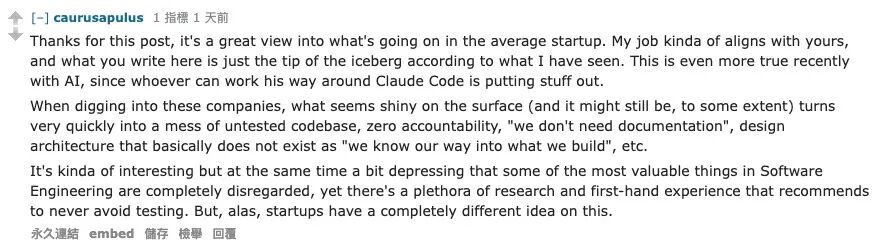
Core Insights - Many startups fail not due to market competition or running out of money, but because their products cannot scale due to accumulated technical debt and chaotic architecture [1][2] - A common pattern of failure emerges over time, with startups experiencing initial success followed by a gradual decline in performance and increasing technical issues [3][4][5][6][7] Technical Debt and Scaling Issues - A significant number of startups face a "scaling crisis" where their codebase and technology stack become unmanageable, leading to an inability to scale their products [2] - Approximately 89% of the startups reviewed had no database indexing, causing slow application performance due to scanning through 100,000 records for each request [8] - About 76% of companies over-provisioned cloud resources, with an average utilization rate of only 13%, leading to unnecessary monthly costs between $3,000 and $15,000 [8] - Nearly 70% of systems had critical authentication vulnerabilities, and 91% of teams lacked any automated testing, making deployments risky [8] Financial Implications - The estimated total loss for a startup due to poor code maintenance and rebuilding efforts can range from $2 million to $3 million, factoring in wasted developer time and lost revenue during reconstruction [8] Awareness and Timing - Many founders only realize the extent of their technical issues between 18 to 24 months into their startup journey, often after securing funding without understanding the impending scalability problems [9] Recommendations for Avoiding Technical Debt - To prevent these issues, it is advised to invest time in architecture design early on, ideally within the first two weeks, to ensure scalability from the outset [10] - Key considerations include anticipating user growth, implementing automated testing from day one, and choosing stable technology stacks [10] - External architecture reviews should be conducted early to identify potential pitfalls before they become critical [10] Industry Perspectives - Despite the seemingly basic nature of the issues identified, many industry professionals acknowledge their prevalence, especially in the context of rapid product launches driven by AI tools [11][12] - The reliance on AI-generated code can exacerbate technical debt, as it often lacks the necessary quality assurance and architectural design [18]