AI编码工具

Search documents
代码产出“暴涨3倍”后,噩梦开始:凌晨2点线上出Bug,却没一个人能解释
猿大侠· 2026-03-23 04:12
Core Insights - The article discusses the misconception that increasing code output directly translates to improved productivity, highlighting that this can lead to bottlenecks and inefficiencies in the software development process [3][8][35] Group 1: AI Tools and Development Efficiency - AI coding tools are being widely adopted with claims of increasing code output by 40% and doubling development efficiency, but many teams are experiencing slower delivery and more online issues [1][2] - The focus on speeding up code writing without addressing the overall software delivery process can create a false sense of productivity while worsening the system's performance [3][8] Group 2: Bottlenecks in the Development Process - The Theory of Constraints suggests that every system has a single bottleneck, and optimizing non-bottleneck areas can lead to a more chaotic system rather than improved speed [7][15] - Real bottlenecks often lie in areas such as decision-making processes, code review, and deployment, rather than in the actual coding phase [19][26] Group 3: Misalignment in Development Goals - Many teams struggle with unclear product goals, leading to wasted efforts on features that do not meet user needs, which is a fundamental issue beyond just delivery speed [16][24] - The fear of releasing code due to instability and lack of feedback loops can create a cycle of delayed releases and increased risk, further complicating the development process [22][23] Group 4: Recommendations for Improvement - Companies should analyze their value stream to identify and eliminate waiting times in the development process, focusing on cycle time rather than just code volume [29][30] - Reducing work in progress (WIP) and listening to frontline engineers can help identify and address bottlenecks effectively [32][33]


速递|OpenAI正在开发GitHub替代品,建构代码仓库剑指微软
Z Potentials· 2026-03-04 02:07
Core Viewpoint - OpenAI is developing an alternative product to GitHub due to increased service interruptions experienced by its engineers, which have hindered their ability to modify code and collaborate effectively [2][3]. Group 1: OpenAI's New Product Development - OpenAI's project is in its early stages and is not expected to be completed in the coming months [3]. - There have been discussions among project employees about potentially selling access to code repositories to OpenAI customers, which would position OpenAI in direct competition with Microsoft, its major investor [3]. - OpenAI's Codex coding assistant could be integrated with the new code repository product to automate tasks like building and debugging code, appealing to developers who want to collaborate with both AI and human partners [5]. Group 2: Industry Context and Competition - The rise of AI coding tools is transforming how software development is conducted, with major companies like Meta, Microsoft, and Amazon reporting that a significant portion of their code is generated by AI [6]. - GitHub's Copilot AI tool has been a pioneer in the market for four years, but its competitive edge is diminishing due to advancements from OpenAI and Anthropic, which offer more sophisticated programming assistants [6]. - Companies like Google and Meta have developed their own internal code repositories, such as Piper and Sapling, to manage the large volume of code produced by their engineers, without releasing these tools to external developers [7]. Group 3: GitHub's Service Interruptions - GitHub has experienced an increase in service interruptions, which coincides with its deeper integration with Microsoft's Azure cloud services [9]. - GitHub is migrating its technology to run on Microsoft Azure data centers, which has raised concerns about the impact on service reliability [11][13]. - Recent service outages have been attributed to both human error and issues with the Azure platform, with GitHub acknowledging that its service availability has not met expected standards [13].

24个月,从写第一行代码到破产:一位架构师在47个“死亡”项目里,看到的共同陷阱
3 6 Ke· 2025-10-15 10:32
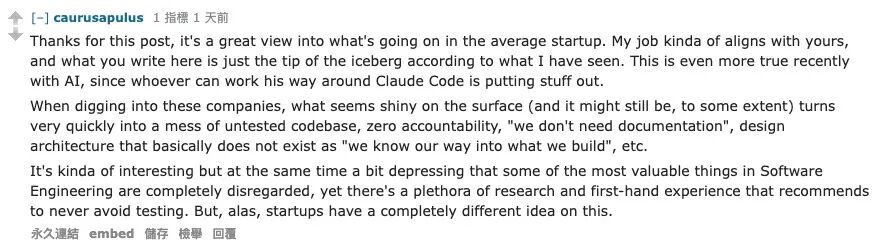
Core Insights - Many startups fail not due to market competition or running out of money, but because their products cannot scale due to accumulated technical debt and chaotic architecture [1][2] - A common pattern of failure emerges over time, with startups experiencing initial success followed by a gradual decline in performance and increasing technical issues [3][4][5][6][7] Technical Debt and Scaling Issues - A significant number of startups face a "scaling crisis" where their codebase and technology stack become unmanageable, leading to an inability to scale their products [2] - Approximately 89% of the startups reviewed had no database indexing, causing slow application performance due to scanning through 100,000 records for each request [8] - About 76% of companies over-provisioned cloud resources, with an average utilization rate of only 13%, leading to unnecessary monthly costs between $3,000 and $15,000 [8] - Nearly 70% of systems had critical authentication vulnerabilities, and 91% of teams lacked any automated testing, making deployments risky [8] Financial Implications - The estimated total loss for a startup due to poor code maintenance and rebuilding efforts can range from $2 million to $3 million, factoring in wasted developer time and lost revenue during reconstruction [8] Awareness and Timing - Many founders only realize the extent of their technical issues between 18 to 24 months into their startup journey, often after securing funding without understanding the impending scalability problems [9] Recommendations for Avoiding Technical Debt - To prevent these issues, it is advised to invest time in architecture design early on, ideally within the first two weeks, to ensure scalability from the outset [10] - Key considerations include anticipating user growth, implementing automated testing from day one, and choosing stable technology stacks [10] - External architecture reviews should be conducted early to identify potential pitfalls before they become critical [10] Industry Perspectives - Despite the seemingly basic nature of the issues identified, many industry professionals acknowledge their prevalence, especially in the context of rapid product launches driven by AI tools [11][12] - The reliance on AI-generated code can exacerbate technical debt, as it often lacks the necessary quality assurance and architectural design [18]
OpenAI发布新模型硬刚Anthropic,Claude Code刚火,就被GPT-5-Codex拍在沙滩上?
3 6 Ke· 2025-09-16 10:09
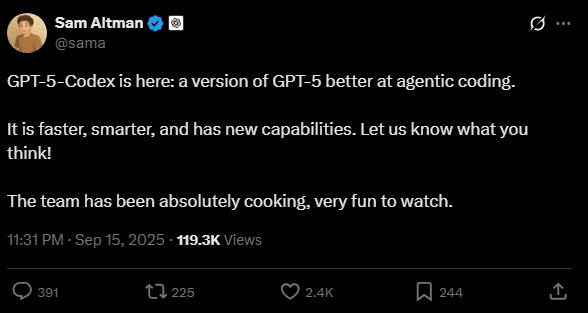
Core Insights - OpenAI has launched a new model, GPT-5-Codex, which is a fine-tuned variant of GPT-5 designed specifically for AI-assisted programming tools, demonstrating improved performance in coding tasks and dynamic thinking time [1][3][6] Model Features - GPT-5-Codex features enhanced code review capabilities, allowing it to identify potential critical errors before product release, thus helping developers mitigate risks [3][4] - The model can dynamically adjust its thinking time based on task complexity, enabling it to work independently for extended periods, completing large refactoring tasks and iterating until successful delivery [6][14] - It has become the default setting for Codex cloud tasks and code reviews, automatically auditing pull requests (PRs) in GitHub repositories [4][7] Performance Metrics - In benchmark tests, GPT-5-Codex outperformed GPT-5 in SWE-bench Verified tasks, which measure coding capabilities and code refactoring performance [8] - The model significantly reduces token usage for low-load tasks by 93.7% compared to GPT-5, while doubling the reasoning, editing, testing, and iteration time for high-complexity tasks [10][18] Market Context - The AI coding tools market is becoming increasingly competitive, with significant investments flowing into companies like Anysphere, which recently raised $900 million, and Anthropic, which secured $13 billion in funding [20][21][22] - The rapid growth of AI coding tools is prompting discussions about the future of programming jobs, with some suggesting a shift towards architecture design rather than traditional coding [19][20] User Feedback - Users have reported that GPT-5-Codex can autonomously run tasks for extended periods and effectively switch between local and web development environments, enhancing productivity [15][16] - There are concerns about the potential impact on entry-level programming jobs, as AI tools like GPT-5-Codex can operate continuously and at a lower cost than hiring junior developers [18][19]
比996还狠,让面试者8小时复刻出自家Devin,创始人直言:受不了高强度就别来
3 6 Ke· 2025-08-28 08:04
Group 1 - Cognition's interview process requires candidates to build an AI tool similar to Devin in an 8-hour simulation, reflecting the company's high-intensity work culture [2][3][44] - The CEO Scott Wu emphasizes that the company does not believe in work-life balance, advocating for a 996 work culture with over 80 hours of work per week [2][3] - The initial team of Cognition included 21 out of 35 members who were previously founders, indicating a strong entrepreneurial background [3][51] Group 2 - Cognition is developing an AI software engineer named Devin, which aims to reshape the future of software engineering [18][25] - Devin operates differently from traditional IDE tools, allowing users to interact with it through platforms like Slack, making it more of an asynchronous experience [22][24] - Devin has been deployed in thousands of companies, completing 30% to 40% of pull requests in successful teams, showcasing its effectiveness [25][26] Group 3 - The acquisition of Windsurf was completed in just three days, highlighting the urgency and strategic importance of the deal for Cognition [58][59] - The integration of Windsurf's team and products is expected to enhance Cognition's capabilities and market reach, particularly in areas where both companies have complementary strengths [64][65] - Cognition aims to maintain a small, elite engineering team, focusing on high-level decision-making and product intuition rather than routine coding tasks [46][50] Group 4 - The AI industry is expected to see significant growth across all layers, with a focus on differentiation and value accumulation in each segment [37][39] - The transition from seat-based to usage-based billing models is anticipated, reflecting the unique nature of AI services [40][41] - The future of software engineering is projected to shift towards guiding AI in decision-making rather than traditional coding, potentially increasing the demand for software engineers [52][53]

重磅!微软宣布开源Copilot!用 5000 万用户直接碾压 Cursor和Windsurf?
AI前线· 2025-05-20 01:24
Core Viewpoint - Microsoft has announced the open-sourcing of GitHub Copilot Extension for VSCode, allowing global developers free access to the advanced AI programming assistant's complete source code, marking a significant shift in the AI coding tools landscape [1][5][6]. Group 1: Open-Sourcing Strategy - Microsoft plans to first open-source the GitHub Copilot Chat extension's codebase and subsequently integrate its components into the core VS Code codebase, with a four-week iteration plan leading to a new release in early June [4]. - The decision to open-source Copilot is driven by several factors: the enhancement of large model capabilities, the unification of popular AI interaction designs across editors, and the maturation of the open-source AI tools ecosystem around VS Code [5][6]. Group 2: New AI Coding Agent - Alongside the open-sourcing announcement, Microsoft introduced a new AI coding agent that can autonomously complete programming tasks such as bug fixes and feature additions, deeply integrated into GitHub Copilot [8][10]. - This AI coding agent can automatically start virtual machines, clone code repositories, and analyze them, providing a summary of its reasoning process and allowing developers to review changes [8][10]. Group 3: Market Position and User Growth - Since Microsoft's acquisition of GitHub in 2018, GitHub's annual revenue has exceeded $2 billion, with Copilot recently increasing its user base to over 15 million, quadrupling from the previous year [12]. - VS Code has a user base of 50 million, and the open-sourcing of GitHub Copilot is seen as a strategy to expand its reach among VS Code users [13][14].