自动形式化技术

Search documents
菲尔兹奖成果首次被AI完整形式化,Gauss20万行代码改写数学史?
机器之心· 2026-03-03 08:14
Core Insights - Math, Inc. has achieved a significant milestone in the field of mathematics by formalizing the proof of the optimal sphere packing theorem in 8-dimensional and 24-dimensional spaces using their AI, Gauss [1][3][10] - The formalization of this theorem marks a revolutionary moment in the collaboration between AI and human mathematicians, showcasing the rapid advancements in AI-assisted mathematical research [6][21][22] Company Overview - Math, Inc. was founded by Christian Szegedy, a former co-founder of xAI and chief scientist at Morph Labs, focusing on developing AI technologies for formal verification in mathematics [3][15] - Gauss, the AI developed by Math, Inc., is designed to assist mathematicians in formal verification tasks, combining natural language reasoning with formal reasoning capabilities [15][16] Achievements - The formal proof of the optimal sphere packing theorem in 8 dimensions was completed in just two weeks, while the 24-dimensional proof involved over 200,000 lines of code [18][23] - Gauss previously completed the formalization of the Prime Number Theorem in just three weeks, a task that took human mathematicians 18 months [3][16] Collaboration and Impact - The collaboration between Math, Inc. and human mathematicians has led to significant advancements, including the identification and correction of errors in existing proofs [16][21] - The formalization of these mathematical results is expected to accelerate research processes and deepen the understanding of the interconnectedness of mathematical knowledge [23][24] Future Directions - Math, Inc. plans to continue collaborating with the sphere packing project and other formal mathematical libraries to ensure the long-term usability and maintainability of the code generated by Gauss [24]


陶哲轩团队1年半项目,被他3周搞定,曾与LeCun吵翻天,如今AI大佬创业用智能体震惊整个学界?
3 6 Ke· 2025-09-12 09:01
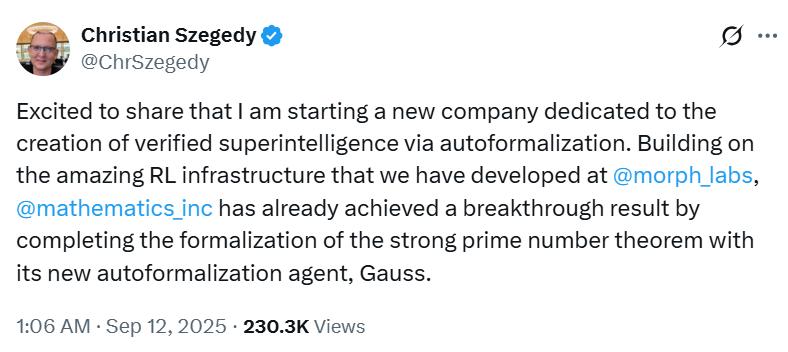
Core Insights - Christian Szegedy, former co-founder of xAI and chief scientist at Morph Labs, has launched a new company called Math Inc., focused on creating verifiable superintelligence through automated formalization technology [1] - Math Inc. has developed an autonomous formalization agent named Gauss, which has successfully formalized the Prime Number Theorem in just three weeks, a task that previously took 18 months for a team of experts [2][3] Group 1: Gauss and Its Capabilities - Gauss is the first autonomous formalization agent designed to assist mathematicians in formal verification tasks, achieving significant milestones in a short time frame [2] - The agent autonomously operates for over 10 hours, completing approximately 95% of formalization and proof tasks, with human involvement required only for the remaining portion [6] - Gauss generated around 25,000 lines of Lean code, including over 1,000 theorems and definitions, marking a significant achievement in formal proof history [4] Group 2: Historical Context and Challenges - The process of converting human mathematical achievements into verifiable machine code has historically been costly and complex, often requiring specialized talent [3] - Previous efforts in formalizing the Prime Number Theorem took 18 months, highlighting the efficiency of Gauss in comparison [3] - The project faced challenges in scaling the Lean verification environment to support thousands of concurrent agents, which was addressed through collaboration with Morph Labs [6] Group 3: Academic Reception and Future Prospects - Gauss has received positive feedback from the academic community, with experts recognizing its potential to revolutionize formal verification and mathematical collaboration [7] - Math Inc. aims to enhance Gauss's capabilities and autonomy in future versions, with plans to significantly reduce the time required for large formalization projects [7] - The company is currently engaging with mathematicians for beta testing, indicating a proactive approach to integrating Gauss into practical applications [7] Group 4: Background of Christian Szegedy - Christian Szegedy has a notable background, having previously worked at Google and contributed to significant advancements in deep learning, including the development of Batch Normalization [8][10] - His experience in AI and formal verification positions Math Inc. as a promising player in the field of verifiable superintelligence [8][9]

陶哲轩团队1年半项目,被他3周搞定!曾与LeCun吵翻天,如今AI大佬创业用智能体震惊整个学界?
AI前线· 2025-09-12 07:13
Core Viewpoint - Math Inc. has launched a new automated formalization agent named Gauss, which has successfully formalized the Prime Number Theorem in a significantly shorter time compared to traditional methods, showcasing the potential of AI in mathematical verification [2][4][5]. Group 1: Company Overview - Math Inc. was founded by Christian Szegedy, a former co-founder of xAI and chief scientist at Morph Labs, focusing on creating verifiable superintelligence through automated formalization technology [2][12]. - The company has developed Gauss, the first automated formalization agent designed to assist mathematicians in formal verification tasks [4][10]. Group 2: Technological Achievements - Gauss completed the formalization of the Prime Number Theorem in just three weeks, a task that previously took a team 18 months to achieve [5][6]. - The agent generated approximately 25,000 lines of Lean code, including over 1,000 theorems and definitions, marking a significant milestone in formal verification [6][10]. - Gauss can autonomously operate for over 10 hours, completing 95% of the formalization and proof work, with human intervention required only for the remaining tasks [8][10]. Group 3: Future Prospects - Math Inc. aims to enhance Gauss's capabilities and autonomy, with plans to significantly reduce the time required for large formalization projects within the next 12 months [10]. - The company is currently engaging with mathematicians for beta testing and aims to provide practical tools for mathematicians and proof engineers [10][9]. Group 4: Academic Recognition - Gauss has received positive feedback from the academic community, with experts highlighting its potential to revolutionize human-computer collaboration in mathematics [9][10].