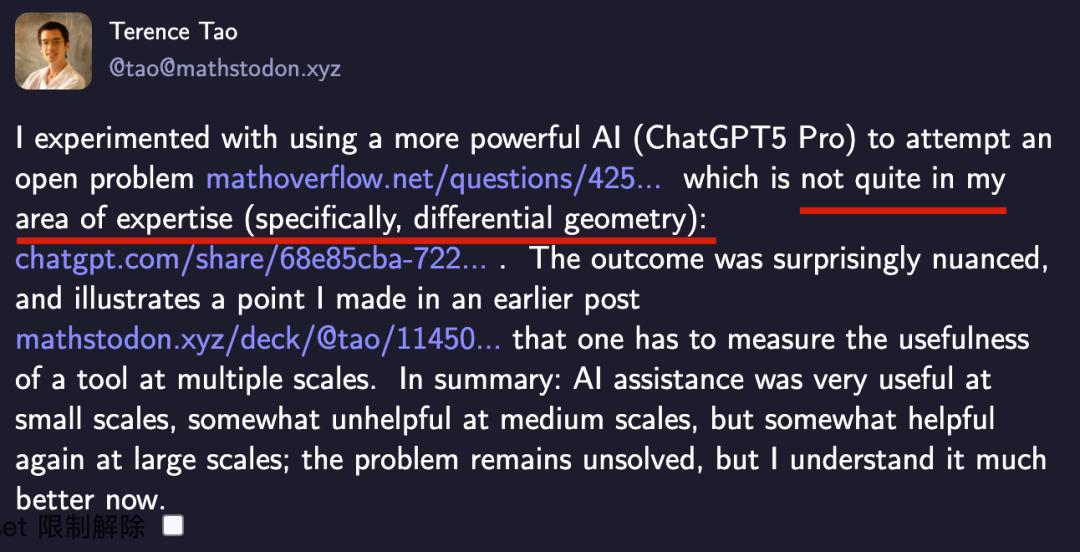
AI辅助数学研究

Search documents
菲尔兹奖成果首次被AI完整形式化,Gauss20万行代码改写数学史?
机器之心· 2026-03-03 08:14
Core Insights - Math, Inc. has achieved a significant milestone in the field of mathematics by formalizing the proof of the optimal sphere packing theorem in 8-dimensional and 24-dimensional spaces using their AI, Gauss [1][3][10] - The formalization of this theorem marks a revolutionary moment in the collaboration between AI and human mathematicians, showcasing the rapid advancements in AI-assisted mathematical research [6][21][22] Company Overview - Math, Inc. was founded by Christian Szegedy, a former co-founder of xAI and chief scientist at Morph Labs, focusing on developing AI technologies for formal verification in mathematics [3][15] - Gauss, the AI developed by Math, Inc., is designed to assist mathematicians in formal verification tasks, combining natural language reasoning with formal reasoning capabilities [15][16] Achievements - The formal proof of the optimal sphere packing theorem in 8 dimensions was completed in just two weeks, while the 24-dimensional proof involved over 200,000 lines of code [18][23] - Gauss previously completed the formalization of the Prime Number Theorem in just three weeks, a task that took human mathematicians 18 months [3][16] Collaboration and Impact - The collaboration between Math, Inc. and human mathematicians has led to significant advancements, including the identification and correction of errors in existing proofs [16][21] - The formalization of these mathematical results is expected to accelerate research processes and deepen the understanding of the interconnectedness of mathematical knowledge [23][24] Future Directions - Math, Inc. plans to continue collaborating with the sphere packing project and other formal mathematical libraries to ensure the long-term usability and maintainability of the code generated by Gauss [24]

谷歌给「AI解数学题」神话降温:能摘低垂果实,但过程依然痛苦
机器之心· 2026-02-03 14:22
Core Insights - Google has made significant progress with its Gemini model, successfully addressing 13 problems from the Erdős Problems database, including 5 novel solutions and 8 rediscoveries of existing answers [1][2][4]. Research Overview - The Erdős Problems database, named after mathematician Paul Erdős, contains 1,179 problems, with 483 (41%) classified as solved. However, many "open" problems may have existing solutions that were not previously identified [4][5]. - The research utilized a custom AI agent named Aletheia, which employed a natural language verifier to filter approximately 700 open Erdős problems down to 212 potential solutions [9]. Methodology - Aletheia's process involved initial filtering by non-expert mathematicians, reducing candidates to 27, which were then rigorously reviewed by domain experts. Out of about 200 candidates, 137 (68.5%) had fundamental errors, while only 13 (6.5%) provided meaningful answers to Erdős's original questions [9][12]. Key Results - The 13 meaningful solutions were categorized into four types: 1. Autonomous solutions (Erdős-652, Erdős-1051) where Aletheia found the first correct solution, although Erdős-652 was based on existing literature [14]. 2. Partial AI solutions for multi-part problems (Erdős-654, Erdős-935, Erdős-1040) [15]. 3. Independent rediscoveries (Erdős-397, Erdős-659, Erdős-1089) where solutions were already known but not initially recognized [15]. 4. Literature identification (Erdős-333, Erdős-591, Erdős-705, Erdős-992, Erdős-1105) where existing solutions were identified despite being marked as open [15][16]. Research Significance - The findings indicate that AI has reached a level where it can tackle "low-hanging fruit" in mathematical problems, providing a new benchmark for AI research in mathematics. However, the authors caution against overstating the mathematical significance of these results, as they are solvable by any expert in the field [19]. - The study highlights challenges in verifying the originality of solutions and the potential for "unconscious plagiarism" where AI reproduces knowledge from training data without proper citation [19][20].


清华AI数学家系统攻克均匀化理论难题!人机协同完成17页严谨证明
量子位· 2025-11-04 08:22
Core Insights - The article discusses the transformation of AI from a "mathematical problem-solving tool" to a "research collaboration partner," exemplified by Tsinghua University's AI mathematician system (AIM) successfully solving a complex mathematical proof [1][2][3] Group 1: AI's Role in Mathematical Research - The research demonstrates the feasibility of AI as a collaborative partner in tackling complex mathematical problems, marking a significant shift in how mathematical discoveries can be approached [2][3] - The study addresses the limitations of current AI systems in mathematics, which often excel in standardized tasks but struggle with real-world research needs [4][5] - The AIM system's collaboration with human researchers led to a comprehensive 17-page mathematical proof, showcasing the potential of human-AI synergy in advanced mathematical research [8][29] Group 2: Methodological Framework - The research outlines five effective human-AI interaction modes that serve as operational guidelines for AI-assisted mathematical research [13][30] - These modes include Direct Prompting, Theory-Coordinated Application, Interactive Iterative Refinement, Applicability Boundary and Exclusive Domain, and Auxiliary Optimization, each designed to enhance the collaborative process [14][17][19][21][22] - The systematic approach to human-AI collaboration not only improves the efficiency of mathematical proofs but also provides a reusable framework for future research [30] Group 3: Future Directions - The study emphasizes the need for further development of human-AI interaction models to enhance mathematical research capabilities and explore their applicability across different mathematical fields [32][34] - Future research will focus on optimizing the AIM system's architecture to improve its reasoning capabilities and overall performance in mathematical theory research [36]
陶哲轩用GPT5-Pro跨界挑战,3年无解的难题,11分钟出完整证明
3 6 Ke· 2025-10-11 09:23
Core Insights - The collaboration between Terence Tao and GPT-5 Pro successfully addressed a three-year-old unsolved problem in differential geometry, showcasing the potential of AI in academic research [1][10]. Group 1: Problem Solving Process - The original problem involved determining if a smooth topological sphere in three-dimensional space, with principal curvature absolute values not exceeding 1, encloses a volume at least equal to that of a unit sphere [3]. - Tao's initial approach was to restrict the problem to star-shaped regions and utilize integral inequalities, but he sought AI assistance for complex calculations [4]. - GPT-5 Pro completed all calculations in 11 minutes and 18 seconds, providing a complete proof for the star-shaped case using various inequalities, some of which Tao was familiar with, while others were new to him [5]. Group 2: AI's Performance Evaluation - AI demonstrated effectiveness in small-scale problems, contributing useful ideas and only minor errors, but it reinforced Tao's incorrect intuition on medium-scale strategies [11][12]. - In large-scale understanding, AI was beneficial in accelerating research and helping Tao abandon unsuitable methods [14]. - Tao's experience highlighted the necessity of human expertise for further advancements in complex problems, indicating that AI's role is more supportive than substitutive [11][16]. Group 3: Historical Context and Evolution of AI Tools - Tao's exploration of AI's potential in mathematics began with the release of ChatGPT, where initial interactions yielded disappointing results due to a lack of depth in understanding mathematical problems [21][22]. - The introduction of GPT-4 marked a turning point, as it significantly improved efficiency in handling statistical data and mathematical tasks, leading to a more optimistic view of AI's integration into research [22][29]. - Tao's ongoing experiments with AI tools have shown that while AI can assist in numerical searches and problem-solving, it still requires careful oversight to mitigate issues like hallucinations or irrelevant outputs [29][31].