自然周期性触底

Search documents
摩根士丹利:国内银行股三季度“自然触底”,四季度及明年一季度迎配置良机
Huan Qiu Wang· 2025-10-21 03:31
Core Viewpoint - Morgan Stanley's latest report indicates that after seasonal adjustments in Q3, Chinese bank stocks are entering a cyclical bottom, with promising investment opportunities expected in Q4 of this year and Q1 of next year. This cycle's bottoming is characterized as a "natural clearing" without large-scale stimulus interventions, marking a new development phase for the market [1]. Group 1: Economic Indicators and Market Dynamics - Multiple economic indicators suggest that the adjustment in the domestic banking system is nearing its end, with a rebound in M1 growth and improved industrial profits occurring without major economic stimulus [1]. - The report highlights that this is a significant milestone, indicating that the internal circulation dynamics of the Chinese economy are strengthening, and the financial system is becoming less dependent on policy stimulus [1]. Group 2: Factors Supporting Bank Stock Revaluation - Four key factors are expected to support the revaluation of bank stocks in the upcoming quarters: 1. The dividend distribution window is approaching, with Q4 typically seeing a concentration of dividend payouts from listed banks, enhancing the attractiveness of high-dividend characteristics for long-term capital [3]. 2. A stable interest rate environment is emerging, which will help alleviate the pressure from the continuous narrowing of banks' net interest margins, thus supporting profitability [3]. 3. The rollout of approximately 500 billion RMB in structural monetary policy tools will inject liquidity into the banking system and guide credit towards specific sectors, optimizing asset structures [3]. 4. Current policy support is more focused on precision and sustainability, avoiding "flood irrigation" and creating a more predictable operating environment for the banking industry [3]. Group 3: Investment Strategy Shift - The previous investment logic relying on macroeconomic strong stimulus is no longer effective. Investors are advised to strategically shift their focus [3]. - Future excess returns will not stem from sector-wide beta trends but rather from alpha opportunities, emphasizing the need to identify leading banks that can achieve earlier and stronger profit rebounds through superior risk management, efficient operating models, and high-quality customer bases in a "natural clearing" environment [3][4].


四季度买银行股?大摩:首次无大规模刺激的“自然周期性触底” 中国银行业进入新时代
Zhi Tong Cai Jing· 2025-10-21 02:42
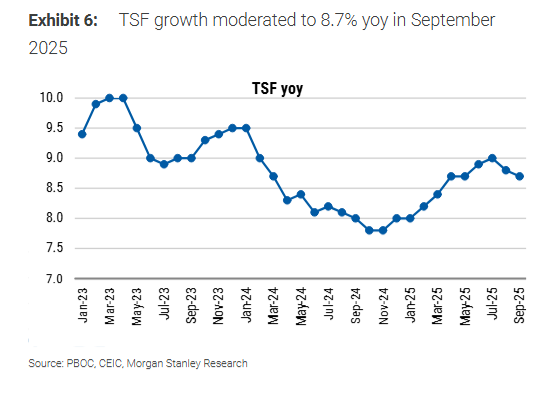
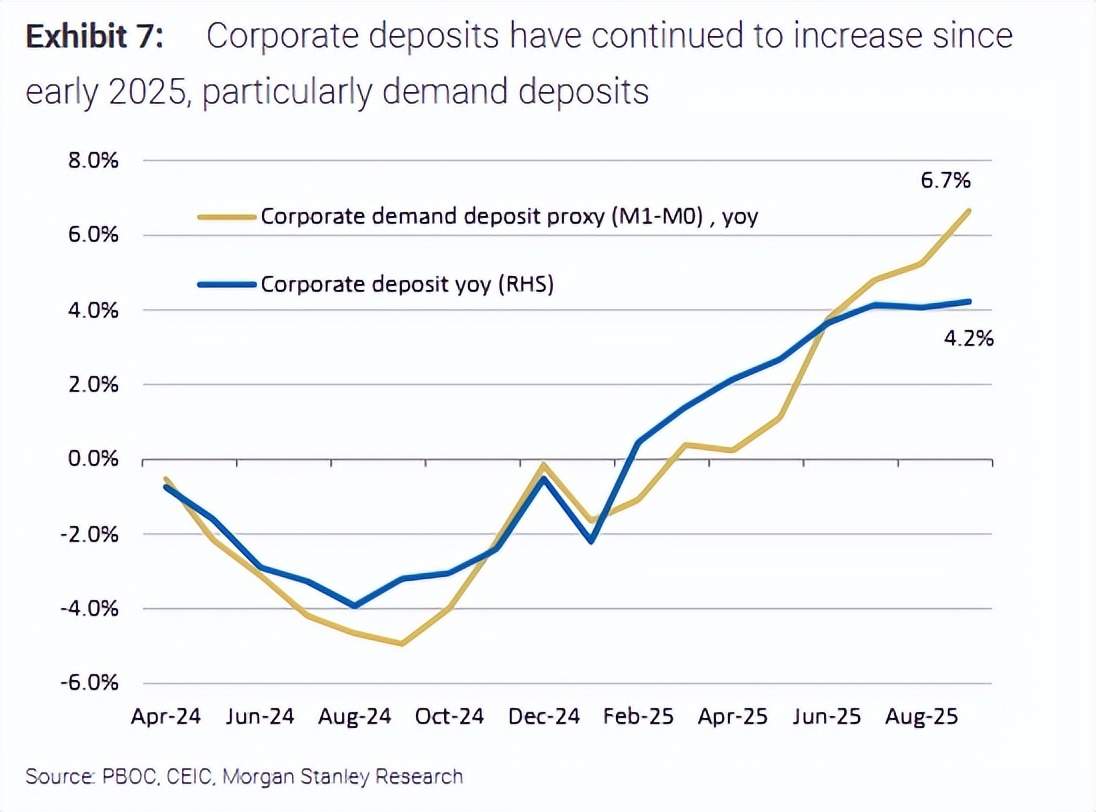
Core Viewpoint - Morgan Stanley believes that domestic bank stocks will present good investment opportunities in the fourth quarter and the first quarter of next year after experiencing seasonal adjustments in the third quarter [1] Group 1: Market Conditions - The Chinese financial system is undergoing an unprecedented change, achieving a "natural cycle bottom" without large-scale stimulus or further monetary easing [3] - The current credit growth is more aligned with economic growth, with social financing growth slowing to 8.7% and loan growth to 6.4% as of September 2025, which stabilizes bank asset returns [4][6] - M1 and corporate current deposit growth have accelerated since early 2025, indicating improved corporate liquidity and confidence, suggesting that risks are easing [6][8] Group 2: Industry Transition - The banking sector is transitioning from a risk control model to a development model, with high-risk asset ratios expected to decline from 9.2% in 2024 to around 3% in the coming years, significantly reducing risk premiums for financial stocks [11][13] - The demand for credit is expected to grow steadily at 5-6% annually, slightly above the projected nominal GDP growth of about 4%, supporting reasonable asset returns and stable net interest margins for banks [13] Group 3: Investment Drivers - Four key factors are expected to support bank stock performance in the fourth quarter: - Dividend-driven capital inflow as banks typically pay mid-term dividends at the end of December and early January, attracting strong demand from institutional investors [14] - Improvement in bank fundamentals, with expected mild pressure on net interest margins and a rebound in fee income due to active capital markets [15] - Supportive policies, including a newly introduced 500 billion RMB structural financial policy tool aimed at supplementing project capital and supporting credit demand without pressuring loan yields [15] - A stable interest rate environment, with minimal adjustments to the loan market quotation rate (LPR) in 2025, which alleviates concerns about sustained pressure on interest spreads [17] Group 4: Investment Opportunities - Banks exhibiting superior profit rebound potential and robust dividend capabilities in the current environment are seen as quality choices to capture opportunities in this "new era" [20]