药品零售行业整合

Search documents
益丰药房:政策拐点催生行情,行业整合时代开启
2026-01-26 02:49
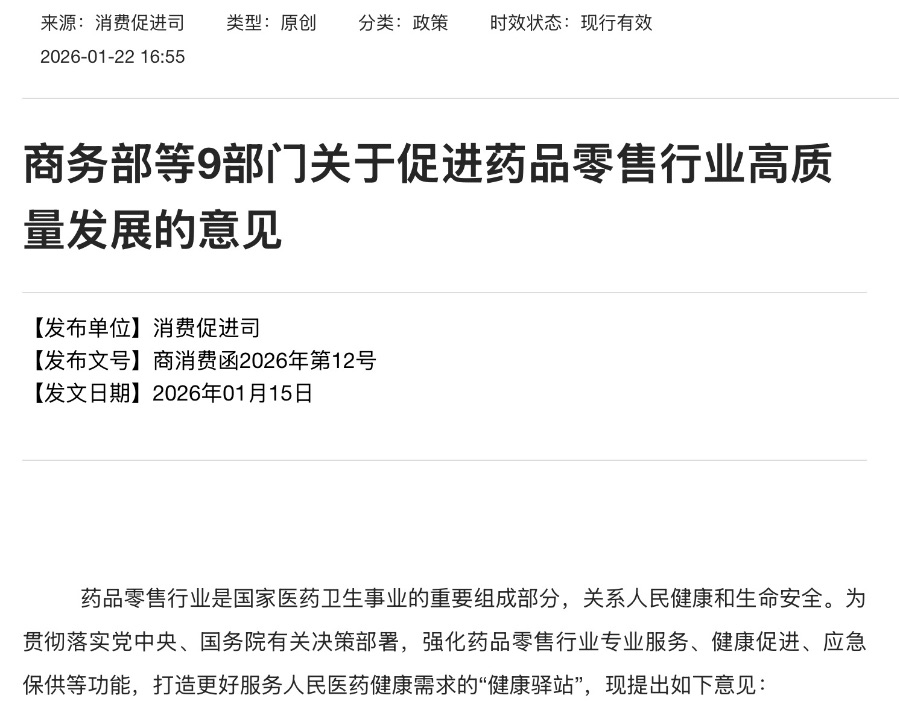
Summary of Yifeng Pharmacy Chain Conference Call Company Overview - **Company**: Yifeng Pharmacy Chain (603939.SS) - **Market Cap**: Rmb30,079 million (US$4,313 million) as of January 23, 2026 [2] Industry Insights - **Policy Change**: The release of the "Opinions on Promoting the High-Quality Development of the Pharmaceutical Retail Industry" by nine central government departments, including the Ministry of Commerce, marks a significant turning point for the pharmaceutical retail sector [1][4] - **Shift in Strategy**: The policy encourages a transition from a period of rectification to one of active support for high-quality growth and integration within the industry [1] - **Consolidation Trend**: The policy explicitly supports horizontal mergers and acquisitions among retail pharmacies and promotes vertical integration between wholesale and retail operations, which is expected to accelerate industry consolidation [4] Key Takeaways from the Policy 1. **Support for Mergers and Acquisitions**: The policy streamlines the process for transferring licenses and insurance qualifications for acquired stores, allowing original qualifications to remain active until new ones are issued [4] 2. **Prescription Outflow**: Encouragement for the flow of prescriptions from hospitals to retail pharmacies and the development of electronic prescription platforms [4] 3. **Insurance Integration**: Aims to optimize outpatient reimbursement services at designated retail pharmacies, aligning payment standards with local primary care institutions [4] 4. **Centralized Procurement**: Retail pharmacies are encouraged to participate in centralized drug procurement programs to enhance bargaining power and reduce costs [4] 5. **Remote Services**: Allows chain pharmacy headquarters to establish centralized pharmaceutical service platforms for remote prescription review and consultation by licensed pharmacists [4] 6. **New Business Models**: Supports the expansion of services to include health consulting and management, and encourages brand-name chains to establish a presence in communities [5] Financial Outlook - **Target Price**: Rmb32.00 per share, derived from DCF analysis with a terminal growth rate of 3% and a WACC of 11.5% [6] - **Valuation Metrics**: Attractive valuation at 16x 2026E PE, with a strong cash position of over Rmb8 billion as of Q3 2025 [1] Investment Recommendation - **Rating**: Maintain Buy rating on Yifeng Pharmacy, positioned to capitalize on the consolidation trend [1] - **Expected Returns**: Anticipated share price return of 29.0% and expected total return of 32.0% [2] Risks - **Key Risks**: 1. Lower-than-expected growth due to slower pharmacy network penetration [7] 2. Unfavorable policies regarding prescription outflow [7] 3. Low-quality M&A activity that fails to generate synergies [7] Conclusion Yifeng Pharmacy Chain is well-positioned to benefit from the supportive policy environment and industry consolidation, with a strong financial foundation and attractive valuation metrics. The investment outlook remains positive, although potential risks must be monitored closely.

药品零售行业迎来政策“礼包”,万亿市场加速变革
2 1 Shi Ji Jing Ji Bao Dao· 2026-01-23 12:17
Core Viewpoint - The Ministry of Commerce and nine other departments have issued the "Opinions on Promoting the High-Quality Development of the Pharmaceutical Retail Industry," proposing 18 measures to enhance the professional, intensive, digital, and standardized development of the pharmaceutical retail sector [1][10]. Group 1: Industry Growth and Transformation - The pharmaceutical circulation market in China is expected to grow from 24.1 trillion yuan in 2020 to 29.5 trillion yuan in 2024, representing a 22.4% increase, with the retail market projected to reach 650 billion yuan by 2024 [1]. - The industry is undergoing a critical transformation from traditional drug sales to comprehensive health services, aiming to become community-oriented "health stations" that enhance the resilience and accessibility of the national health security system [1][10]. Group 2: Challenges and Pain Points - Current challenges in the pharmaceutical retail sector include a shortage of licensed pharmacists, inadequate prescription review processes, restrictions on online prescription sales, and obstacles in medical insurance reimbursement [1][2]. - The lack of quality control and service capabilities in retail pharmacies, along with the need for improved supporting policies, are significant issues that the new document aims to address [2]. Group 3: Policy Measures and Recommendations - The "Opinions" encourage the enhancement of pharmaceutical service capabilities by promoting the establishment of pharmacist teams and health consultants in retail pharmacies, as well as allowing remote prescription reviews by registered pharmacists [4]. - The document supports the optimization of the purchasing experience, participation in centralized drug procurement, and the establishment of payment security systems to facilitate the transition from "drug sales terminals" to "health service stations" [4]. Group 4: Industry Structure and Integration - The "Opinions" advocate for the restructuring of the industry by encouraging mergers and acquisitions among retail pharmacies to improve operational efficiency and quality control [6][7]. - The document highlights the importance of integrating wholesale and retail operations to enhance supply chain efficiency and reduce operational costs [7]. Group 5: Regulatory and Digital Transformation - The "Opinions" propose the development of smart regulation to ensure accurate tracking and verification of drug traceability codes, transitioning to a service-oriented and preventive regulatory model [8][9]. - The document emphasizes the need for a unified digital transformation strategy across the industry, as current efforts are fragmented and lack government coordination [9]. Group 6: Emergency Services and Public Health - The "Opinions" call for strengthening the emergency supply capabilities of retail pharmacies and enhancing public support for drug supply during emergencies [9][10]. - Overall, the document aims to address the industry's challenges and improve the accessibility and quality of health services for the public [10].