药物递送

Search documents
北航校史首篇Cell论文:常凌乾团队等开发器官上的“智能贴片”,实现精准高效且安全的细胞内药物递送
生物世界· 2026-01-27 12:00
Core Viewpoint - The article discusses a significant breakthrough in drug delivery technology, specifically through the development of a flexible, implantable bioelectronic device called POCKET, which allows for precise and efficient drug delivery to complex organ surfaces, addressing long-standing issues in traditional drug delivery methods [2][3]. Research Background - The research originated from a clinical challenge faced by doctors regarding hereditary ovarian gene mutations, where traditional gene therapy methods pose risks to reproductive cells. The team shifted focus to a physical method called electroporation to deliver therapeutic agents safely to ovarian surface cells without affecting the eggs [7]. Breakthrough Innovation - The research team drew inspiration from traditional paper-cutting art to create a "customized organ conformal kirigami theory," establishing a quantitative relationship between geometric parameters of the kirigami structure and the curvature of organs, enabling the design of patches that achieve over 95% coverage on organ surfaces [9]. Device Design and Functionality - The POCKET device features a four-layer functional design, including a nanopore array film for direct tissue contact, a hydrogel drug-loading layer, a silver nanowire electrode layer for electric field distribution, and a flexible substrate layer. This design allows for high conformability and large-area adhesion to various organ surfaces [12]. Efficacy Validation 1: Ovarian Cancer Prevention - In animal models, POCKET successfully delivered functional BRCA1 plasmids to ovarian surface cells, significantly reducing cancer risk without affecting reproductive cells. This approach restored ovarian hormone secretion and fertility, providing a viable alternative to surgical removal for women with cancer risk mutations [15]. Efficacy Validation 2: Organ Damage Repair - In kidney transplant scenarios, POCKET was used to deliver anti-inflammatory drugs locally, showing significant improvement in tubular repair and kidney function while avoiding systemic side effects associated with oral medications, highlighting its advantages in chronic disease management [19]. Technology Translation and Clinical Application - The POCKET platform offers new tools for precise treatment of ovarian cancer prevention and organ damage repair, integrating flexible electronics and micro-nano processing for effective control and long-term operation. The technology has progressed from laboratory to industry, with a high-tech company already established and the first product, Ultra-NEP, applied in skin health [22][24].


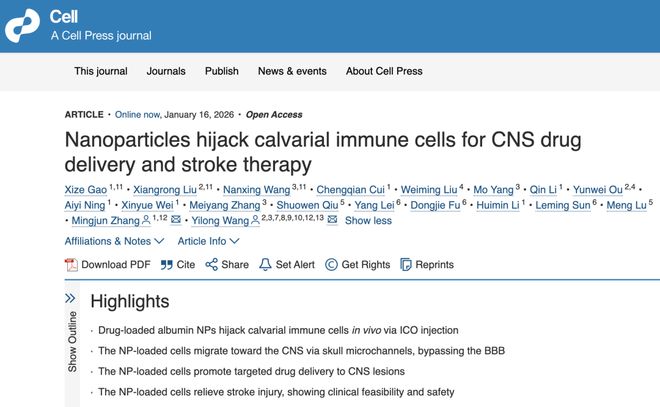
微创、高效、直达大脑!我国科学家开辟脑卒中病灶给药新路径
Huan Qiu Wang Zi Xun· 2026-01-17 23:43
Core Viewpoint - The research teams from Tsinghua University and Capital Medical University have developed a novel method to bypass the blood-brain barrier using nanoparticles to deliver drugs directly to stroke lesions, potentially overcoming a significant challenge in neurological disease treatment [1][3]. Group 1: Research Findings - The study reveals that the bone marrow within the skull is not a static structure but is connected to the meninges through microchannels, allowing immune cells to bypass the blood-brain barrier and enter the brain [3]. - The research team utilized a minimally invasive injection method to deliver albumin nanoparticles into the skull bone marrow, which were efficiently taken up by immune cells, forming "skull immune cell micro-nanobots" for targeted drug delivery [3][4]. - The nanoparticles demonstrated low systemic exposure, with minimal entry into peripheral blood and major organs, ensuring good biocompatibility and safety [3][4]. Group 2: Clinical Implications - In mouse models of acute ischemic stroke, the new delivery method significantly reduced infarct volume and edema, improved neurological function, and showed long-term benefits in reducing brain atrophy and enhancing survival rates [4]. - An exploratory clinical study involving 20 patients with malignant cerebral artery occlusion indicated that the procedure was well-tolerated, with no severe adverse events reported, and showed positive trends in neurological recovery [4][5]. Group 3: Future Prospects - The research suggests that this delivery pathway could extend beyond drug delivery, potentially integrating with brain-machine interface technologies to facilitate multi-directional exchanges of materials, energy, and information between the brain and artificial systems [5].
Nature子刊:另辟蹊径,天津医科大学张晓敏/李筱荣团队利用小细胞内囊泡递送药物,治疗视网膜疾病
生物世界· 2026-01-14 08:00
Core Viewpoint - The research highlights the superior potential of small intracellular vesicles (sIV) over small extracellular vesicles (sEV) in drug delivery and retinal neuroprotection, suggesting a promising avenue for clinical applications in biomedical engineering [3][9][12]. Group 1: Research Findings - The study developed a method for isolating sIV from various cell types and demonstrated that sIV outperforms sEV in uptake, drug delivery, and retinal neuroprotection [3][7]. - sIV are smaller in size and yield higher quantities compared to sEV, exhibiting stronger cellular uptake capabilities in both in vitro and in vivo models [9]. - Molecular analysis revealed that sIV are enriched with endoplasmic reticulum and Golgi apparatus-related proteins, possessing unique microRNA characteristics associated with the intracellular membrane system, and contain higher levels of phospholipids such as phosphatidylcholine and phosphatidylethanolamine [9]. Group 2: Therapeutic Applications - sIV derived from mesenchymal stem cells (MSC) showed remarkable therapeutic effects in a retinal degeneration model by alleviating endoplasmic reticulum stress and delivering neuroprotective factors [9][11]. - The enhanced drug loading and delivery capabilities of sIV allow for effective transport of lipophilic compounds, such as rapamycin, to the retina [11]. Group 3: Implications for Clinical Translation - The findings indicate that sIV could serve as a promising alternative to traditional biological nanovesicles in clinical translation, potentially overcoming the limitations faced by sEV in therapeutic applications [12].

3D打印新材料可与人体免疫系统兼容 有望推动人造器官移植和药物递送技术发展
Ke Ji Ri Bao· 2025-11-24 00:55
Group 1 - A new type of 3D printing material has been developed by a research team from the University of Virginia, which is compatible with the human immune system and has the potential to advance organ transplantation and drug delivery technologies [1][2] - The research team modified the properties of polyethylene glycol (PEG) to create a stretchable network structure, overcoming the limitations of traditional production methods that resulted in weak and crystalline structures [1] - The innovative "foldable bottle brush" structure allows the material to be both strong and highly elastic, enabling the production of 3D printable, highly stretchable PEG-based hydrogels and solvent-free elastomers [1] Group 2 - The team indicated that by altering the shape of the UV light, complex structures can be created, opening new possibilities for manufacturing artificial organs or drug delivery systems [2] - The stretchable 3D printed PEG material has been shown to be biocompatible, suitable for in-body applications such as organ scaffolds, as confirmed by cell culture tests [2] - The material may be combined with other substances to produce 3D printed products with varying chemical compositions, showcasing its potential as a high-performance solid electrolyte in advanced battery technologies [2]
AptarGroup (NYSE:ATR) 2025 Conference Transcript
2025-11-19 13:02
Summary of AptarGroup Conference Call Company Overview - **Company**: AptarGroup - **Industry**: Pharmaceutical and Consumer Goods - **Core Business**: The pharmaceutical segment accounts for nearly 70% of EBITDA, focusing on proprietary drug delivery devices, primarily for chronic disease treatments such as asthma and COPD [2][5][12] Key Points and Arguments Financial Performance - **Growth Rates**: The pharmaceutical business has experienced top-line growth of 7%-11% over the last few years, with an average adjusted EBITDA growth of 26% [5][12] - **Profitability**: EBITDA margins for the pharma segment range from 32% to 36% [5] - **Capital Deployment**: Capital is preferentially allocated to the pharma business due to its high returns and growth potential [5][6] Dividend and Shareholder Returns - **Dividends**: AptarGroup has a strong track record of returning capital to shareholders, with $8 billion in dividends and $6 billion in share repurchases over the last seven years [6] - **Recent Dividend Increase**: A 7% increase in dividends was announced, maintaining a payout ratio of 30%-40% [6] Sustainability and Corporate Responsibility - **Sustainability Recognition**: AptarGroup has received multiple accolades for sustainability, including being in the top 1% of Echovate and recognized by Forbes and Time Magazine [7][8] Drug Delivery Innovations - **Proprietary Systems**: The company has developed proprietary drug delivery systems, with a focus on nasal delivery, which is increasingly recognized for its effectiveness in treating various conditions [9][10][14] - **Pipeline Development**: The pipeline includes treatments for neurodegenerative diseases and cardiovascular conditions, with a focus on combination medicines that ensure a perpetual revenue stream [12][13] Market Position and Growth Opportunities - **Market Share**: AptarGroup holds significant market shares in respiratory, dermal, and eye care segments, with ongoing growth opportunities in injectables and oral delivery systems [11][12] - **Injectables Growth**: The injectables segment is expected to grow, driven by GLP-1 products, which are projected to become a larger portion of the injectables business [18][19] Strategic Acquisitions - **M&A Activity**: The company has made strategic acquisitions to enhance its technology portfolio and expand its capabilities in drug delivery [24][25] - **Focus on Adjacent Markets**: AptarGroup is exploring opportunities in dermal and ophthalmic drug delivery, as well as enhancing its capabilities in nasal delivery [24][25] Stock Performance and Share Repurchases - **Stock Price Reaction**: The stock price has been affected by recent challenges, particularly related to Narcan, but management believes the reaction is overdone [17][25] - **Share Buybacks**: The company has increased its share repurchase activity, with $190 million spent year-to-date, and plans to exhaust remaining authorizations [25] Additional Important Insights - **Operational Efficiency**: The beauty segment has seen improvements in operational efficiency, which is expected to enhance profitability as volumes increase [16] - **Regulatory Expertise**: AptarGroup's deep regulatory expertise positions it as a partner of choice for early-stage drug development [3][12] This summary encapsulates the key insights from the AptarGroup conference call, highlighting the company's strong financial performance, innovative drug delivery systems, and strategic growth initiatives.

EyePoint Pharmaceuticals (NasdaqGM:EYPT) FY Conference Transcript
2025-11-10 16:30
Summary of EyePoint Pharmaceuticals FY Conference Call Company Overview - **Company**: EyePoint Pharmaceuticals (NasdaqGM:EYPT) - **Mission**: To improve patients' lives through enhanced treatment of retinal diseases, focusing on drug delivery systems [6][5][4] Key Trials and Developments - **Pivotal Trials**: - Two pivotal trials for wet age-related macular degeneration (AMD): Lugano Trial and Lugia Trial, both fully enrolled with over 400 patients each [6][7] - Expected readout for Lugano Trial in mid-2026 and Lugia Trial shortly thereafter [6] - Phase three trials for diabetic macular edema (DME) named COMO and COPRI, with patient dosing starting in Q1 2026 [7] - **Drug Mechanism**: Vorolanib, the drug in focus, exhibits both anti-VEGF and anti-inflammatory effects by blocking the JAK1 receptor, which is significant for conditions like diabetic macular edema and wet AMD [9] Enrollment and Study Design - **Rapid Enrollment**: The rapid enrollment in the wet AMD trials was attributed to strong phase two data and the patient-centric design of the studies [11][10] - **Patient Population**: The phase three study includes both previously treated and naive patients, with expectations of better outcomes in naive patients [14][13] Safety and Efficacy Expectations - **Safety Profile**: The safety results so far are consistent with prior trials, with no vision loss reported due to the drug insert [21][23] - **Efficacy Goals**: The aim is to be statistically non-inferior to Eylea, with hopes of achieving statistical superiority [20][19] Competitive Landscape - **Market Position**: EyePoint aims to differentiate itself from competitors like Vabysmo and Eylea by offering a different mechanism of action and a six-month dosing schedule [36][37] - **First-to-Market Advantage**: If approved, EyePoint will be the first to market with its sustained-release product, which is expected to be advantageous [38] Market Potential - **DME Market Size**: The DME market is approximately $3 billion in the U.S., representing about 35-40% of the overall market for retinal diseases [49][50] Regulatory and Global Strategy - **Regulatory Readiness**: EyePoint is preparing for a pre-approval inspection by the FDA and has a clear plan for NDA submission based on the results of the ongoing trials [33][31] - **Ex-U.S. Strategy**: The company plans to include European sites in its studies and is preparing for potential launch outside the U.S., with a focus on finding a global partner at the right time [50][51] Conclusion EyePoint Pharmaceuticals is positioned at a pivotal moment with multiple ongoing trials and a strong focus on innovative drug delivery for retinal diseases. The company is optimistic about its upcoming trial results and the potential market impact of its products.

Lipella Pharmaceuticals Announces U.S. Patent Issuance for Diagnostic Technology
Globenewswire· 2025-06-17 12:30
Core Insights - Lipella Pharmaceuticals Inc. has been granted U.S. Patent No. 12,326,492 for a method to detect interstitial cystitis using MRI, providing protection until at least 2045 [1][2] - The patented method aims to enhance outcome assessments for mucosal disorders, including existing programs for oral lichen planus, hemorrhagic cystitis, and bladder cancer [2] - The patent strengthens Lipella's strategic position in drug delivery, allowing non-invasive monitoring of body cavity lesions, which could serve as an early detection tool [3] Company Overview - Lipella Pharmaceuticals is a clinical-stage biotechnology company focused on developing new drugs by reformulating existing generic drugs for new applications [3] - The company targets diseases with significant unmet needs where no approved drug therapies currently exist [3] - Lipella completed its initial public offering in 2022 [3]