
虚拟货币“挖矿”

Search documents
进一步防范处置虚拟货币等相关风险
Zhong Guo Zheng Quan Bao· 2026-02-06 20:24
Core Viewpoint - The People's Bank of China and other regulatory bodies have issued a notice to further prevent and address risks associated with virtual currencies and Real World Assets (RWA), emphasizing the illegal nature of virtual currency activities within the country [1][2]. Regulatory Stance - The notice reiterates a long-standing prohibitive policy stance against virtual currency activities, stating that virtual currencies do not hold the same legal status as fiat currencies and that any related activities within the country are illegal [1][2]. - It is specified that no domestic or foreign entities are allowed to provide virtual currency-related services to domestic subjects without proper authorization [2][3]. Stablecoins Regulation - The notice clarifies that stablecoins pegged to fiat currencies are effectively performing some functions of legal tender, and any issuance of stablecoins linked to the Renminbi outside of China requires approval from relevant authorities [2]. - It highlights the cross-border risk transmission associated with virtual currencies, necessitating strict regulations on the issuance of virtual currencies by domestic entities abroad [2][3]. RWA Tokenization - The concept of RWA tokenization is defined as the conversion of ownership and income rights of assets into tokens using encryption and distributed ledger technology [2]. - Activities related to RWA tokenization within the country are prohibited unless authorized by regulatory bodies, as they may involve illegal fundraising or securities issuance [2][3]. Cross-Border Business Regulations - Strict regulations are imposed on domestic entities engaging in RWA tokenization activities abroad, with oversight from various regulatory bodies to ensure compliance with existing laws [3][4]. - Any unauthorized business activities related to RWA tokenization are prohibited, and entities must seek approval before proceeding [3][4]. Financial Institutions Management - Financial institutions and intermediaries are required to manage their overseas operations in compliance with domestic regulations, including customer due diligence and anti-money laundering measures [4][5]. - Financial institutions are prohibited from providing services related to unauthorized RWA tokenization activities and must report any illegal activities to the relevant authorities [5][6]. Virtual Currency Mining Regulation - The notice emphasizes the ongoing crackdown on virtual currency mining activities, with local governments held accountable for identifying and shutting down existing mining projects [6]. - New mining projects are strictly prohibited, and companies involved in the production of mining equipment are not allowed to offer sales or services within the country [6].
八部门印发通知进一步防范和处置虚拟货币交易炒作风险 一文划重点
Yang Shi Xin Wen Ke Hu Duan· 2026-02-06 13:01
Core Viewpoint - The recent joint notice issued by the People's Bank of China and other regulatory bodies aims to further prevent and address risks associated with virtual currencies and the tokenization of real-world assets (RWA), highlighting the illegal nature of related financial activities and the need for strict regulatory measures [1][8]. Group 1: Virtual Currency Regulations - Virtual currencies do not have the same legal status as fiat currencies and should not be used as a medium of exchange in the market [2]. - Any entity or individual is prohibited from issuing stablecoins pegged to the Renminbi abroad without approval from relevant authorities [3]. - Virtual currency-related business activities are classified as illegal financial activities and are strictly prohibited, including exchanges between fiat and virtual currencies, trading of virtual currencies, and token issuance [3][4]. Group 2: RWA Tokenization Regulations - The notice defines the concept of RWA tokenization and emphasizes that conducting RWA-related activities within the country is considered illegal financial activity [5]. - Activities such as issuing tokens representing ownership or rights to real-world assets using blockchain technology are prohibited unless approved by regulatory authorities [5]. - Foreign entities are also barred from providing RWA tokenization services to domestic subjects in any form [5]. Group 3: Mining Activities - The notice mandates strict control over virtual currency mining activities, including the closure of existing mining projects and a ban on new mining operations [6]. - Companies involved in the production and sale of mining equipment are prohibited from offering services within the country [6]. Group 4: Enforcement and Monitoring - The notice emphasizes the need for enhanced inter-departmental collaboration to monitor and address illegal activities related to virtual currencies and RWA, maintaining a high-pressure stance against such activities [7][8]. - The rise in speculative activities surrounding virtual currencies and RWAs has led to increased illegal fundraising and fraud, necessitating stronger regulatory measures [8].
公众需守好“钱袋子”!七协会联合发声:虚拟货币非法定货币 | 快讯
Hua Xia Shi Bao· 2025-12-05 13:55
Core Viewpoint - The recent announcement by the China Internet Finance Association and six other associations highlights the risks associated with virtual currencies and illegal activities, emphasizing the need for public awareness and caution against scams and illegal fundraising activities [2][3]. Group 1: Risks of Virtual Currencies - Virtual currencies are not issued by monetary authorities and do not have the same legal status as fiat currencies, making them illegal for circulation within China [3]. - Air coins, such as π coin, lack substantial technological innovation and clear commercial applications, with serious issues related to fraud and market manipulation [3]. - Stablecoins currently do not meet customer identification and anti-money laundering requirements, posing risks of being used for money laundering and illegal fundraising [3]. Group 2: Regulatory Stance - The announcement reiterates that no institutions are allowed to engage in activities related to virtual currencies or tokenization of real-world assets [3]. - The financial management authorities in China have not approved any activities related to the tokenization of real-world assets, highlighting the regulatory stance against such practices [3]. Group 3: Historical Context - Previous warnings have been issued by the China Internet Finance Association regarding risks associated with NFTs and virtual currency trading, emphasizing the need for compliance with national laws and regulations [4]. - In April 2022, a call was made to curb the financialization and securitization of NFTs, and in May 2021, a warning was issued against virtual currency trading speculation [4].

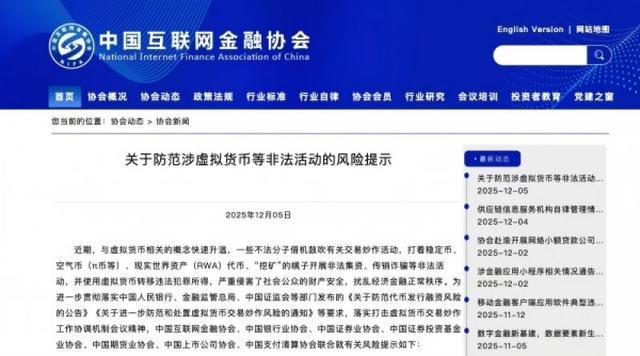
七部门发布《关于防范涉虚拟货币等非法活动的风险提示》
智通财经网· 2025-12-05 12:31
Core Viewpoint - The Chinese Internet Finance Association and six other departments issued a risk warning regarding virtual currencies and related illegal activities, emphasizing that member units must not engage in or provide services for virtual currency and real-world asset token issuance and trading within China [1][2]. Group 1: Nature of Virtual Currencies and Related Activities - Virtual currencies are not issued by monetary authorities and do not have the same legal status as legal tender in China, making them illegal for circulation [2]. - Certain virtual currencies, such as π coins, lack substantial technological innovation and clear commercial applications, leading to significant fraud and market manipulation risks [2]. - Stablecoins currently do not meet customer identification and anti-money laundering requirements, posing risks of being used for money laundering and fraudulent fundraising [2]. - The tokenization of real-world assets carries multiple risks, including false asset risks and speculative trading risks, with no approved activities in this area by Chinese financial authorities [2]. Group 2: Prohibitions on Financial Institutions - Member units are prohibited from participating in the issuance and trading of virtual currencies and real-world asset tokens within China [4]. - Banks and payment institutions must not provide any financial services or credit support to virtual currency mining enterprises and projects [4]. - Securities, fund, and futures institutions are also barred from offering services related to the issuance and trading of virtual currencies and real-world asset tokens [4]. Group 3: Public Awareness and Precautions - The public is urged to be vigilant against various forms of virtual currency and real-world asset token activities, which are often associated with speculation and fraud [5]. - Individuals should enhance their risk awareness and avoid participating in virtual currency and real-world asset token activities to protect their finances [5][6]. - Any suspicious activities related to virtual currencies should be reported to regulatory authorities, and individuals should refrain from engaging with promotional materials that suggest historical returns or speculative prospects [6].