虚拟货币诈骗

Search documents
全球最大电诈集团被端!美国没收近13万枚比特币,价值1070亿元!
Sou Hu Cai Jing· 2025-10-20 11:45
Core Insights - The collapse of the largest global fraud group, linked to a network of Bitcoin addresses, has revealed a transnational scam empire capable of influencing national operations and enslaving thousands globally [1][3]. Group 1: Overview of the Fraud Group - The Taizi Group was involved in extensive fraud operations, with 127,000 Bitcoins equivalent to over 100 billion RMB seized in a joint operation by the US and UK in mid-October [3]. - The group's operations were disguised as legitimate businesses in real estate, finance, and consumer goods, while actually serving sophisticated fraud and money laundering activities [10]. Group 2: Operational Mechanisms - The group coerced employees to surrender personal belongings and operated in a controlled environment, effectively turning workplaces into prisons for victims [11]. - They utilized a systematic approach to online scams, targeting vulnerable individuals through emotional manipulation and fake romantic relationships, leading victims to invest in virtual currencies [15]. Group 3: Financial Operations - Funds from scams were funneled into a digital currency system, with significant amounts stored in Bitcoin wallets located in Dubai and transactions processed through servers in Singapore [17]. - The group believed that decentralization would shield them from detection, but every transaction on the blockchain is traceable, allowing authorities to track illicit funds [19]. Group 4: Law Enforcement Actions - The US and UK had been monitoring the Taizi Group for years, employing undercover operatives to gather critical information and subsequently freezing assets linked to the group's leader, Chen Zhi [20]. - The operation led to the freezing of $15 billion in assets, effectively crippling the group's financial operations and leading to the disarray of its workforce [22]. Group 5: Implications and Future Outlook - The US intervention was prompted by numerous reports from American citizens who had fallen victim to the group's scams, highlighting the international nature of the fraud [24]. - The case serves as a warning to those who believe that the digital realm is free from regulation, indicating that such environments will no longer be lawless [26].


警惕这13个项目项目正在掏空你的钱包!涉嫌传销、虚假理财诈骗!
Sou Hu Cai Jing· 2025-07-14 10:51
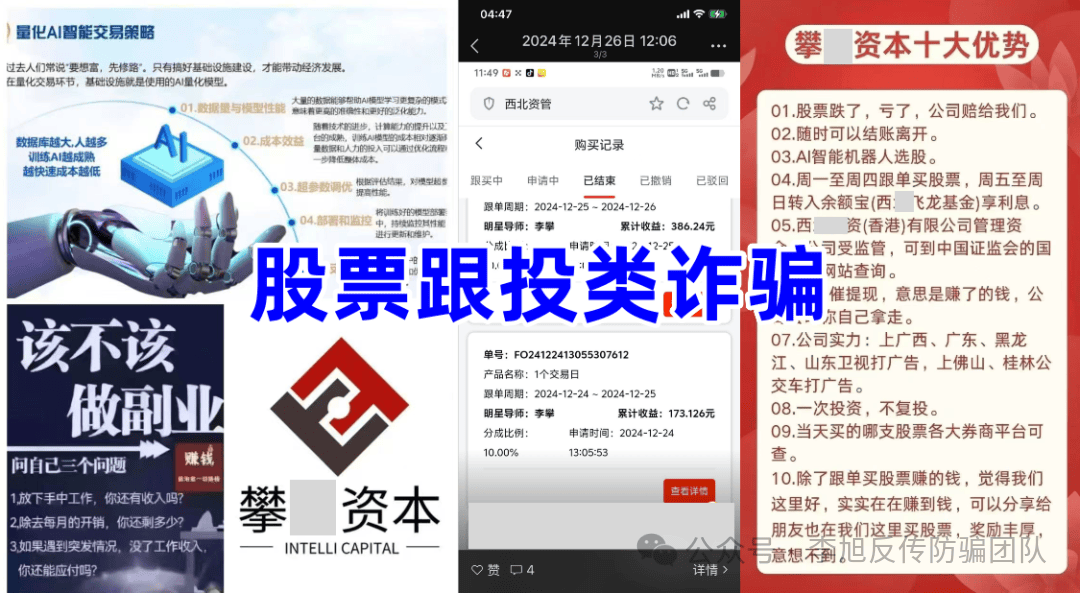
Group 1 - The rise of virtual currencies has led to financial innovation but also created a breeding ground for scams, with Ponzi schemes and fraudulent investment projects disguised as blockchain and decentralized high-yield investments [1] - Recent scams include "Xinkangjia DGCX" virtual currency fraud, "Xinlizhong" stock-following fraud, and "Blu Trading" virtual currency fraud [1] - The "Xinlizhong" stock-following project has collapsed, similar to the previous "Lianmou Investment" stock-following scam [6][2] Group 2 - Fraudulent apps like "Panmou Capital" and "Shengshu" have been reported, promoting high returns and requiring participants to download unregistered applications [2][4] - The "AIFEEX" virtual currency staking project claims to offer static returns on investments in AFM coins, promoting a multi-level dynamic return structure [14][16] - The "AAVE" blockchain bank project promotes high returns and uses a referral system, exhibiting characteristics typical of pyramid schemes [19][20] Group 3 - Various fraudulent apps, such as "Renmin Zhishang" and "Zhonghua Minsheng," have been reported, promoting fictitious high-yield investment projects and requiring participants to pay fees to withdraw funds [23][29] - The "STA" cross-border e-commerce project has been flagged for requiring participants to pay deposits and promising returns through a multi-level sales structure, indicating potential fraud [36][38] - The "Jinduan Club" and "Guangzhou Certain Cosmetics" scams involve participants paying large sums to join and promising high returns, showcasing the prevalence of pyramid schemes [42][43]