
行业集中度提高

Search documents
净赚超6.3亿!储能巨头瑞浦兰钧,扭亏为盈
Sou Hu Cai Jing· 2026-02-24 01:08
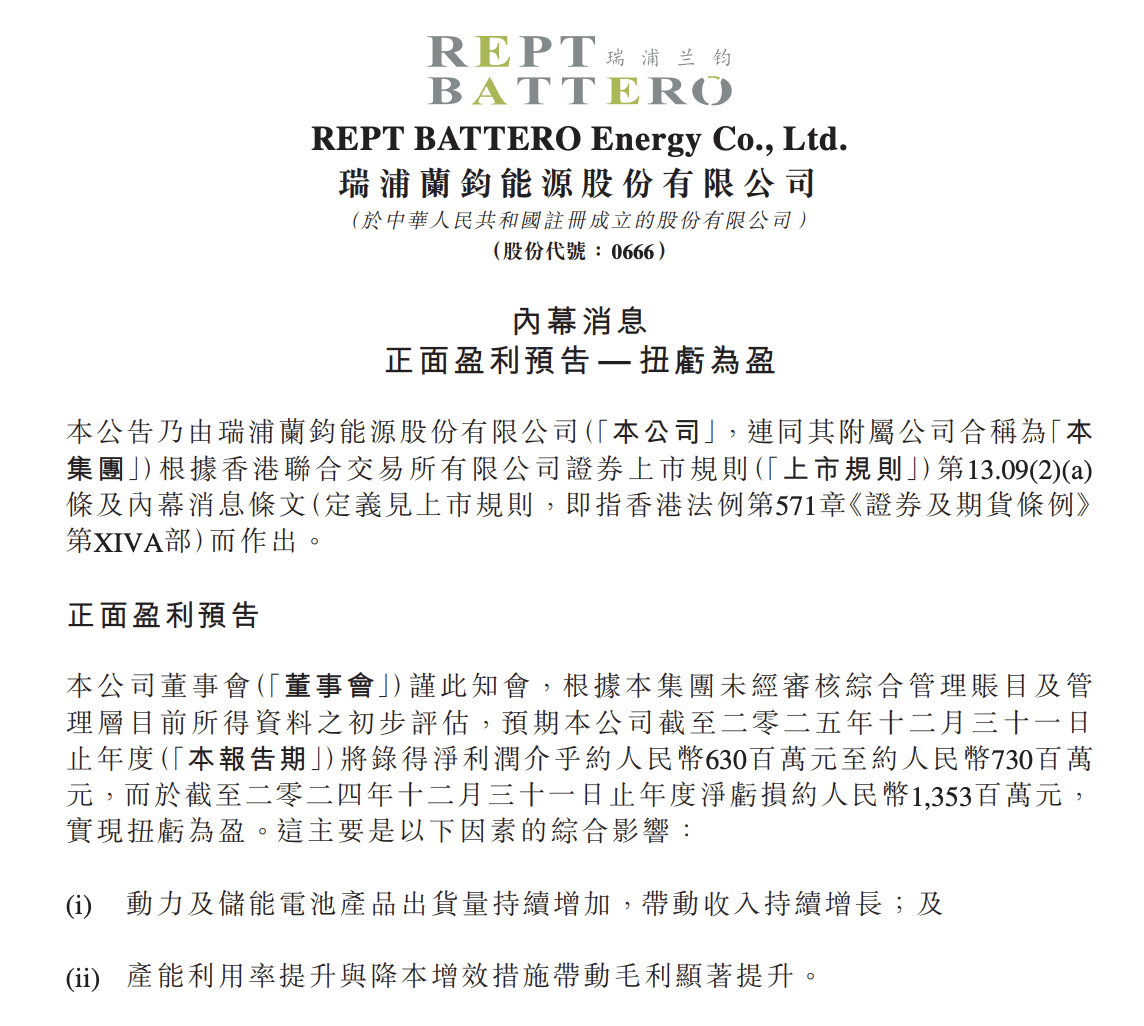
Core Viewpoint - The global energy storage market is experiencing a surge in demand, leading to improved financial performance for related companies, particularly for leading firms like Ruipu Lanjun, which is expected to turn a profit by 2025 after significant losses in 2024 [1][4]. Group 1: Company Performance - Ruipu Lanjun forecasts a net profit of 630 million to 730 million yuan for the year ending December 31, 2025, a significant turnaround from a net loss of 1.353 billion yuan in 2024 [1][4]. - The company's recovery is attributed to increased shipment volumes of power and energy storage battery products, which have driven steady revenue growth [4]. - The improvement in gross profit margins is also due to enhanced capacity utilization and cost reduction measures [4]. Group 2: Market Position and Competition - Ruipu Lanjun is a core subsidiary of Qingshan Group, focusing on the design, research, production, and sales of lithium-ion battery solutions for electric vehicles and smart power storage [4]. - The company is primarily positioned in the new energy heavy truck battery segment, with a projected battery installation volume of 94.8 GWh in 2025, accounting for 64% of the total commercial vehicle battery installation volume in China [4]. - Despite being ranked sixth in the market with 5.7 GWh, Ruipu Lanjun faces stiff competition from industry leaders like CATL and BYD, which dominate the market [4][7]. Group 3: Industry Outlook - The energy storage demand explosion is expected to alleviate some competitive pressures in the lithium battery industry, although the clearing of mid-tier companies will accelerate [8]. - The industry is likely to see a further increase in concentration, benefiting leading firms as they navigate through the current market challenges [8]. - Analysts predict that Ruipu Lanjun will continue to benefit from economies of scale and integrated transformation, with net profits expected to grow further by 2026 [8].

研判2025!中国雾灯行业产业链、市场规模、竞争格局及发展趋势分析:行业市场规模持续上涨,未来有望向智能化升级[图]
Chan Ye Xin Xi Wang· 2025-12-15 01:35
Core Viewpoint - The fog light industry in China is experiencing significant growth, with the market size projected to increase from 1.88 billion yuan in 2015 to 5.11 billion yuan in 2024, reflecting a compound annual growth rate (CAGR) of 11.7% [1][7]. Industry Overview - Fog lights are essential automotive lighting devices used in adverse weather conditions to ensure driving safety. They are categorized into front and rear fog lights, with specific color and design features [3][4]. - The industry chain includes upstream components such as metals, plastics, LED chips, and optical lenses; midstream involves manufacturing fog lights; and downstream applications cover passenger cars, commercial vehicles, and new energy vehicles [6]. Market Dynamics - The growth of the fog light market is supported by government policies mandating the installation of compliant fog lights in vehicles, which has increased the installation rate [1][7]. - Rising living standards and the increasing number of vehicles, particularly the surge in new energy vehicles, are driving new demand for fog lights [1][7]. Competitive Landscape - Domestic companies like Xingyu Co., Ltd. and Huayu Vision are expanding rapidly in the mid-range market while gradually entering the high-end sector. Numerous small and medium-sized manufacturers focus on niche markets due to limitations in technology and funding [8]. Industry Trends 1. **Technological Innovation and Smart Development**: The adoption of LED technology is expected to enhance performance, with improvements in brightness, color temperature, and precision in light distribution. Laser fog lights may emerge as a new breakthrough due to their superior penetration and brightness [12]. 2. **Global Expansion**: Chinese fog light manufacturers are poised to accelerate their overseas presence, leveraging a complete supply chain and competitive pricing to capture global market share [12]. 3. **Increasing Industry Concentration**: The industry is expected to consolidate, with weaker companies facing potential elimination, while stronger firms may expand through mergers and acquisitions, enhancing overall competitiveness [13].



