规模魔咒

Search documents
新旧交替!百亿基金经理大洗牌
券商中国· 2026-02-01 13:12
Core Viewpoint - The rise of AI technology has led to a new batch of active equity fund managers managing over 10 billion yuan, referred to as "new hundred billion" fund managers, who are now part of the latest lineup alongside established managers like Zhang Kun and Liu Yanchun, creating a "new and old" transition in the fund management landscape [1][7]. Group 1: New vs. Old Fund Managers - As of January 31, the number of active equity fund managers managing over 10 billion yuan remains above 100, continuing a trend of recovery since Q3 2025, returning to levels seen at the end of 2023 [2]. - "New hundred billion" fund managers typically have shorter management tenures and previously lower scales, but have rapidly grown their assets under management (AUM) in 2025, with examples like Zhang Lu from Yongying Fund, whose AUM increased from just over 2 billion yuan at the end of 2024 to over 30 billion yuan [2]. - Other notable "new hundred billion" managers include Lan Xiaokang from China Europe Fund and Zheng Xi from E Fund, both of whom saw significant AUM increases in the past year [3]. Group 2: Performance and Strategy Shifts - Established "old hundred billion" managers like Zhang Kun and Liu Yanchun still hold significant AUM but have seen declines from their peak levels, with Zhang Kun's AUM dropping from over 130 billion yuan in 2021 to around 48 billion yuan currently [3]. - The market dynamics have shifted, with "new hundred billion" managers benefiting from the AI and technology sectors, while "old hundred billion" managers have largely maintained positions in traditional blue-chip assets, leading to performance discrepancies [7][8]. - Some "old hundred billion" managers have begun to adjust their strategies, with examples like Xie Zhiyu, who has shifted from blue-chip stocks to technology-focused investments, achieving notable returns [8]. Group 3: Market Dynamics and Risks - The current market structure reflects a systematic reconstruction of active equity funds driven by style rotation and performance dynamics, with a notable shift towards technology growth sectors [7]. - There is a cautionary note regarding the potential risks associated with large fund sizes, as excessive concentration in specific sectors like AI could lead to significant volatility and redemption pressures [9][10]. - The regulatory environment is tightening, requiring fund managers to create sustainable performance metrics while managing the risks associated with large AUM and concentrated holdings [10].


告别“网红基金”陷阱:4个方法,教你避开“赎旧买新”的坑
Sou Hu Cai Jing· 2025-12-17 23:11
Core Viewpoint - The article highlights the pitfalls of following trendy funds, emphasizing that investors often fall into the "sell old, buy new" trap, which is driven by the financial incentives of financial advisors rather than genuine investment opportunities [1][3]. Group 1: Sales Tactics and Financial Incentives - Financial advisors often push clients to sell old funds and buy new ones, not for the clients' benefit, but to earn higher commissions, which can be two to three times greater for new funds compared to old ones [3][4]. - A typical scenario involves clients like Ms. Zhang, who, influenced by advisors, redeem older funds only to incur losses due to fees and missed opportunities in the old funds [2][4]. Group 2: Costs of Switching Funds - The article outlines three main losses associated with the "sell old, buy new" strategy: 1. Redemption fees for old funds can range from 1% to 1.5%, leading to a loss of 2,000 to 3,000 yuan on a 200,000 yuan redemption [4]. 2. New funds often have a 1-3 month establishment period during which they cannot capitalize on market movements, resulting in missed gains [5]. 3. Large fund sizes can hinder performance, as funds that grow from 1 billion to 10 billion yuan may struggle to deliver returns, with a 40% lower probability of outperforming peers compared to smaller funds [6]. Group 3: Recommendations for Investors - Investors are advised to avoid the "sell old, buy new" strategy unless the old fund is underperforming significantly [7][8]. - Preference should be given to older funds with a proven track record, as they provide historical performance data that new funds lack [9]. - Investors should ask specific questions regarding fees, establishment periods, and differences in investment strategies before accepting recommendations from financial advisors [10]. - It is recommended to choose funds with sizes between 2 billion and 5 billion yuan for better management flexibility, avoiding large funds that may be burdened by scale [11].

三年亏39%,中欧基金400亿医药女王葛兰要卸任?
Sou Hu Cai Jing· 2025-08-23 06:32
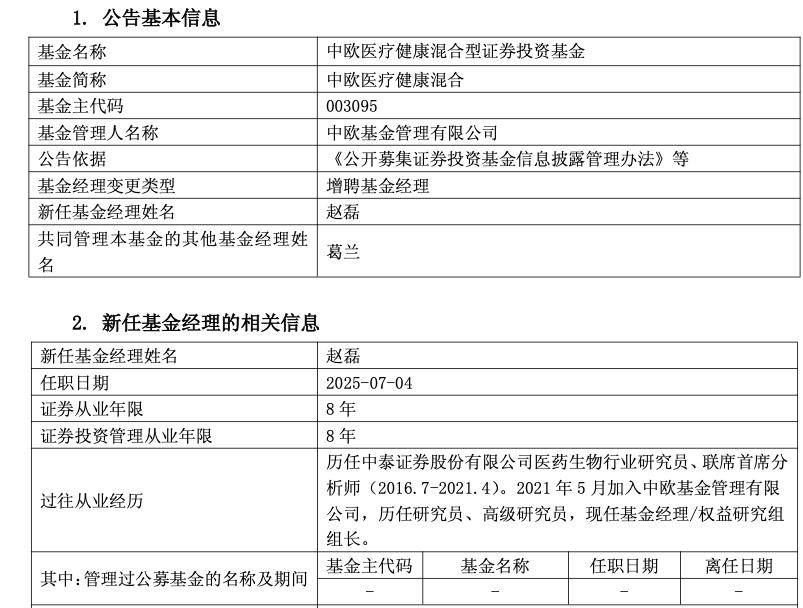
Core Viewpoint - The recent announcement by China Europe Fund regarding the appointment of Zhao Lei as a co-manager for the China Europe Medical Health Mixed Fund has raised concerns among investors, particularly in light of the fund's significant losses over the past three years, leading to speculation about the future of the fund and its management [1][5][19] Fund Management Changes - The China Europe Medical Health Mixed Fund, with a total scale of 311.79 billion yuan, has appointed Zhao Lei to co-manage alongside the well-known manager Ge Lan [1][2] - Zhao Lei has 8 years of experience in the securities industry, primarily focused on medical research, but lacks independent management experience of large-scale funds [3][14] Performance Metrics - The fund has experienced a net value decline of 39.40% over the past three years, significantly underperforming its peers, which averaged a decline of 15.85%, and the CSI 300 index, which fell by 10.76% [8][10] - The fund's performance has deteriorated sharply, with a peak return of 90.57% in 2021, followed by three consecutive years of losses that have diluted long-term returns [8][10] Investor Sentiment - Investor sentiment has turned negative, with many expressing concerns about the management changes and the fund's performance, leading to speculation about potential withdrawals from the fund [5][19] - The shift in management strategy, including the appointment of a co-manager, has raised questions about the future direction of the fund and the distribution of decision-making power between Ge Lan and Zhao Lei [14][19] Industry Context - The medical sector is currently facing challenges due to policy adjustments and overcapacity, impacting the performance of key stocks previously favored by Ge Lan [16][17] - The ongoing struggles in the medical sector may complicate Zhao Lei's ability to balance high-research investment stocks with low-valuation consumer medical stocks, potentially affecting the fund's future performance [18][19]