
永赢高端装备智选

Search documents
涉嫌联合大V违规带货?这家基金公司什么情况
Sou Hu Cai Jing· 2026-02-04 07:56
Core Viewpoint - Yongying Fund has recently gained attention due to its outstanding performance in the public fund market, but it is also facing scrutiny over regulatory violations related to product promotion and underperformance of several funds against benchmarks [3][4]. Group 1: Fund Performance - Yongying Technology Smart A (022364.OF) achieved a remarkable 233.29% return in 2025, leading the public fund performance rankings [3]. - Yongying High-end Equipment Smart and Yongying Information Industry Smart funds have been implicated in a controversy involving unauthorized promotion, resulting in a significant increase in their assets under management [6]. - Despite the strong performance of some funds, many of Yongying's products have underperformed against their benchmarks over a three-year period, with 17 funds showing lower returns than their respective benchmarks [4][10]. Group 2: Regulatory Issues - A report highlighted that a financial influencer promoted Yongying's funds without proper qualifications, leading to a surge in investment and raising concerns about compliance with regulatory standards [6]. - Following the controversy, Yongying Fund announced purchase limits on the implicated funds, restricting individual investors to a maximum of 1 million yuan per day [6]. - The company has also increased the risk ratings of several funds, including Yongying High-end Equipment Smart, from "R3 medium risk" to "R4 medium-high risk" [8]. Group 3: Fund Management and Strategy - Yongying Information Industry Smart, managed by Wang Wenlong, has a management scale of 899 million yuan but has underperformed with a net value growth rate of -12.77% since its inception [7]. - Yongying High-end Equipment Smart, managed by Zhang Lu, has shown significant growth in management scale, reaching 9.765 billion yuan, but its performance has been volatile, with a net value growth rate of 94.62% in 2025, while earlier years saw negative returns [7][9]. - The Yongying Smart series focuses on new productivity tools, with specific investments in AI applications and high-end equipment sectors like satellite internet [7].

新旧交替!百亿基金经理大洗牌
券商中国· 2026-02-01 13:12
Core Viewpoint - The rise of AI technology has led to a new batch of active equity fund managers managing over 10 billion yuan, referred to as "new hundred billion" fund managers, who are now part of the latest lineup alongside established managers like Zhang Kun and Liu Yanchun, creating a "new and old" transition in the fund management landscape [1][7]. Group 1: New vs. Old Fund Managers - As of January 31, the number of active equity fund managers managing over 10 billion yuan remains above 100, continuing a trend of recovery since Q3 2025, returning to levels seen at the end of 2023 [2]. - "New hundred billion" fund managers typically have shorter management tenures and previously lower scales, but have rapidly grown their assets under management (AUM) in 2025, with examples like Zhang Lu from Yongying Fund, whose AUM increased from just over 2 billion yuan at the end of 2024 to over 30 billion yuan [2]. - Other notable "new hundred billion" managers include Lan Xiaokang from China Europe Fund and Zheng Xi from E Fund, both of whom saw significant AUM increases in the past year [3]. Group 2: Performance and Strategy Shifts - Established "old hundred billion" managers like Zhang Kun and Liu Yanchun still hold significant AUM but have seen declines from their peak levels, with Zhang Kun's AUM dropping from over 130 billion yuan in 2021 to around 48 billion yuan currently [3]. - The market dynamics have shifted, with "new hundred billion" managers benefiting from the AI and technology sectors, while "old hundred billion" managers have largely maintained positions in traditional blue-chip assets, leading to performance discrepancies [7][8]. - Some "old hundred billion" managers have begun to adjust their strategies, with examples like Xie Zhiyu, who has shifted from blue-chip stocks to technology-focused investments, achieving notable returns [8]. Group 3: Market Dynamics and Risks - The current market structure reflects a systematic reconstruction of active equity funds driven by style rotation and performance dynamics, with a notable shift towards technology growth sectors [7]. - There is a cautionary note regarding the potential risks associated with large fund sizes, as excessive concentration in specific sectors like AI could lead to significant volatility and redemption pressures [9][10]. - The regulatory environment is tightening, requiring fund managers to create sustainable performance metrics while managing the risks associated with large AUM and concentrated holdings [10].
永赢基金,不代表永远能赢!
Xin Lang Cai Jing· 2026-01-23 07:56
Core Insights - Yongying Fund achieved significant success in equity investment in 2025, with a notable increase in management scale and performance metrics [4][26] - The fund's management scale reached a record high of 631.645 billion yuan by the end of Q4 2025, with equity fund scale growing by over 120 billion yuan [5][28] - Despite strong performance, challenges such as frequent changes in the research team and high volatility in returns pose risks for the future [3][26] Management Scale and Performance - By the end of Q4 2025, Yongying Fund's public management scale was 631.645 billion yuan, marking a new high since its establishment [5][28] - The equity fund scale increased by over 120 billion yuan in 2025, primarily driven by the "Smart Selection" series, which reached 78.489 billion yuan by the end of Q4 2025 [5][28] - The average return of equity products in 2025 was 44.05%, outperforming the industry average of 24.63% [5][28] Fund Performance and Volatility - Yongying Technology Smart Selection A achieved a remarkable return of 233.29% in 2025, but saw a sharp decline to 3.05% by January 22, 2026 [29][33] - The fund experienced a maximum drawdown of -27.04%, significantly higher than the industry average of -16.94% [11][33] - The fund's concentrated holdings strategy led to high volatility, with an annualized volatility of 34.71% compared to 20.8% for similar products [9][33] Team Changes and Challenges - Since 2024, 12 fund managers have left Yongying Fund, including 10 from the equity team, indicating significant turnover [13][35] - The average tenure of fund managers at Yongying Fund is 3.53 years, which is below the industry average [39] - The recent departure of experienced managers has raised concerns about the stability of the investment research team [38][40] Product Structure and Strategy - Yongying Fund's product structure remains heavily weighted towards fixed income, with over 70% of its funds in this category as of Q4 2025 [30][41] - The "Smart Selection" series focuses on high-growth sectors such as AI, robotics, and digital economy, aiming to capture specific industry opportunities [21][44] - The fund's differentiated product strategy helps avoid common issues of product homogeneity and overlap in holdings [21][44]

“固收+”规模突围 主动产品热点频现
Zhong Guo Zheng Quan Bao· 2026-01-22 21:42
Core Viewpoint - The "fixed income +" products, led by secondary bond funds, have achieved significant growth in Q4 2025, with secondary bond funds adding over 250 billion yuan in scale, reaching a total of 1.5 trillion yuan by the end of 2025 [1] Group 1: Growth of "Fixed Income +" Products - Secondary bond funds experienced explosive growth in Q4 2025, with Invesco Great Wall Fund being a leading public institution in this sector [2] - By the end of 2025, Invesco Great Wall Fund's secondary bond fund management scale surpassed 190 billion yuan, ranking first in the public fund industry [2] - The fund "Invesco Great Wall Jing Sheng Shuang Xi" was the only secondary bond fund to add over 20 billion yuan in scale during Q4 2025, with a stock position of 14.63% and an A-class share return of 10.24% for the year [2] Group 2: Performance of Other Fund Managers - Other fund managers like Huatai PineBridge, China Merchants Fund, and others are also advancing their "fixed income +" business, with notable achievements in Q4 2025 [3] - The "Yongying Stable Enhancement Fund" managed by Gao Nan and Yu Guohao added over 14 billion yuan in scale, becoming the largest secondary bond fund in the market by the end of 2025 [3] - By the end of 2025, there were 14 secondary bond fund products with scales exceeding 20 billion yuan, with stock positions generally above 16% [3] Group 3: Active Equity Funds - Active equity funds faced significant redemptions and scale shrinkage in Q4 2025, but some focused products successfully attracted investments [4] - Funds focusing on sectors like storage chips and satellite internet saw substantial scale increases, with returns exceeding 56% for some products [4] - Other growth-style funds in technology and resource sectors also reported scale increases of over 15 billion yuan in Q4 2025 [5] Group 4: Stock Selection Products - Stock selection products like "Anxin Rui Jian You Xuan" and "Yongying Rui Xin" attracted significant investments, with the latter's A-class share return exceeding 90% in 2025 [6] - The fund's strategy focuses on company growth potential and earnings realization, with a diversified approach to industry concentration [6]
“固收+”规模突围主动产品热点频现
Zhong Guo Zheng Quan Bao· 2026-01-22 20:56
Core Insights - In Q4 2025, "fixed income +" products, led by secondary bond funds, experienced significant growth, with secondary bond funds adding over 250 billion yuan in scale, reaching a total of over 1.5 trillion yuan by the end of 2025 [1] - Active equity funds, including ordinary stock, mixed equity, balanced, and flexible allocation funds, faced redemption and scale shrinkage, although some high-performing products attracted investments, leading to scale increases [1] Group 1: Growth of "Fixed Income +" Products - Secondary bond funds saw explosive growth in Q4 2025, with Invesco Great Wall Fund being a leading public institution, managing over 190 billion yuan in secondary bond funds by the end of 2025 [1] - In Q4 2025, Invesco Great Wall Fund was the only public institution to add over 50 billion yuan in secondary bond fund management scale, with the Invesco Great Wall Jing Sheng Shuang Xi fund being the only product to add over 20 billion yuan in scale during the quarter [1] - Other funds, such as Yongying Stable Enhancement Fund, also saw significant scale increases, with a total scale approaching 50 billion yuan by the end of 2025, and a yield of 16.47% for the A class share [2] Group 2: Performance of Active Equity Funds - Despite facing redemptions, some active equity funds focusing on niche sectors attracted significant investments, with funds like Yongying Pioneer Semiconductor Smart Selection and Yongying High-end Equipment Smart Selection increasing their scales by over 8 billion yuan each in Q4 2025 [3] - Funds focusing on AI and technology sectors, such as Zhonghang Opportunity Leading and Debang Xinxing Value, also saw scale increases of over 1.5 billion yuan, with returns exceeding 25% for some products [4] - Overall, the number of secondary bond fund products exceeding 20 billion yuan in scale reached 14 by the end of 2025, with many maintaining stock positions above 16% [3]
2025年四季度,永赢基金旗下多只“智选”系列产品规模大涨
Zhong Zheng Wang· 2026-01-21 06:14
Group 1 - Yongying Fund's public funds reported significant growth in several actively managed equity products in Q4 2025, particularly the "Smart Selection" series, with notable increases in assets under management (AUM) exceeding 8 billion yuan for both Yongying Pioneer Semiconductor Smart Selection and Yongying High-end Equipment Smart Selection, reaching over 9 billion yuan by the end of 2025 [1] - Yongying Technology Smart Selection also saw an increase of nearly 4 billion yuan in Q4 2025, with its AUM surpassing 15 billion yuan by year-end [1] - The Yongying High-end Equipment Smart Selection A fund achieved a remarkable return of 56.42% in Q4 2025 [1] Group 2 - Fund manager Gao Nan indicated that the fund's strategy focuses on bottom-up stock selection, emphasizing company growth potential and earnings realization, while aiming to diversify industry concentration [2] - The fund also considers stocks with solid fundamentals, safety margins, and potential for improvement, optimizing its structure by evaluating various factors including safety margins and market trends [2] - Due to the growth in AUM, the fund has increased its focus on mid to large-cap companies, prioritizing mid-term certainty and safety margins [2]
热门产品掀起限购潮 基金公司差异化导购
Zhong Guo Zheng Quan Bao· 2026-01-18 20:56
Core Viewpoint - Fund companies are implementing purchase limits on popular products to avoid rapid scale expansion and protect existing investors' returns, reflecting a shift from scale-driven to investor return-driven strategies [1][4]. Group 1: Fund Purchase Limits - Several fund companies have initiated purchase limits on high-performing funds, particularly those focused on AI applications and commercial aerospace, due to increased market activity in these sectors [1][5]. - On January 12, 2026, following a surge in the AI application sector, Debon Fund announced a reduction in purchase limits for its popular fund from 10 million yuan to 100,000 yuan for A shares and from 1 million yuan to 10,000 yuan for C shares [2]. - Yongying Fund also limited large purchases for two of its actively managed equity funds starting January 14, 2026, due to their significant recent gains [2]. Group 2: Reasons for Limiting Purchases - Fund managers indicate that limiting purchases after a price increase is primarily to protect performance, as new inflows can dilute returns when the fund's net asset value is high [4]. - Limiting fund size helps avoid operational challenges associated with large capital inflows, which can hinder effective portfolio management and lead to unpredictable fluctuations in net asset value [4]. - The current trend shows a cautious approach to fund size expansion, contrasting with previous years when many new products were launched during market upswings [4]. Group 3: Alternative Investment Options - Fund companies are exploring other niche sectors and products like "fixed income plus" and FOFs to provide investors with balanced investment options amid crowded market segments [1][6]. - Some companies are focusing on promoting long-term high-performance products rather than popular sector funds, emphasizing their integrated research platforms to enhance fund manager capabilities [6].
热门产品掀起限购潮基金公司差异化导购
Zhong Guo Zheng Quan Bao· 2026-01-18 20:45
Core Viewpoint - Fund companies are implementing purchase limits on popular products to prevent rapid scale expansion and protect existing investors' returns, reflecting a shift from scale-driven to investor return-driven strategies [1][2][3] Group 1: Fund Purchase Limits - Several fund companies, including 德邦基金 and 永赢基金, have announced purchase limits on high-performing funds focused on AI applications and other hot sectors due to increased market interest [1][2] - 中欧基金 has also implemented purchase limits on three of its products, with one fund's net asset value capped at 2 billion RMB to control its scale [2] - 工银瑞信基金 announced limits on its FOF product, indicating a trend of limiting purchases even amid a hot market [2] Group 2: Reasons for Limiting Purchases - Fund managers indicate that limiting purchases is necessary to protect performance, as new inflows at high net asset values can dilute returns and lead to inefficient cash management [2][3] - Limiting fund size helps avoid operational challenges associated with large-scale funds, which can hinder effective portfolio management and lead to significant net asset value fluctuations [3] Group 3: Market Strategy Adjustments - Fund companies are exploring alternative investment options, such as "固收+" and FOF products, to provide investors with balanced choices amid crowded sectors like AI and commercial aerospace [1][3] - Marketing strategies are shifting focus from popular sectors to long-term high-performing products, with an emphasis on the company's integrated research platform rather than individual fund managers [4]
刚开年就限购?德邦基金24小时两调上限,多只绩优产品加码“控流”
Sou Hu Cai Jing· 2026-01-14 14:20
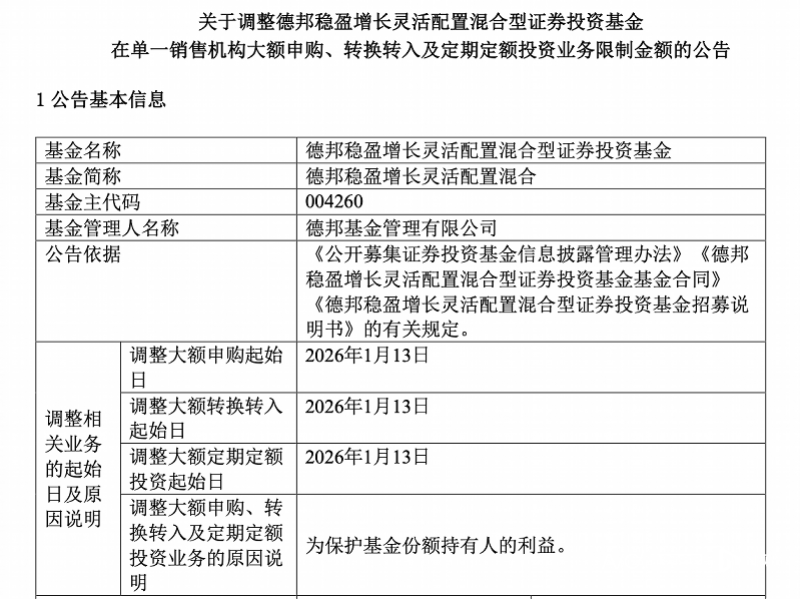
Core Viewpoint - The recent rumor about "Debon Stable Growth Flexible Allocation Mixed Fund" attracting 12 billion yuan in a single day has sparked widespread discussion in the investment community, leading to the fund's management implementing multiple purchase restrictions to protect existing investors' interests [1][2]. Group 1: Fund Management Actions - On January 12, the fund denied the rumor of 12 billion yuan inflow, stating that such data is non-public information [2]. - Following the denial, the fund announced a purchase limit of 10 million yuan for Class A and 1 million yuan for Class C shares starting January 13 [2][4]. - On January 13, the fund further reduced the purchase limits to 100,000 yuan for Class A and 10,000 yuan for Class C shares, effective January 14 [4]. Group 2: Market Context and Trends - The fund's actions are part of a broader trend in the industry, with multiple high-performing funds implementing purchase restrictions since the beginning of 2026, indicating a "purchase limit wave" [6]. - On January 13, nearly 30 equity funds announced purchase restrictions, reflecting a shift in industry logic towards protecting investor interests rather than pursuing aggressive growth [6][7]. - Analysts suggest that limiting large purchases helps manage operational difficulties associated with larger fund sizes and creates a "scarcity effect" that may attract more investors [7]. Group 3: Fund Performance - As of January 13, the latest net asset values for Class A and C shares were 1.29 yuan and 1.27 yuan, respectively, with a single-day increase of 8.32% on January 12 [5]. - The top ten holdings of the fund included stocks that experienced significant price increases, contributing to the fund's net value surge [5].
运作超三年半,中欧小盘成长混合触发比例配售
Xin Lang Cai Jing· 2026-01-14 07:25
Core Viewpoint - The announcement from China Europe Fund regarding the subscription confirmation ratio for the China Europe Small Cap Growth Mixed Fund indicates that the fund's net asset value has exceeded the control limit of 2 billion yuan, leading to a partial confirmation of subscription applications at a ratio of 47.843581% as of January 12, 2026 [1][3][4]. Group 1: Fund Management and Control - The China Europe Small Cap Growth Mixed Fund, established on June 28, 2022, has been operational for over three and a half years, yet it has triggered a subscription limit due to exceeding the set asset value cap [1][3]. - The fund's management has set a net asset value limit of 2 billion yuan to control its scale, as stated in the announcement made on November 6, 2025 [4]. - If the total net subscriptions on any given day would push the fund's net asset value above 2 billion yuan, all valid subscription applications that meet sales and quota restrictions will be partially confirmed based on a proportional allocation principle [4]. Group 2: Market Trends and Implications - In the context of high-quality development in the public fund industry, fund companies are proactively limiting subscriptions during favorable market conditions to ensure the effectiveness of investment strategies and stabilize fund operations, thereby protecting the interests of investors [2][4]. - Since the beginning of 2026, there has been a significant influx of capital into the equity market, leading to subscription limits on several equity funds, including those focused on AI applications [2][4]. - For instance, on January 13, 2026, Debon Fund reduced the subscription limits for its Debon Stable Growth A and C class shares from 10 million yuan and 1 million yuan to 100,000 yuan and 10,000 yuan, respectively [2][4].