永赢科技智选

Search documents
科技行情下的资金抉择:AI爆款被追逐,这几位 “稳健派” 的规模增长也超百亿元……
聪明投资者· 2026-02-04 07:06
Core Viewpoint - The article highlights the significant growth in the public fund market in China, driven by a strong technology sector, with total public fund assets reaching 37.71 trillion yuan by the end of 2025, an increase of nearly 4.9 trillion yuan from the end of 2024 [2]. Fund Growth Overview - Since April 2025, public fund sizes have set historical records for nine consecutive months, with the total public fund size reaching 37.71 trillion yuan by December 2025, up from 32.83 trillion yuan at the end of 2024 [2]. - Among various fund types, money market funds lead with a size of 15.03 trillion yuan, followed by bond funds at 10.94 trillion yuan, and stock funds increasing to 6.05 trillion yuan, a growth of nearly 1.4 trillion yuan from the end of 2024 [2]. Top Performing Funds - The top three actively managed equity funds in terms of size growth in 2025 are all from Yongying Fund, with notable performances from Zhang Lu's Yongying Advanced Manufacturing Smart Selection, which saw a growth of 64.19 billion shares and a scale increase of 17.7 billion yuan, achieving a return of 98.41% [5]. - Other notable funds include Yongying Rui Xin and Yongying Technology Smart Selection, which grew by 65.76 billion shares and 40.9 billion shares respectively, with Yongying Technology Smart Selection achieving a remarkable annual return of 233.29% [5][6]. Fund Manager Insights - Yongying Fund's total actively managed equity fund size reached 111.517 billion yuan by December 31, 2025, primarily driven by the "Smart Selection" series, which focuses on high-growth sectors such as humanoid robots, photolithography machines, and AI applications [12]. - Fund manager Gao Nan's total managed fund size reached a record high of 701.05 billion yuan by the end of 2025, with significant growth attributed to the secondary bond fund Yongying Stable Growth [16]. Investment Strategies - Gao Nan's investment strategy emphasizes stock selection based on company growth potential and profitability, aiming for a diversified industry exposure while capturing growth opportunities [23]. - The article notes that several fund managers have initiated purchase limits on their products to manage rapid growth in fund sizes [24]. Market Trends - The article indicates a significant capital flow towards both ends of the investment spectrum, with a notable increase in funds focused on technology and value-oriented investments [9][8]. - The performance of non-technology funds also saw substantial growth in 2025, indicating a broader market interest beyond just technology-focused investments [8].

新旧交替!百亿基金经理大洗牌
券商中国· 2026-02-01 13:12
Core Viewpoint - The rise of AI technology has led to a new batch of active equity fund managers managing over 10 billion yuan, referred to as "new hundred billion" fund managers, who are now part of the latest lineup alongside established managers like Zhang Kun and Liu Yanchun, creating a "new and old" transition in the fund management landscape [1][7]. Group 1: New vs. Old Fund Managers - As of January 31, the number of active equity fund managers managing over 10 billion yuan remains above 100, continuing a trend of recovery since Q3 2025, returning to levels seen at the end of 2023 [2]. - "New hundred billion" fund managers typically have shorter management tenures and previously lower scales, but have rapidly grown their assets under management (AUM) in 2025, with examples like Zhang Lu from Yongying Fund, whose AUM increased from just over 2 billion yuan at the end of 2024 to over 30 billion yuan [2]. - Other notable "new hundred billion" managers include Lan Xiaokang from China Europe Fund and Zheng Xi from E Fund, both of whom saw significant AUM increases in the past year [3]. Group 2: Performance and Strategy Shifts - Established "old hundred billion" managers like Zhang Kun and Liu Yanchun still hold significant AUM but have seen declines from their peak levels, with Zhang Kun's AUM dropping from over 130 billion yuan in 2021 to around 48 billion yuan currently [3]. - The market dynamics have shifted, with "new hundred billion" managers benefiting from the AI and technology sectors, while "old hundred billion" managers have largely maintained positions in traditional blue-chip assets, leading to performance discrepancies [7][8]. - Some "old hundred billion" managers have begun to adjust their strategies, with examples like Xie Zhiyu, who has shifted from blue-chip stocks to technology-focused investments, achieving notable returns [8]. Group 3: Market Dynamics and Risks - The current market structure reflects a systematic reconstruction of active equity funds driven by style rotation and performance dynamics, with a notable shift towards technology growth sectors [7]. - There is a cautionary note regarding the potential risks associated with large fund sizes, as excessive concentration in specific sectors like AI could lead to significant volatility and redemption pressures [9][10]. - The regulatory environment is tightening, requiring fund managers to create sustainable performance metrics while managing the risks associated with large AUM and concentrated holdings [10].
37万亿基金规模排名出炉 10公司跻身“万亿俱乐部”
2 1 Shi Ji Jing Ji Bao Dao· 2026-01-28 00:50
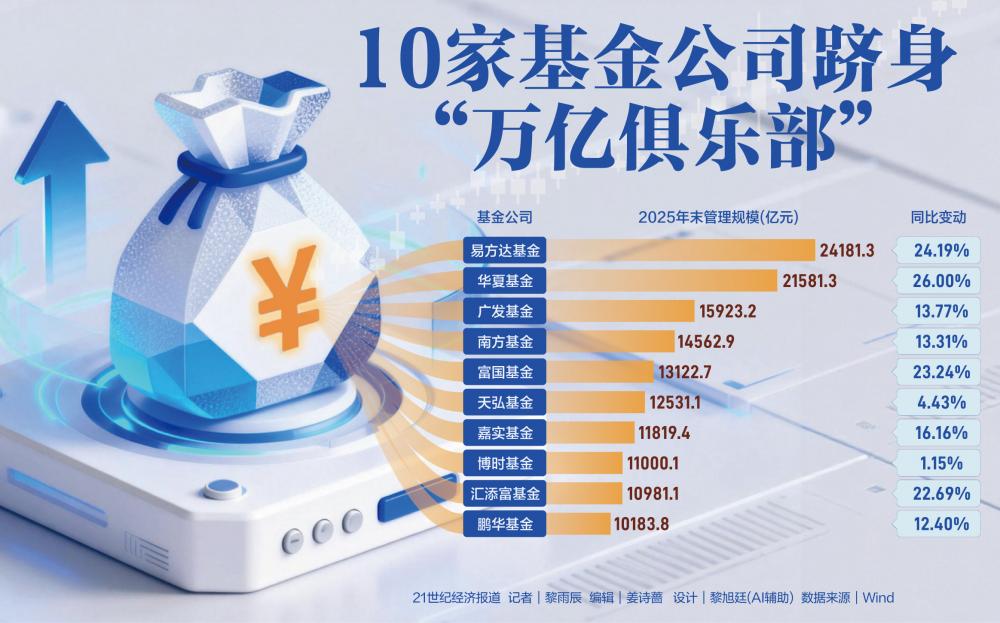
Core Insights - The public fund industry in China has reached a record management scale of 37.64 trillion yuan by the end of 2025, with a quarterly increase of over 1.3 trillion yuan, indicating a steady expansion trend [1][11] - All top 10 public fund managers have entered the "trillion yuan club," reflecting a solidified ranking structure among leading firms [3][14] - The competitive landscape within the industry is shifting, with a notable transition from a focus on fixed income to a resurgence in equity styles, particularly in active investment [1][11] Fund Management Scale - The top two fund companies, E Fund and Huaxia Fund, have surpassed 2 trillion yuan in management scale, with E Fund at 2.42 trillion yuan and Huaxia Fund at 2.16 trillion yuan, showing quarterly growth of 1.16% and 0.54% respectively [3][13] - The third and fourth positions are held by GF Fund and Southern Fund, with management scales of 1.59 trillion yuan and 1.46 trillion yuan, respectively, where GF Fund exhibited a significant quarterly growth of 3.41% [3][13] - The number of public funds exceeding 1 trillion yuan has increased from 8 to 10, with Huitianfu and Penghua Funds entering this elite group [4][14] Non-Monetary Scale Growth - Over 60% of public funds achieved growth in non-monetary scale by the end of 2025, with 100 out of 164 fund companies reporting increases [16] - E Fund's non-monetary scale rose from 1.34 trillion yuan to 1.66 trillion yuan, while Huaxia Fund increased from 1.16 trillion yuan to 1.44 trillion yuan, marking significant growth [5][15] - Notably, Guotai Fund recorded the highest quarterly growth in non-monetary scale, exceeding 500 billion yuan in Q4 2025 [6][15] Active Investment and Product Performance - The expansion of non-monetary scale for many public funds is closely linked to their active equity or "fixed income plus" business performance [18] - E Fund leads in active equity and "fixed income plus" products with a scale of 499.16 billion yuan, followed by Jingshun Great Wall Fund and China Universal Fund [18] - Jingshun Great Wall Fund achieved a remarkable 43.93% growth in non-monetary scale, driven by a significant increase in its active equity products [18][19] Market Trends and Future Outlook - The industry is witnessing a shift from a focus on "first-launch blockbuster" products to a model that emphasizes sustained performance and management longevity [21] - The diversification of asset allocation among residents is expected to gain broader recognition, with increasing interest in various non-monetary fund categories [16]
“固收+”规模突围 主动产品热点频现
Zhong Guo Zheng Quan Bao· 2026-01-22 21:42
Core Viewpoint - The "fixed income +" products, led by secondary bond funds, have achieved significant growth in Q4 2025, with secondary bond funds adding over 250 billion yuan in scale, reaching a total of 1.5 trillion yuan by the end of 2025 [1] Group 1: Growth of "Fixed Income +" Products - Secondary bond funds experienced explosive growth in Q4 2025, with Invesco Great Wall Fund being a leading public institution in this sector [2] - By the end of 2025, Invesco Great Wall Fund's secondary bond fund management scale surpassed 190 billion yuan, ranking first in the public fund industry [2] - The fund "Invesco Great Wall Jing Sheng Shuang Xi" was the only secondary bond fund to add over 20 billion yuan in scale during Q4 2025, with a stock position of 14.63% and an A-class share return of 10.24% for the year [2] Group 2: Performance of Other Fund Managers - Other fund managers like Huatai PineBridge, China Merchants Fund, and others are also advancing their "fixed income +" business, with notable achievements in Q4 2025 [3] - The "Yongying Stable Enhancement Fund" managed by Gao Nan and Yu Guohao added over 14 billion yuan in scale, becoming the largest secondary bond fund in the market by the end of 2025 [3] - By the end of 2025, there were 14 secondary bond fund products with scales exceeding 20 billion yuan, with stock positions generally above 16% [3] Group 3: Active Equity Funds - Active equity funds faced significant redemptions and scale shrinkage in Q4 2025, but some focused products successfully attracted investments [4] - Funds focusing on sectors like storage chips and satellite internet saw substantial scale increases, with returns exceeding 56% for some products [4] - Other growth-style funds in technology and resource sectors also reported scale increases of over 15 billion yuan in Q4 2025 [5] Group 4: Stock Selection Products - Stock selection products like "Anxin Rui Jian You Xuan" and "Yongying Rui Xin" attracted significant investments, with the latter's A-class share return exceeding 90% in 2025 [6] - The fund's strategy focuses on company growth potential and earnings realization, with a diversified approach to industry concentration [6]
“固收+”规模突围主动产品热点频现
Zhong Guo Zheng Quan Bao· 2026-01-22 20:56
Core Insights - In Q4 2025, "fixed income +" products, led by secondary bond funds, experienced significant growth, with secondary bond funds adding over 250 billion yuan in scale, reaching a total of over 1.5 trillion yuan by the end of 2025 [1] - Active equity funds, including ordinary stock, mixed equity, balanced, and flexible allocation funds, faced redemption and scale shrinkage, although some high-performing products attracted investments, leading to scale increases [1] Group 1: Growth of "Fixed Income +" Products - Secondary bond funds saw explosive growth in Q4 2025, with Invesco Great Wall Fund being a leading public institution, managing over 190 billion yuan in secondary bond funds by the end of 2025 [1] - In Q4 2025, Invesco Great Wall Fund was the only public institution to add over 50 billion yuan in secondary bond fund management scale, with the Invesco Great Wall Jing Sheng Shuang Xi fund being the only product to add over 20 billion yuan in scale during the quarter [1] - Other funds, such as Yongying Stable Enhancement Fund, also saw significant scale increases, with a total scale approaching 50 billion yuan by the end of 2025, and a yield of 16.47% for the A class share [2] Group 2: Performance of Active Equity Funds - Despite facing redemptions, some active equity funds focusing on niche sectors attracted significant investments, with funds like Yongying Pioneer Semiconductor Smart Selection and Yongying High-end Equipment Smart Selection increasing their scales by over 8 billion yuan each in Q4 2025 [3] - Funds focusing on AI and technology sectors, such as Zhonghang Opportunity Leading and Debang Xinxing Value, also saw scale increases of over 1.5 billion yuan, with returns exceeding 25% for some products [4] - Overall, the number of secondary bond fund products exceeding 20 billion yuan in scale reached 14 by the end of 2025, with many maintaining stock positions above 16% [3]
公募去年四季报透视:半数主动权益降仓, “翻倍基”在买什么
Di Yi Cai Jing· 2026-01-21 12:49
Core Insights - The ongoing debate regarding the "AI bubble" highlights differing opinions among fund managers about the current state and future of the AI sector, with some suggesting it is in the early stages of bubble formation while others believe valuations are reasonable [6][7] Group 1: Fund Performance and Trends - Over 40% of actively managed equity funds reported positive returns in the last quarter, with 45 funds doubling their size due to significant inflows, and some "mini funds" experiencing growth exceeding 40 times [1][2] - The technology and non-ferrous metals sectors remain core investment themes, although there has been a noticeable internal adjustment in holdings, with some fund managers reducing positions in leading companies [1][2] Group 2: Fund Manager Strategies - More than half of the actively managed equity funds reduced their stock positions in response to market volatility, with over 10 funds decreasing their equity allocation by more than 20% [4][5] - Notable funds like Yongying Technology Select A reduced their stock allocation from 94.41% to 80.34%, indicating a cautious approach to market fluctuations [5] Group 3: AI Sector Valuation and Outlook - Fund managers are divided on whether the AI sector has entered a bubble, with some arguing that the rapid technological advancements justify current valuations, while others caution that high valuations increase the pressure for performance [6][7] - The AI industry is seen as being in a phase of accelerated iteration and commercialization, with high potential but also significant risks associated with valuation pressures and market sentiment [7][8] Group 4: Future Market Expectations - Fund managers maintain a relatively optimistic outlook for the equity market, suggesting that while returns may decline compared to 2025, the risk of significant downturns remains limited, and structural opportunities for excess returns still exist [8]
2025年四季度,永赢基金旗下多只“智选”系列产品规模大涨
Zhong Zheng Wang· 2026-01-21 06:14
Group 1 - Yongying Fund's public funds reported significant growth in several actively managed equity products in Q4 2025, particularly the "Smart Selection" series, with notable increases in assets under management (AUM) exceeding 8 billion yuan for both Yongying Pioneer Semiconductor Smart Selection and Yongying High-end Equipment Smart Selection, reaching over 9 billion yuan by the end of 2025 [1] - Yongying Technology Smart Selection also saw an increase of nearly 4 billion yuan in Q4 2025, with its AUM surpassing 15 billion yuan by year-end [1] - The Yongying High-end Equipment Smart Selection A fund achieved a remarkable return of 56.42% in Q4 2025 [1] Group 2 - Fund manager Gao Nan indicated that the fund's strategy focuses on bottom-up stock selection, emphasizing company growth potential and earnings realization, while aiming to diversify industry concentration [2] - The fund also considers stocks with solid fundamentals, safety margins, and potential for improvement, optimizing its structure by evaluating various factors including safety margins and market trends [2] - Due to the growth in AUM, the fund has increased its focus on mid to large-cap companies, prioritizing mid-term certainty and safety margins [2]
翻倍基批量涌现,能持续吗?
雪球· 2026-01-19 07:50
Group 1 - The core viewpoint of the article is that the strong performance of equity funds in the past year has returned, with 85 funds achieving over 100% returns in 2025, including 74 active equity funds and 11 index funds and ETFs [4][5] - The article emphasizes that historical performance is not indicative of future results, and the focus should be on the sustainability of such high returns [6][24] - The best-performing funds in 2025 concentrated their investments in the top-performing sectors, particularly telecommunications and metals, which saw returns exceeding 80% [10][11] Group 2 - The article discusses the "champion curse" in mutual funds, indicating that historically, top-performing funds often struggle to maintain their performance in subsequent years [25][28] - Data shows that very few funds that ranked in the top quartile in one year continue to do so over the next five years, highlighting the difficulty of sustaining high performance [27][30] - The analysis includes both active and passive funds, revealing that even top-performing ETFs and index funds face challenges in maintaining their leading positions over time [33][36] Group 3 - The article presents statistical evidence that the probability of a fund maintaining its top quartile ranking from one year to the next is around 30%, which is only slightly better than random chance [39][41] - It notes that poor past performance is often a predictor of continued underperformance, while good past performance does not guarantee future success [43][46] - The article concludes that the concentrated investment strategies that lead to extreme performance are risky, as they rely on accurately predicting market trends, which is challenging even for professional investors [49][51]

冠军基、爆款基,从永赢基金到德邦基金,黑马背后隐藏何隐忧
Nan Fang Du Shi Bao· 2026-01-16 13:09
Core Insights - The public fund industry is experiencing a surge in popularity, with reports of a single fund, Debang Stable Growth Mixed Fund, attracting 12 billion yuan in a single day, indicating a strong influx of capital [2][3] - The fund's performance has been volatile, raising concerns about the sustainability of its high returns and the potential dilution of existing investors' interests [2][4] Fund Performance and Strategy - Debang Stable Growth Mixed Fund has heavily invested in AI application stocks, with its top ten holdings accounting for 70.27% of its net value, leading to a significant increase in its unit net value by 9.24% on January 9 [3][4] - Despite the recent surge, the fund has underperformed its benchmark over the long term, with a three-year return of 16.23%, lagging behind its benchmark by 0.25 percentage points [6] Market Trends and Comparisons - The rise of "tool funds" characterized by high concentration and volatility has been noted, with comparisons drawn to Yongying Fund's success with its "Smart Selection" series, which has seen significant growth in assets under management [7][10] - The strategy of concentrating holdings in high-growth sectors can yield impressive returns during favorable market conditions, but it also leads to substantial net value fluctuations [8][11] Investor Concerns - The extreme volatility of these "tool funds" raises questions about their stability and the ability of investors to manage the associated risks [11][14] - There is a growing concern that the influx of new capital may dilute the returns for existing investors if fund managers do not adjust their holdings accordingly [4][12] Regulatory and Industry Implications - The recent performance of these funds has prompted discussions about the need for clearer performance benchmarks and risk management practices within the industry [13][14] - The Securities Regulatory Commission has proposed guidelines to ensure that performance benchmarks align with the investment objectives and risk profiles of funds, addressing the issue of "name not matching reality" [14]

费率大战打响!主动基金赚2倍,ETF成资金避风港,普通人选对躺赢
Sou Hu Cai Jing· 2026-01-15 12:55
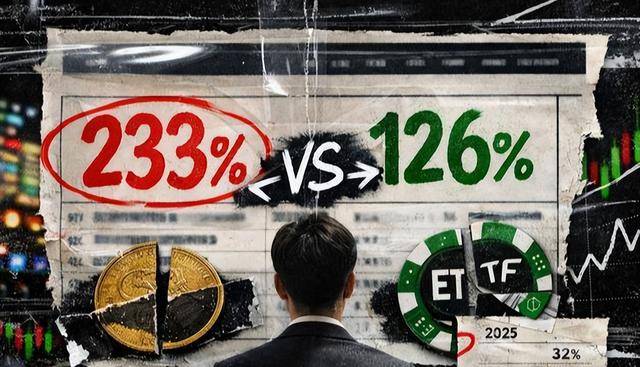
Core Insights - The year 2025 has been a remarkable year for the fund market, with active funds achieving an annual return of 233%, setting a new record for public funds, while ETFs saw their scale surge by over 2 trillion, surpassing Japan to become the leading ETF market in Asia [1][2] Group 1: Active Funds Performance - Active equity funds averaged a return of 32% in 2025, with 75 funds doubling their value, and the top performer, Yongying Technology Smart Selection, skyrocketing by 233% [2] - The top twenty active funds are concentrated in popular technology sectors such as AI, computing power, and semiconductors, indicating a strong trend towards tech-driven investments [2] Group 2: ETF Market Growth - The ETF market experienced significant growth, with the scale increasing from 3.73 trillion to 6.02 trillion, a rise of 61% in 2025, driven by both retail and institutional investments [7] - Notable ETFs in the communication sector, such as the Guotai CSI Communication Equipment ETF, achieved returns of 126%, while several others in AI and mining also saw substantial gains [5] Group 3: Industry Trends and Challenges - Despite the impressive returns of active funds, their market share declined by over ten percentage points, as many investors opted to take profits and shift their investments towards ETFs [7] - The active fund industry faced significant turnover, with 434 high-level personnel changes and over 300 fund managers leaving their positions, indicating a shift towards younger managers with a focus on technology [9] Group 4: Long-term Performance and Cost Considerations - Data from招商证券 shows that only 51 active equity funds outperformed the CSI 300 index from 2019 to 2024, highlighting the difficulty of consistently beating the market [11] - New regulations set to take effect in 2026 will reduce overall fund sales costs by 34%, potentially saving investors 30 billion annually, but active funds still carry management fees around 1.2% to 1.5% [13] Group 5: Investment Strategy Recommendations - A mixed investment strategy combining both active and passive funds is recommended, with 50% allocated to broad market ETFs, 20% to sector-specific ETFs, and 30% to a limited number of active funds [15][17] - Investors are advised to select active funds that have demonstrated resilience through market cycles and align with their understanding of specific sectors to mitigate risks [17] Conclusion - The competition between active funds and ETFs in 2025 illustrates that both can coexist as complementary investment strategies, with a focus on long-term stability and cost management being crucial for investors [19]