计算范式重构

Search documents
深度|黄仁勋对话Cisco CEO:未来十年算力将提升100万倍;写代码只是打字,领域知识才是你的“超级力量”
Sou Hu Cai Jing· 2026-02-15 09:00
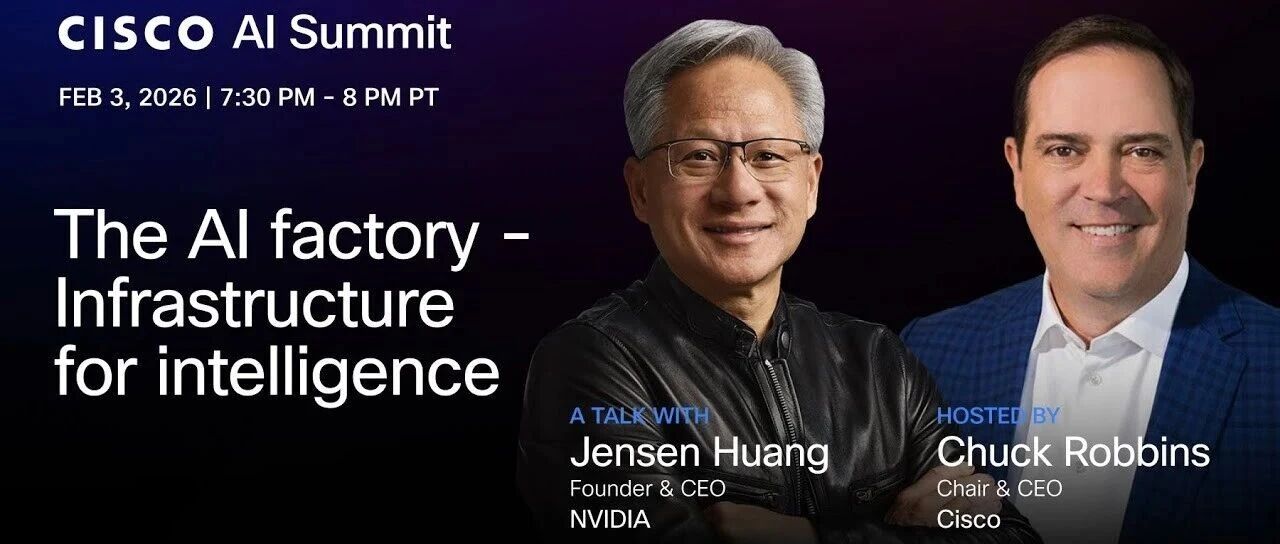
Core Insights - The conversation at the Cisco AI Summit highlighted the transformation from explicit programming to implicit programming, emphasizing the need for companies to adapt to AI technologies and integrate them into their processes [4][5][15]. Group 1: AI Transformation - The shift from explicit programming to implicit programming allows computers to understand intentions and solve problems autonomously, marking a significant change in computing paradigms [4][5]. - Companies should assume that computational power is infinite and act accordingly to tackle their most impactful challenges [4][5]. - The ROI of new technologies is often difficult to quantify initially, and companies should encourage experimentation in a safe environment to foster innovation [4][16][17]. Group 2: AI Integration in Business - Companies must integrate AI into their workflows rather than treating it merely as a tool, as this will enhance organizational knowledge and efficiency [4][45]. - The concept of "AI in the loop" is proposed as a more effective approach than "Human in the loop," suggesting that AI should be embedded in processes to continuously improve company value [45]. Group 3: Future of Computing - The computing stack is being reinvented, with a focus on creating a new architecture that combines AI capabilities with networking and security [15][42]. - The advancements in AI are leading to a "bounty" of intelligence, where tasks that previously took a year can now be completed in a day, fundamentally changing decision-making processes [20][39]. Group 4: Industry Opportunities - The potential for AI to enhance labor and create new opportunities is significant, with the IT industry poised to tap into a much larger economic scale [39]. - Companies are encouraged to leverage their domain expertise and understanding of customer needs, as this is where true value lies, rather than focusing solely on coding [40].


深度|黄仁勋对话Cisco CEO:未来十年算力将提升100万倍;写代码只是打字,领域知识才是你的“超级力量”
Z Potentials· 2026-02-15 03:06
Core Insights - The article discusses the transformation from explicit programming to implicit programming, emphasizing the need for companies to adapt to AI technologies and integrate them into their processes to enhance efficiency and innovation [6][10][19]. Group 1: Transition to Implicit Programming - Companies are moving from explicit programming, where specific instructions are given, to implicit programming, where the intent is communicated to the computer, allowing it to solve problems autonomously [6][10]. - AI advancements are expected to increase computational capabilities by a factor of one million over the next decade, compared to the traditional Moore's Law, which predicts a tenfold increase in the same period [6][25]. - Organizations should foster a culture of experimentation with AI, allowing employees to explore various models in a safe environment, as innovation often occurs outside of strict control [21][22]. Group 2: AI Integration and Enterprise Transformation - The concept of "AI in the loop" is introduced, suggesting that AI should be integrated into business processes to capture employee experiences and enhance company knowledge [49]. - Companies must identify their core competencies and focus on impactful work rather than getting bogged down by the initial ROI of new technologies [21][22]. - The collaboration between Cisco and NVIDIA aims to create a new computing stack that integrates AI capabilities while maintaining control, security, and manageability [19][20]. Group 3: The Future of AI and Business - The future of AI is seen as generative rather than retrieval-based, where software adapts to different contexts and user needs in real-time [33][39]. - The article highlights the importance of understanding the physical world and causal relationships in developing next-generation AI, termed "Physical AI" [42][43]. - Companies are encouraged to leverage their domain expertise and knowledge to effectively communicate their needs to AI systems, thus enhancing their competitive edge [44][45].